Human Memory

Your constantly-updated definition of Human Memory and collection of videos and articles.
Be a conversation starter: Share this page and inspire others!

690 Shares

What is Human Memory?

There are many types of memory, notably short and long-term memory. User experience (UX) designers cater to the limits of memory to make products easier to use.

Transcript

All UX designers must know how memory works and how to design around it. This is particularly true for information visualization designers, who must ensure that the viewer readily understands their work for it to be immediately helpful, which results in a much more visually digestible overall user experience.

Information architecture and clean layouts also help users identify and remember the essential pieces of information, a crucial element of interaction design.

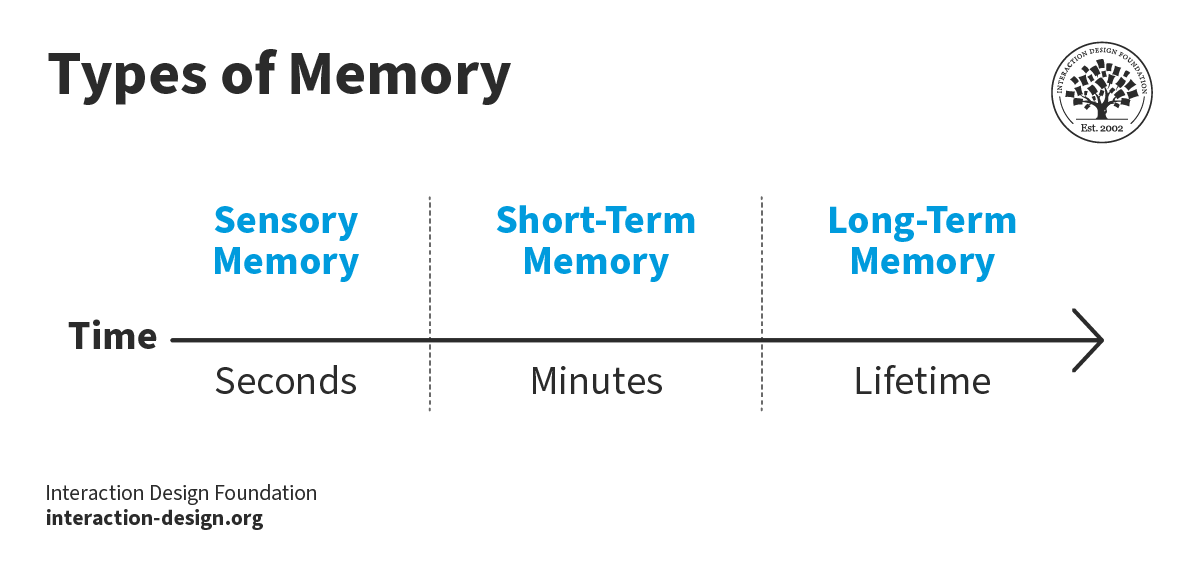
Types of Memory

Human memory is a powerful mental process that has many implications in life and how you experience things, from remembering meaningful events to enabling you to execute tasks and achieve goals.
© Interaction Design Foundation, CC BY-SA 4.0

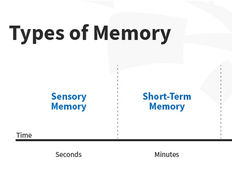
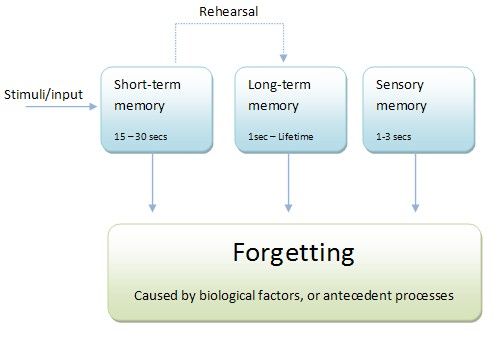
In essence, human memory has three facets: sensory memory, short-term memory and long-term memory. The designer is most concerned with the first two types and strategically designs to appeal to short-term and sensory memory.

Transcript

Designers often design around "Task load," the amount of information or choices a person can process simultaneously, also called "working memory."

One of the most valuable pieces of information about task load is that humans have trouble remembering and engaging with anything with more than seven (give or take 2) task items. Designers consider this memory limitation when presenting information and wireframing products to provide the most memorable and efficient user experience.

Transcript

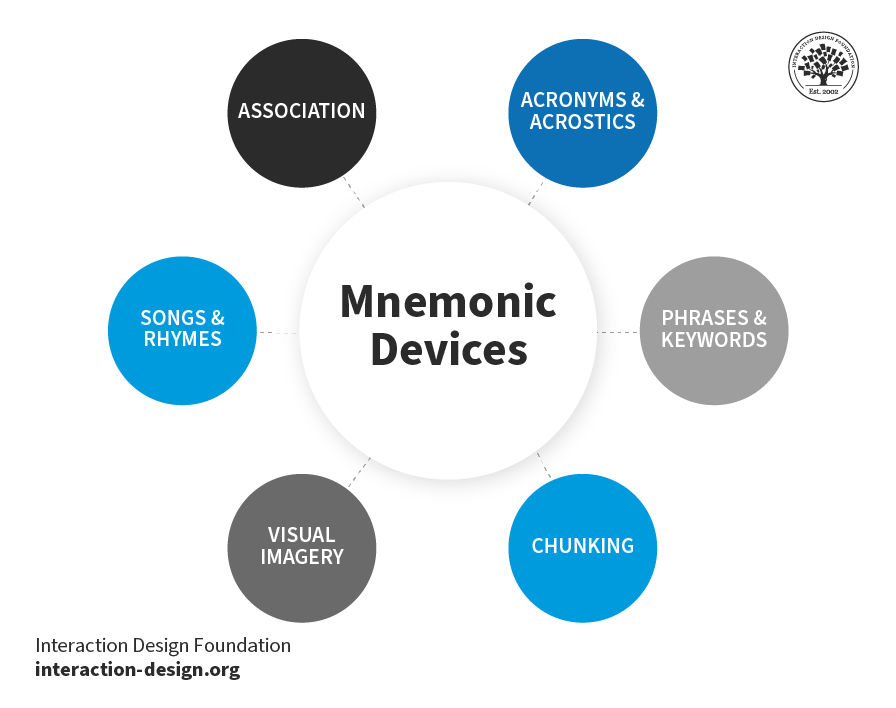
Types of Mnemonics

Mnemonics is the science of memory, and people use a few interesting mnemonic devices to "hack" our brain's programming to improve their memories. The brain is naturally unreliable at remembering abstract things like numbers, dates or concepts. However, it is naturally very good at remembering stories and remembering spaces.

The first method is to turn abstract information into a story that is easier to remember, usually through memorable phrases that tell a short story. One common English-language mnemonic phrase to remember the colors of the rainbow is:

"Richard Of York Gave Battle In Vain."

It helps us remember the following:

"Red, Orange, Yellow, Green, Blue, Indigo, Violet."

The other method dates back to ancient Greece, called "the method of loci." These ancient thinkers noticed that it was much easier to remember the location of physical objects than abstract thoughts. However, with training, they could create a way to activate "spatial memory" to memorize abstract concepts or facts.

They developed a technique called a "mind palace," where a person creates an imaginary version of a space and populates it with object versions of abstract thoughts.

For example, a person might imagine their childhood bedroom and place a memory on a shelf in that imaginary bedroom. To remember the memory again, they imagine the bedroom and look on the shelf for the memory.

There are memory competitions, and memory champions use techniques that combine or adapt this concept for more impressive feats of memory, like memorizing the order of a randomly shuffled deck of cards.
© Interaction Design Foundation, CC BY-SA 4.0

How to Boost User Memory

For designers, this means we have a few ways to improve the memory of our users.

  • Employ storytelling to make information more easily digestible and memorable. 

  • Have clean, logical menus and a visual hierarchy that is easy to understand and scan.

    Transcript

  • Design for recognition vs. recall or interfaces with items people can quickly identify instead of recalling them from scratch.

  • Leverage spatial memory. Augmented and virtual reality, in particular, can easily activate spatial memory to improve the amount of information users can store.

Questions About Human Memory?
We've Got Answers!

What is core memory in the human brain?

Core memory isn't a scientific term in neuroscience or mental health. The concept originated from Pixar's movie "Inside Out." Core memory represents significant life moments and memories that hold more emotional value. Although not a real psychological phenomenon, core memories have gained cultural popularity. People often use the term to describe impactful life experiences. 

Discover more about how memory shapes our lives in our article How We Use Long-Term Memory and How it Informs Us Who We Are.

What is human memory in psychology?

In psychology, human memory is the mind's ability to store, retain, and recall information. It's a complex process that involves acquiring, storing, and retrieving data. Psychologists study three main types: sensory memory, short-term memory, and long-term memory.

Sensory memory holds information briefly from our senses.

Transcript

Short-term memory keeps information for a short period, like a mental notepad.

Long-term memory stores information for longer, from personal experiences to learned knowledge.

Transcript

Understanding these types helps psychologists and designers create more effective learning and user experiences.

What is the memory capacity of the human brain?

Due to its vast nature, we can't quantify the human brain's memory capacity. Scientists often compare it to digital storage. They estimate the storage could be around 2.5 petabytes or 2.5 million gigabytes. That is the equivalent of 8.5 years of 24/7, full HD video recording. This means your brain can hold a massive amount of information.

However, the brain doesn't work like a computer. It prioritizes and stores information based on relevance and frequency of use. This huge capacity allows you to store a lifetime of memories and knowledge, from everyday facts to personal experiences.

What are the 4 types of memory?

There are four main types of memory in the human brain: sensory, short-term, working, and long-term memory.

Sensory memory holds information from your senses for a brief moment.

Short-term memory keeps information for a short duration, like a temporary holding space.

Working memory processes and manipulates information held in short-term memory. It retains information for longer than short-term memory and helps you with reasoning and decision-making.

Long-term memory stores vast amounts of information for extended periods, from personal experiences to learned facts. Watch the video below, where Alan Dix discusses long-term memory in more detail.

Transcript

These types interact and contribute to your overall memory function. They play a crucial role in learning and recalling information.

What is the capacity of human memory?

The human memory has immense capacity, often linked to an ocean's depth and breadth. Unlike computers, the brain doesn't store data in bytes but through connections and associations. Every new experience or piece of information creates new connections. This network of connections grows as you learn and experience more. 

Your brain filters and prioritizes this information. It focuses on essential or frequently used information. The brain can store astonishing data, but we don't know the exact limit. It reflects the richness and complexity of human experiences and knowledge.

Is human memory important for UX design?

Human memory significantly impacts UX (User Experience) design. Designers must grasp how people remember and process information. This enhances information visualization by making images that are easier to remember. Awareness of human memory also leads to more effective, user-friendly products. Key considerations include the appropriate use of short-term and sensory memory, along with reliance on recognition rather than recall. (Recognition reduces the demands on long-term memory.) Such designs ensure users easily remember and navigate essential features. 

Effective UX design helps users develop strong, intuitive memories of product use. Using memory-friendly designs, UX designers enhance product accessibility, enjoyment, and efficiency. Thus, a deep understanding of human memory becomes the basis of successful UX design.

This concept aligns with narrative sketching and drawing principles. The video, discussing the basics of visual representation and memory, complements this understanding of UX design and human memory interaction.

Transcript

What is human memory in HCI?

In HCI (Human-Computer Interaction), human memory refers to how users process, store, and recall information while interacting with computers. It's vital for designing interfaces that are easy to use and remember. 

HCI focuses on matching computer systems with human cognitive capabilities. This includes considering short-term and long-term memory in design.

Designers ensure interfaces align with how users naturally remember tasks and information. They aim for designs that help users easily recall how to use a system without confusion. 

Understanding human memory in HCI leads to more intuitive and user-friendly technology. For a deeper insight, consider Alan Dix's video on short-term memory in HCI. 

Transcript

How many GB is human memory?

You may find estimating human memory in gigabytes (GB) difficult. The brain stores information differently than a computer. It uses networks of connections, not digital bytes. Scientists suggest the capacity might be around 2.5 petabytes, equivalent to 2.5 million gigabytes. They did a rough estimate. 

The brain's storage focuses on connections and experiences more than a quantifiable byte count. The comparison highlights the vast capacity of our memory despite its different functioning from digital storage.

How long can the human brain remember?

The human brain can remember information for varying lengths of time, depending on the type of memory. Short-term memory holds information for seconds to a minute. Working memory retains information for 15 to 30 seconds, used during tasks. 

Long-term memory can keep information for years, even decades. This includes personal experiences, knowledge, and skills. Factors like attention, repetition, emotional impact, and relevance to the individual influence how long the brain retains information. Some memories last a lifetime, especially those with vital emotional or personal significance. 

Where to learn more about human memory?

  • Perception and Memory in HCI and UX Course: This comprehensive course offers insights into human perception and memory. You find them valuable to create effective user interfaces. It covers the role of perception in interaction, the relationship between sensation and perception, and the intricacies of designing for memory. 

  • HCI (Memory) Video by Alan Dix: This video provides a concise overview of human memory in the context of HCI. Alan Dix discusses the various types of memory and their importance in designing user interfaces. 

Transcript

Earn a Gift Earn a Gift, Answer a Short Quiz!

1
2
3
4
1
2
3
4
Question 1
Question 2
Question 3
Get Your Gift
Interaction Design Foundation logo

Question 1

Why do UX designers consider the limitations of short-term memory when designing interfaces?

1 point towards your gift

  • To reduce the cognitive load on users by limiting the number of items they must remember.
  • To make sure users can focus only on one task at a time.
  • To help users store all information in their long-term memory during a single session.
Interaction Design Foundation logo

Question 2

How does chunking help users process information in UX design?

1 point towards your gift

  • By combining smaller pieces of information into meaningful groups.
  • By presenting all information at once for easy recall.
  • By removing unnecessary content to prevent distraction.
Interaction Design Foundation logo

Question 3

How can storytelling improve user memory in design?

1 point towards your gift

  • By helping users engage with abstract information.
  • By presenting facts and figures without emotional context.
  • By limiting the use of visual elements to avoid confusion.

Learn More About Human Memory

Make learning as easy as watching Netflix: Learn more about Human Memory by taking the online IxDF Course Information Visualization.

Why? Because design skills make you valuable. In any job. Any industry.

In This Course, You'll

  • Get excited when you discover how to turn complex information into actionable visuals that drive people's decision-making and accelerate business results. Did you know that visuals are processed 60,000 times faster in the brain than text? That's why you can inform and persuade so quickly and effortlessly with information visualizations! With large amounts of information at the center of every company, your ability to visualize information is a highly sought-after skill and will help you excel in any job. You already visualize information every day, like highlighting important points in a presentation or sketching a diagram to explain an idea, so it's easier than you think to master Information Visualization, no matter your background.

  • Make yourself invaluable when you enlighten and motivate people with your visualization skills. Your new skills will empower you to transform the vast sea of information in journalism, marketing, research, User Experience, and User Interface design into clear, actionable insights. With easy-to-follow frameworks, you'll create visuals for apps and websites with user interfaces so easy to navigate that people will love them. More love, better business outcomes, and the kind of salary that reflects your value. As AI becomes a powerful tool for visualizing information, you stay in demand because your timeless human-centered design skills let you turn data into visuals people actually resonate with and act on. Remember those meetings overwhelmed by endless rows of data? It won't happen on your shift, as you'll transform complex information into impactful visuals that make your ideas stand out instantly.

  • Gain confidence and credibility as you learn from the best. You'll get step-by-step guidance to easily display any information type. You'll get downloadable templates to carry out user observations and conduct user interviews with empathy. This Information Visualization course will give you the practical, in-demand design skills you need to get your message across and stand out in your field!

It's Easy to Fast-Track Your Career with the World's Best Experts

Master complex skills effortlessly with proven best practices and toolkits directly from the world's top design experts. Meet your expert for this course:

  • Alan Dix: Author of the bestselling book “Human-Computer Interaction” and Director of the Computational Foundry at Swansea University.

Get an Industry-Recognized IxDF Course Certificate

Increase your credibility, salary potential and job opportunities by showing credible evidence of your skills.

IxDF Course Certificates set the industry gold standard. Add them to your LinkedIn profile, resumé, and job applications.

Course Certificate Example

Be in distinguished company, alongside industry leaders who train their teams with the IxDF and trust IxDF Course Certificates.

Our clients: IBM, HP, Adobe, GE, Accenture, Allianz, Phillips, Deezer, Capgemin, Mcafee, SAP, Telenor, Cigna, British Parliament, State of New York

All Free IxDF Articles on Human Memory

Read full article
Recalling Color Theory Keywords: a way to refresh your memories! - Article hero image
Interaction Design Foundation logo

Recalling Color Theory Keywords: a way to refresh your memories!

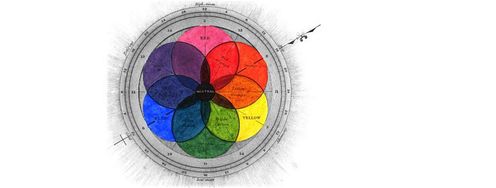
Choosing the best combination of colors for an interactive design layout is not, as it may appear, a guessing game. Knowing which ones to use will save you time (and headaches). Getting it right will also keep your users connected.Since the early days of art and design, the use of color has followed

Social shares
1.1k
Published
Read Article
Read full article
The Properties of Human Memory and Their Importance for Information Visualization - Article hero image
Interaction Design Foundation logo

The Properties of Human Memory and Their Importance for Information Visualization

It is important to know that while neuroscience has progressed dramatically over the last decades; there is no complete understanding of how human memory works. We know, for example, that data in the brain is stored in clusters of neurons but we don’t know how, precisely, it is stored or even how it

Social shares
903
Published
Read Article
Read full article
Preattentive Visual Properties and How to Use Them in Information Visualization - Article hero image
Interaction Design Foundation logo

Preattentive Visual Properties and How to Use Them in Information Visualization

A preattentive visual property is one which is processed in spatial memory without our conscious action. In essence it takes less than 500 milliseconds for the eye and the brain to process a preattentive property of any image. This is good news for information visualization designers and graphic des

Social shares
978
Published
Read Article
Read full article
The Self-Generation Effect: How to Create More Memorable User Interfaces - Article hero image
Interaction Design Foundation logo

The Self-Generation Effect: How to Create More Memorable User Interfaces

Learn how to improve user experience by incorporating the self-generation effect in your user interface design. The self-generation effect is prompted in many of the customization tools built into some of the most widely-used products out there. This phenomenon provides users with a sense of control

Social shares
667
Published
Read Article
Read full article
What Types of Memory do we Have? - Article hero image
Interaction Design Foundation logo

What Types of Memory do we Have?

Our focus here will be on how human memory is organized, along with a brief look at how it works. Our main goal is that you come away with a better understanding of how memory functions and some of its limitations so that we can be more effective as designers.The main topics are:Sensory memoryPercep

Social shares
505
Published
Read Article
Read full article
How We Use Long-Term Memory and How it Informs Us Who We Are - Article hero image
Interaction Design Foundation logo

How We Use Long-Term Memory and How it Informs Us Who We Are

The sensory, short-term, and long-term components of memory come from the well-established multi-store model of memory, first proposed by Atkinson and Shiffrin in the late 1960s (see below for the original paper). While not without its detractors, it is still the most commonly accepted description o

Social shares
477
Published
Read Article

The Properties of Human Memory and Their Importance for Information Visualization

The Properties of Human Memory and Their Importance for Information Visualization

It is important to know that while neuroscience has progressed dramatically over the last decades; there is no complete understanding of how human memory works. We know, for example, that data in the brain is stored in clusters of neurons but we don’t know how, precisely, it is stored or even how it is encoded. Thus when it comes to understanding memory from a design perspective we will examine certain properties of human memory that are commonly understood to be correct.

Human memory doesn’t exist in isolation; the brain isn’t just responsible for memorizing things but also for processing the data and acting on that data. Much of our memory and much of the information we receive is visual and it is with visual memories that the designer is mainly concerned.

Three Types of Memory

There are three main types of memory that are processed in the brain:

  • Sensory Memories

  • Short-term Memories

  • Long-term Memories

Author/Copyright holder: JSpudeman. Copyright terms and licence: Public Domain.

Sensory Memories

Sensory memories are the memories which are stored for tiny time periods and which originate from our sensory organs (such as our eyes or our nose). They are typically retained for less than 500 milliseconds.

Visual sensory memory is often known as iconic memory. Sensory visual memories are the raw information that the brain receives (via the optic nerve) from the eye. We store and process sensory memories automatically – that is without any conscious effort to do so.

The processing of this information is called preattentive processing (e.g. it happens prior to our paying attention to the information). It is a limited form of processing which does not attempt to make sense of the whole image received but rather to a small set of features of the image – such as colors, shapes, tilt, curvature, contrast, etc.

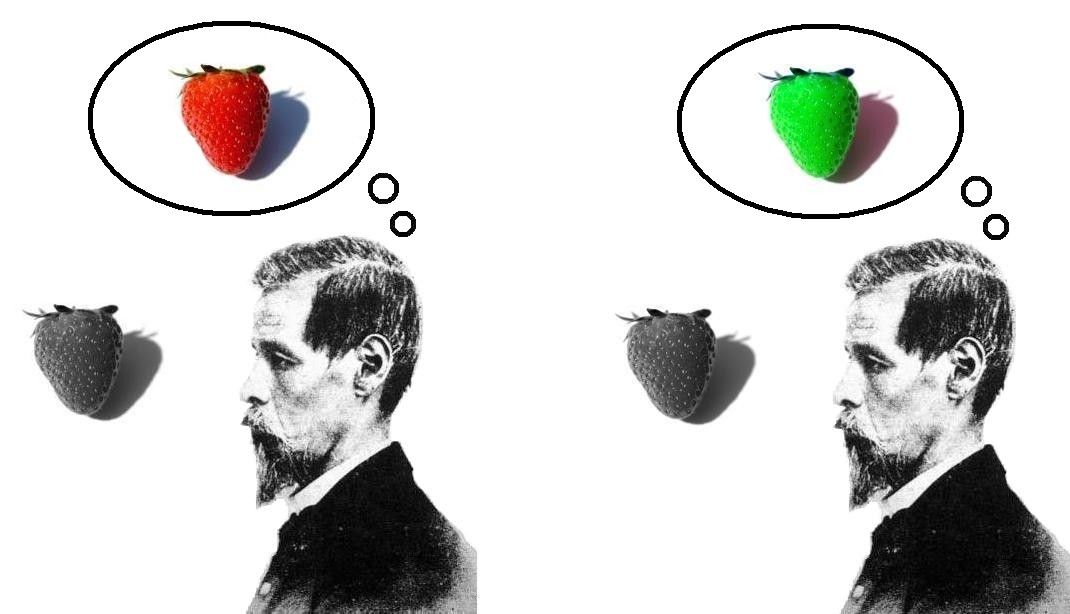
Author/Copyright holder: Was a bee. Copyright terms and licence: CC BY-SA 2.5

It is sensory memory which draws your attention to the strawberries in this graphic.

Short-Term Memories

Short-term memory is used to process sensory memories which are of interest to us – for whatever reason. The sensory memory is transferred to the short-term memory where it may be processed for up to a minute (though if the memory is rehearsed – e.g. repeated – it may remain in short-term memory for a longer period up to a few hours in length).

Short-term memory is of limited capacity. Experiments conducted by, among others, George A Miller the psychologist, and reported in his paper “The Magical Number Seven, plus or minus two” suggest that we can store between 5 and 9 similar items in short-term memory at the most.

This capacity can be increased by a process known as “chunking”. This is where we group items to form larger items. So, for example, you can memorize a 12 digit phone number in short-term memory by taking digits in pairs (35) rather than singly (3 and 5) which gives you 6 chunks to remember (which falls between 5 and 9) rather than 12 digits (which exceeds the capacity of short-term memory).

Chunking can occur visually as well as through combination of numeric or alpha-numeric attributes. A common example of this would be in a bar chart where a single bar may represent a chunk of information.

This is useful to the visual designer because it allows a visual representation of information to be easily processed in short-term memory and for that representation to offer more complex insights than an initial examination of the capacity of short-term memory might allow.

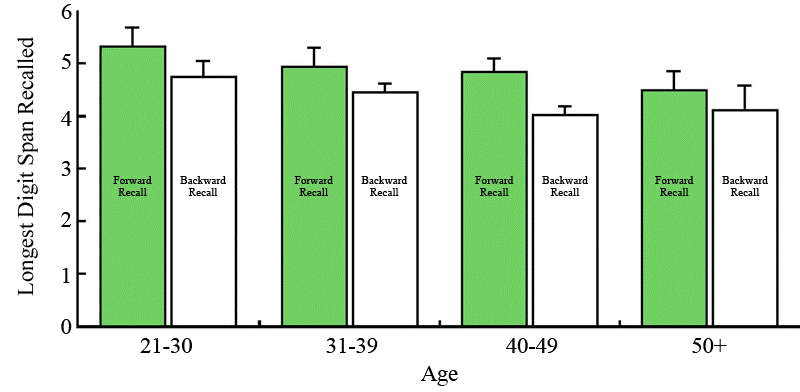
Author/Copyright holder: Michaelchilliard. Copyright terms and licence: CC BY-SA 3.0

This graph, above, shows how information recall is limited from the short term memory and recall becomes worse when asked to recall a sequence backwards.

Long-Term Memories

In most instances the memories transferred to our short-term memories are quickly forgotten. This is, probably, a good thing. If we didn’t forget the huge volumes of information that we perceive on a daily basis we could well become overloaded with information and find processing it in a meaningful way soon became impossible.

In order for most memories to transfer from short-term to long-term memory – conscious effort must be made to effect the transfer. This is why students review for examinations; the repeated application of information or rehearsing of information enables the transfer of the material they are studying to long-term memory.

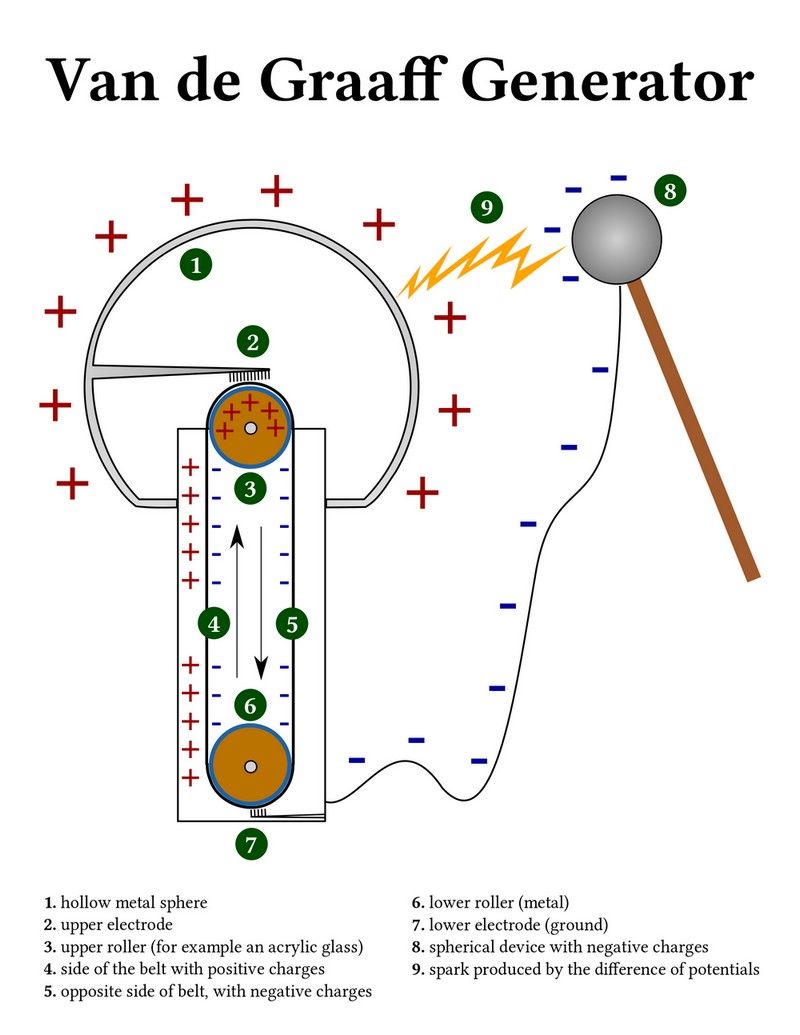
Author/Copyright holder: Omphalosskeptic. Copyright terms and licence: CC BY-SA 3.0

It is also possible for a long-term memory to evolve through a meaningful association in the brain. For example, we know that a static shock is painful even if we are only shocked once. It doesn’t take repeated shocks to memorize that. The meaningful connection between the pain and the shock allow us to process the memory long-term. In fact strong emotional or physical connections are often the easiest way for something to enter long-term memory.

The image above is of a Van de Graaf Generator which can be used to generate static electricity – you can then touch the generator and another person to give them a static shock. It’s worth remembering that they won’t come back for a 2nd attempt…

It is worth noting that majority of designs and in particular, information visualizations, will not be committed to long-term memory. It may be that the conclusions or understanding they bring will be transferred to long-term memory (usually through revision or application) but the design itself will not.

The vast majority of interaction between the user and an information visualization will occur in sensory and short-term memory.

The Take Away

The key link between design (and in particular information visualization design) and human memory is that interaction takes place in sensory and short-term memory for most users. This means paying careful attention to not providing more than 9 chunks of data in a visualization (and ideally no more than 5) and trying to ensure that you use a single visualization to convey the information because once someone’s attention moves from one image to another – the first is quickly forgotten.

Edward Tufte, the world’s leading authority in information visualization asks; “Can the same image prompt different stories and memories in different people? That’s a good test for a “super-graphic.” By better understanding memory, perhaps we can create super graphics more easily.

References & Where to Learn More:

Course: Information Visualization

George A. Miller. The magical number seven, plus or minus two. The Psychological Review, 63(2):81–97, 1956.

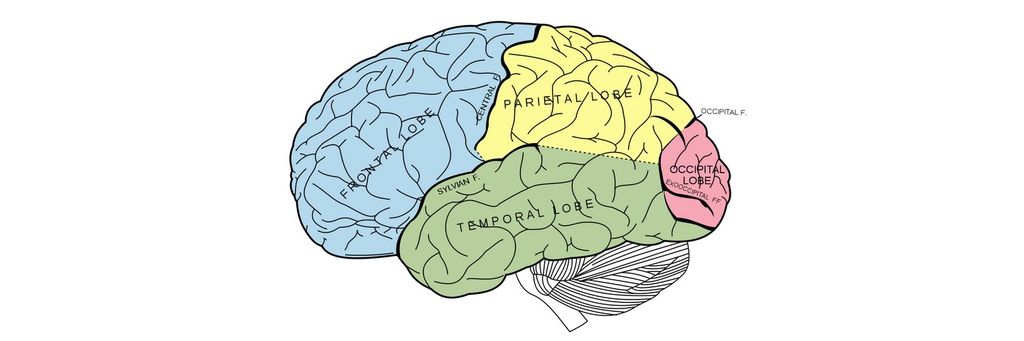
Hero Image: Author/Copyright holder: Henry Vandyke Carter. Copyright terms and licence: Public Domain.

Feel Stuck?
Want Better Job Options?

AI is replacing jobs everywhere, yet design jobs are booming with a projected 45% job growth. With design skills, you can create products and services people love. More love means more impact and greater salary potential.

At IxDF, we help you from your first course to your next job, all in one place.

See How Design Skills Turn Into Job Options
Privacy Settings
By using this site, you accept our Cookie Policy and Terms of Use.
Customize
Accept all

Be the One Who Inspires

People remember who shares great ideas.

Share on:

Academic Credibility — On Autopilot

Don't waste time googling citation formats. Just copy, paste and look legit in seconds.