Human-Computer Interaction

Your constantly-updated definition of Human-Computer Interaction and collection of videos and articles.
Be a conversation starter: Share this page and inspire others!

5,319 Shares

What is Human-Computer Interaction?

Human-computer interaction (HCI) is a multidisciplinary field of study focusing on the design of computer technology and, in particular, the interaction between humans (the users) and computers. While initially concerned with computers, HCI has since expanded to cover almost all forms of information technology design.

Transcript

Here, Professor Alan Dix explains the roots of HCI and which areas are particularly important to it.

The Meteoric Rise of HCI

HCI surfaced in the 1980s with the advent of personal computing, just as machines such as the Apple Macintosh, IBM PC 5150 and Commodore 64 started turning up in homes and offices in society-changing numbers. For the first time, sophisticated electronic systems were available to general consumers for uses such as word processors, games units and accounting aids. Consequently, as computers were no longer room-sized, expensive tools exclusively built for experts in specialized environments, the need to create human-computer interaction that was also easy and efficient for less experienced users became increasingly vital. From its origins, HCI would expand to incorporate multiple disciplines, such as computer science, cognitive science and human-factors engineering.
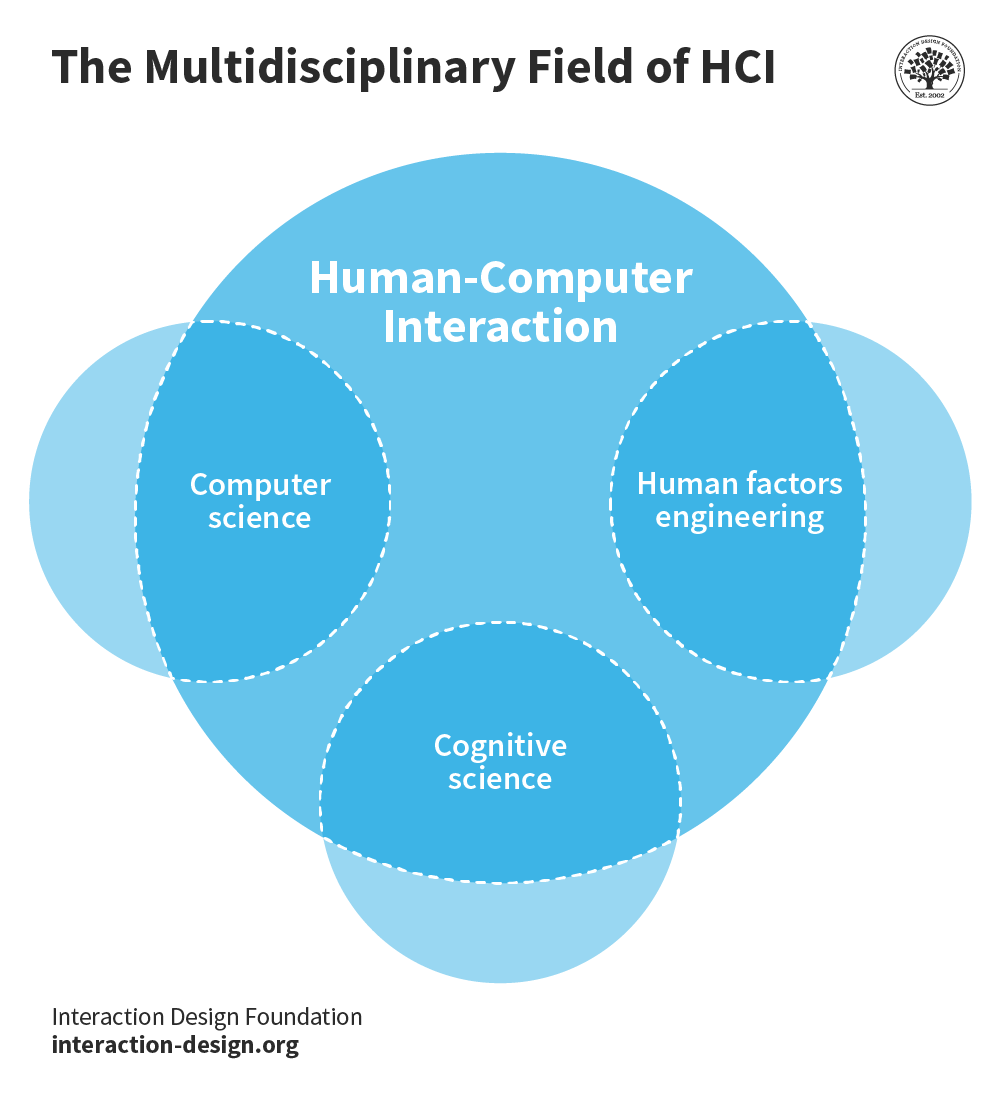
HCI soon became the subject of intense academic investigation. Those who studied and worked in HCI saw it as a crucial instrument to popularize the idea that the interaction between a computer and the user should resemble a human-to-human, open-ended dialogue. Initially, HCI researchers focused on improving the usability of desktop computers (i.e., practitioners concentrated on how easy computers are to learn and use). However, with the rise of technologies such as the Internet and the smartphone, computer use would increasingly move away from the desktop to embrace the mobile world. Also, HCI has steadily encompassed more fields:

“…it no longer makes sense to regard HCI as a specialty of computer science; HCI has grown to be broader, larger and much more diverse than computer science itself. HCI expanded from its initial focus on individual and generic user behavior to include social and organizational computing, accessibility for the elderly, the cognitively and physically impaired, and for all people, and for the widest possible spectrum of human experiences and activities. It expanded from desktop office applications to include games, learning and education, commerce, health and medical applications, emergency planning and response, and systems to support collaboration and community. It expanded from early graphical user interfaces to include myriad interaction techniques and devices, multi-modal interactions, tool support for model-based user interface specification, and a host of emerging ubiquitous, handheld and context-aware interactions.”

— John M. Carroll, author and a founder of the field of human-computer interaction.

The UX Value of HCI and Its Related Realms

HCI is a broad field which overlaps with areas such as user-centered design (UCD), user interface (UI) design and user experience (UX) design. In many ways, HCI was the forerunner to UX design.
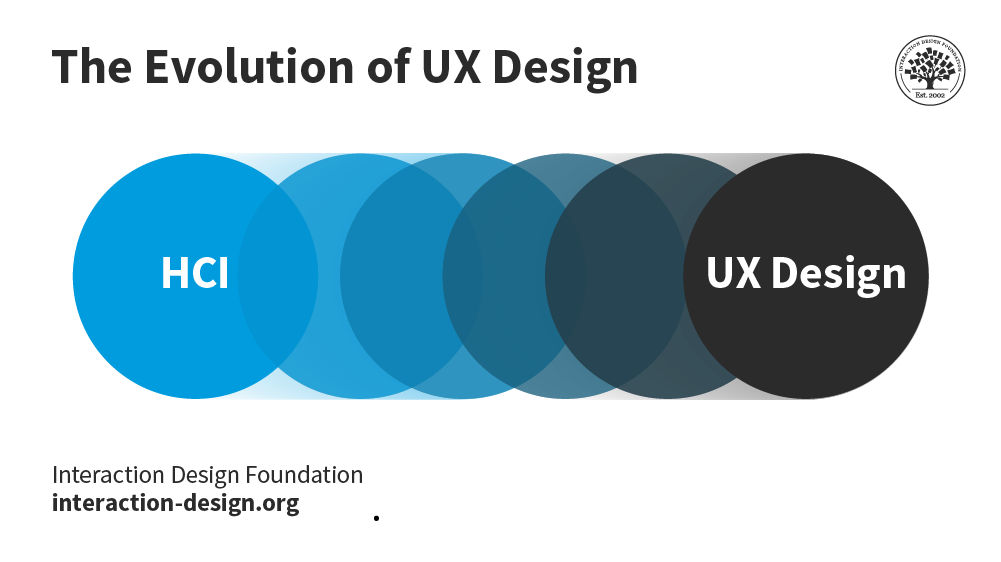
Despite that, some differences remain between HCI and UX design. Practitioners of HCI tend to be more academically focused. They're involved in scientific research and developing empirical understandings of users. Conversely, UX designers are almost invariably industry-focused and involved in building products or services—e.g., smartphone apps and websites. Regardless of this divide, the practical considerations for products that we as UX professionals concern ourselves with have direct links to the findings of HCI specialists about users’ mindsets. With the broader span of topics that HCI covers, UX designers have a wealth of resources to draw from, although much research remains suited to academic audiences. Those of us who are designers also lack the luxury of time which HCI specialists typically enjoy. So, we must stretch beyond our industry-dictated constraints to access these more academic findings. When you do that well, you can leverage key insights into achieving the best designs for your users. By “collaborating” in this way with the HCI world, designers can drive impactful changes in the market and society.


Questions About Human-Computer Interaction?
We've Got Answers!

What is cognition in human computer interaction?

Cognition in human-computer interaction includes the mental processes occurring between humans and computers. This encompasses perceiving inputs from the computer, processing them in the brain, and producing outputs like physical actions, speech, and facial expressions. 

Transcript
 

The video above looks at cognition as a continuous input-output loop that goes from action, through to perception (input through our senses), to cognition (mental processing), back to action (the output). Although one might perceive this process as starting with perception, it is vital to remember that perceptions often trigger actions, but at their core, humans and animals focus on performing activities in the world. This understanding is crucial for the design of effective digital interactions.

What is design in human computer interaction?

Transcript

Design in human-computer interaction, as discussed in the video, is about achieving goals within constraints. It involves understanding the purpose or goal, like enjoyment or work efficiency, and navigating the constraints, such as medium, platform, time, and money, to achieve that purpose. 

It is essential to understand the materials, both digital and human, and to make trade-offs between different goals and constraints. Ultimately, the central message is that the user is at the heart of what you do as a designer. Understanding the users and the technology you work with is crucial for successful design.

What is ergonomics in human computer interaction?

Ergonomics in Human-Computer Interaction (HCI) refers to the design and implementation of interfaces that ensure user comfort, efficiency, and effectiveness. In this video, HCI expert Prof Alan Dix discusses touch and haptics in user interfaces, highlighting the importance of ergonomics in device design.

Copyright
Transcript

For example, mobile phones and cars use haptic feedback to provide users with intuitive and engaging experiences. However, poorly implemented haptic feedback can confuse users. This underscores the importance of ergonomics in HCI to ensure that interfaces are user-friendly, intuitive, and do not cause strain or discomfort, ultimately enhancing the user's overall experience with a device or application.

Why is human computer interaction important?

Human-Computer Interaction (HCI) is crucial due to its direct impact on the user experience. 

Transcript

As highlighted in the video, the shift towards service orientation, prompted by the internet and digital goods, has made usability and user experience increasingly important. Users now have multiple choice points and can easily swap services if they are not satisfied, which underscores the criticality of user experience. Prof Alan Dix uses the analogy of Maslow’s hierarchy of needs in the context of user interfaces, stating that once the basic needs of functionality and usability are addressed, user experience becomes the key differentiator. 

User experience is the factor that will make someone choose your product over another. Therefore, optimizing the HCI is paramount to ensure the success and competitiveness of a product or service.

Does human computer interaction require coding?

HCI does not require any knowledge of coding. While coding can be a part of the design process and implementation, it is not necessary for understanding and applying the principles of human-computer interaction.

When was the first computer invented?

The first computer, as we know it today, was invented in the 1950s. At that time, computers were room-sized and cost millions of dollars or pounds or euros in current terms. Thomas Watson of IBM famously mispredicted that five computers would be enough forever, reflecting the sentiment of the time. Over the decades, the cost and size of computers have drastically reduced, making them accessible to the general public. By the mid-70s, the first personal computers were coming through, and today, the total number of computers and smartphones exceeds the number of people in the world. 

For a detailed evolution of computer technology, watch the video below:

Copyright
Transcript

Where to study human computer interaction?

If you are looking to study Human-Computer Interaction (HCI), the Interaction Design Foundation (IxDF) is the most authoritative online learning platform. IxDF offers three comprehensive online HCI courses:

  1. HCI: Foundations of UX Design: This course provides a solid foundation in HCI principles and how they apply to UX design.

  2. HCI: Design for Thought and Emotion: Unlock the secrets of the human mind and learn how to apply these insights to your work.

  3. HCI: Perception and Memory: Learn about the role of perception and memory in HCI and how to design interfaces that align with human cognitive capabilities.

Enroll in these courses to enhance your HCI knowledge and skills from the comfort of your home.

Earn a Gift Earn a Gift, Answer a Short Quiz!

1
2
3
4
1
2
3
4
Question 1
Question 2
Question 3
Get Your Gift
Interaction Design Foundation logo

Question 1

Which of the following professionals is NOT typically involved in the field of Human-Computer Interaction?

1 point towards your gift

  • Marketing Manager
  • Usability Engineer
  • User Experience Designer
Interaction Design Foundation logo

Question 2

What significant shift has HCI made since its inception in terms of design focus?

1 point towards your gift

  • From desktop interfaces to everyday computing
  • From mobile interfaces to virtual reality
  • From physical interfaces to solely gesture-based controls
Interaction Design Foundation logo

Question 3

Which element is important in the design of human-computer interactions to ensure intuitive use?

1 point towards your gift

  • Complex animations
  • High graphical resolution
  • User psychology

Learn More About Human-Computer Interaction

Make learning as easy as watching Netflix: Learn more about Human-Computer Interaction by taking the online IxDF Course Human-Computer Interaction: The Foundations of UX Design.

Why? Because design skills make you valuable. In any job. Any industry.

 In This Course, You'll

  • Get excited about designing products and experiences people truly love. From medical apps that save lives to educational tools that bridge learning gaps, Human-Computer Interaction (HCI) is at the heart of every great User Experience (UX) Design. You'll learn what people enjoy and how to use that knowledge to create meaningful, engaging solutions. No design background? No problem. You already have transferable skills, like empathy, problem-solving, communication, and organizing information, so you have more HCI knowledge than you realize. HCI blends psychology, design, engineering, and ethics to help you craft experiences that feel intuitive and make it easy for people to fulfill their needs and reach their goals. That's what we human beings love. More love means higher business profits and a salary that reflects your value.

  • Make yourself invaluable when you discover the science behind great design. You'll master timeless human-centered design skills like perception, insight, and strategic thinking that become even more powerful in an AI-enhanced world. Turn AI into your superpower with your unique human understanding that no algorithm can generate on its own. Studies show that tech and design-related occupations will grow 23% by 2031, much faster than the average. HCI skills are in demand across every industry. This course helps you structure your existing skills and apply them creatively, from idea to delivery. With your HCI skills, it's easy to drive customer loyalty and business success because you know how to design for people. Level up in your current role or use your new skills to break into a career in design and tech.

  • Gain confidence and credibility as you build experiences so effortless they feel like second nature. It's easier than you think. With ready-to-use templates for global navigation, personas, and more, you'll get everything you need to immediately apply your skills and create user-centered results people keep coming back to. Build a standout portfolio and fast-track your career with optional hands-on exercises. This course will give you real-world human-centered design solutions, such as a website, app, or smart device, to showcase your in-demand skills.

It's Easy to Fast-Track Your Career with the World's Best Experts

Master complex skills effortlessly with proven best practices and toolkits directly from the world's top design experts. Meet your expert for this course:

  • Alan Dix: Author of the bestselling book “Human-Computer Interaction” and Director of the Computational Foundry at Swansea University.

Get an Industry-Recognized IxDF Course Certificate

Increase your credibility, salary potential and job opportunities by showing credible evidence of your skills.

IxDF Course Certificates set the industry gold standard. Add them to your LinkedIn profile, resumé, and job applications.

Course Certificate Example

Be in distinguished company, alongside industry leaders who train their teams with the IxDF and trust IxDF Course Certificates.

Our clients: IBM, HP, Adobe, GE, Accenture, Allianz, Phillips, Deezer, Capgemin, Mcafee, SAP, Telenor, Cigna, British Parliament, State of New York

All Free IxDF Articles on Human-Computer Interaction

Read full article
A Brief History of Human-Computer Interaction - Article hero image
Interaction Design Foundation logo

A Brief History of Human-Computer Interaction

Human Computer Interaction is the academic discipline that most of us think of as UI design. It focuses on the way that human beings and computers interact to ever increasing levels of both complexity and simplicity.It’s a Very New DisciplineIt’s perhaps easy to see that until the mid to late 1970s

Social shares
820
Published
Read Article
Read full article
Human Data Interaction (HDI): The New Information Frontier - Article hero image
Interaction Design Foundation logo

Human Data Interaction (HDI): The New Information Frontier

After more than 40 years in the field, Human Computer Interaction (HCI) is already a well-established design discipline. Now, the pervasiveness of big data, new data collection and interaction techniques is giving rise to a new but related discipline: Human Data Interaction (HDI). This is likely to

Social shares
693
Published
Read Article
Read full article
How to Use Mental Models in UX Design - Article hero image
Interaction Design Foundation logo

How to Use Mental Models in UX Design

Mental models are important in Human-Computer Interaction (HCI) and interaction design because they provide information about how users perceive the world and interact with products or services. Let’s explore this concept more closely.Mental models indicate what a user expects to happen based on exp

Social shares
1k
Published
Read Article
Read full article
Design Iteration Brings Powerful Results. So, Do It Again Designer! - Article hero image
Interaction Design Foundation logo

Design Iteration Brings Powerful Results. So, Do It Again Designer!

The iterative design process is a simple concept. Once, through user research, you have identified a user need and have generated ideas to meet that need, you develop a prototype. Then you test the prototype to see whether it meets the need in the best possible way. Then you take what you learned fr

Social shares
1.2k
Published
Read Article
Read full article
Guidelines for Design for Appropriation - Article hero image
Interaction Design Foundation logo

Guidelines for Design for Appropriation

Appropriation occurs when a user takes a design and puts it to use in a way that wasn’t anticipated by the designer. This can have real benefits for a product; it enables the product to become more useful and can increase the product’s appeal to different audiences and increase its market life too.

Social shares
534
Published
Read Article
Read full article
How to Become a Digital Designer: The Complete Guide - Article hero image
Interaction Design Foundation logo

How to Become a Digital Designer: The Complete Guide

In a digital world—for that’s what it pretty much is—what could be more natural than for every brand, company, and digital professional to want to make a mark? No surprise, then, that with 93% of all brand communication being visual, a great deal of that is all about digital design—so a digital desi

Social shares
652
Published
Read Article

A Brief History of Human-Computer Interaction

A Brief History of Human-Computer Interaction

Human Computer Interaction is the academic discipline that most of us think of as UI design. It focuses on the way that human beings and computers interact to ever increasing levels of both complexity and simplicity.

It’s a Very New Discipline

It’s perhaps easy to see that until the mid to late 1970s this discipline wasn’t particularly important. The few people who had access to computers were academics or professionals with a few incredibly dedicated (and wealthy) hobbyists thrown into the mix. Without a broad base of users; it wasn’t necessary to focus on how those users interacted with computers – they just made do with whatever was to hand or created what they needed themselves.

Then with the dawn of personal computing; the flood gates opened. The masses wanted computing and they didn’t want to go through complicated rigmarole to do what they wanted with a computer. They weren’t prepared to build and program their own joysticks for the games they bought, they didn’t expect to design the mouse before they could use a word processor and so on…

Cognitive Sciences

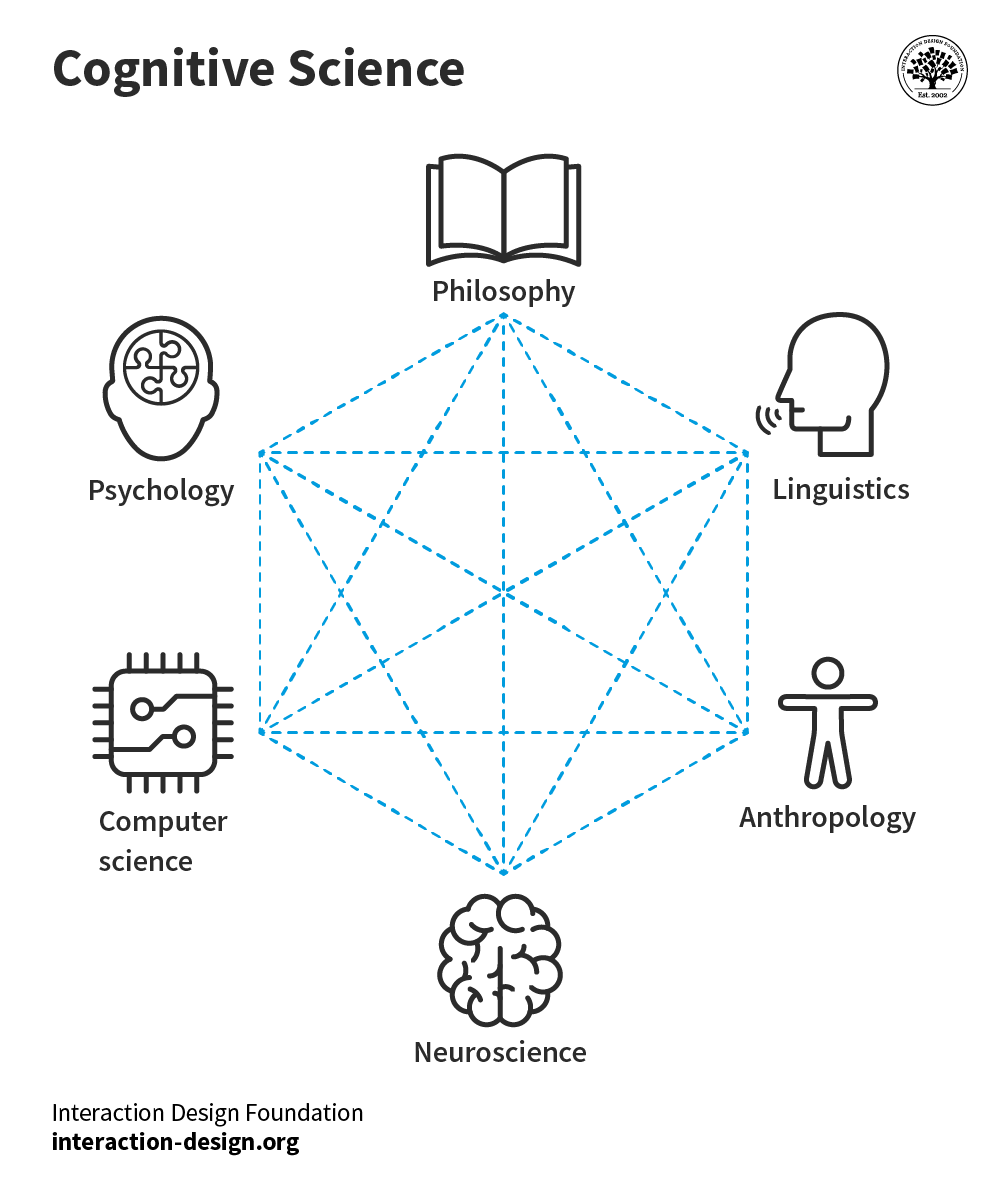
Luckily, for the masses, there was a discipline waiting in the wings to help with the tasks that lay ahead. Cognitive sciences (a broad and heady mix which includes psychology, language, artificial intelligence, philosophy and even anthropology) had been making steady progress during the 1970s and by the end of the decade they were ready to help articulate the systems and science required to develop user interfaces that worked for the masses.

Engineering

This is known as “cognitive engineering” e.g. building things that work with our thoughts. And once again the engineering discipline had also come on leaps and bounds during the 1970s in order to support this change. In aviation, for example, engineering had already started to simplify the user interface of complex airplanes. It was natural for some of this work to move into the UI field for computing devices.

Documentation

It’s also important to recognize the challenge of documenting these developments. New systematic approaches needed to be taken in order to record developments and to share these with other practitioners of the new discipline worldwide. There really is, after all, no advantage in reinventing the mouse over and over again.

John Carroll the Edward Frymoyer Chair Professor of Information Sciences and Technology at the Pennsylvania State University says that the discipline of Human Computer Interaction was born (or perhaps “emerged” is a better word) in 1980 as all these separate disciplines began to realign around a single objective; making computing easier for the masses.

You can read the full text of John’s book on Human Computer Interaction here on the IxDF website. It’s completely free to read online and our members can also download a free copy to their preferred e-book reader.

References & Where to Learn More:

Header Image: Author//Copyright holder: Glasbergen. Copyright terms and licence: All rights reserved. Img

Course: “Human-Computer Interaction: The Foundations of UX Design”

Imgs: Cognitive Science, Robotics, Diagram

Feel Stuck?
Want Better Job Options?

AI is replacing jobs everywhere, yet design jobs are booming with a projected 45% job growth. With design skills, you can create products and services people love. More love means more impact and greater salary potential.

At IxDF, we help you from your first course to your next job, all in one place.

See How Design Skills Turn Into Job Options
Privacy Settings
By using this site, you accept our Cookie Policy and Terms of Use.
Customize
Accept all

Be the One Who Inspires

People remember who shares great ideas.

Share on:

Academic Credibility — On Autopilot

Don't waste time googling citation formats. Just copy, paste and look legit in seconds.