Endowment Effect

Your constantly-updated definition of Endowment Effect and collection of videos and articles.
Be a conversation starter: Share this page and inspire others!

394 Shares

What is Endowment Effect?

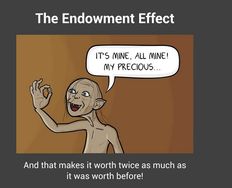
The endowment effect refers to the way in which humans tend to prefer objects they already possess over those they do not. We place a higher value on an object we are asked to give up, than on a similar object we are asked to obtain. Designers apply this effect to product and web design to influence user behavior.

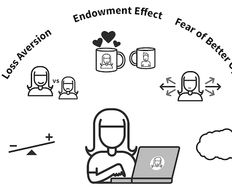
The term emerged in behavioral economics, where the empirical research of psychologists Richard Thaler, Daniel Kahnerman, and Jack Knetsch has shown considerable differences between buying and selling prices of consumption goods, even when strategic considerations (for making a profit) are excluded. The effect is generally interpreted as a manifestation of the “loss-aversion” principle, which states that humans weigh losses more heavily than they do gains.

When designing a user experience, designers can apply the endowment effect as something that will enhance the prospects of customer retention. For example, having accepted an offer for an initial free trial period for a digital product, users might consider the product as something they “own.” Consequently, they might be more willing to pay a fair price for continuing to “own” it. This is opposed to the users approaching that item without having had the chance to sample it (in which case, lacking the warmth of an owner’s perspective, they would be far less prepared to pay that price for it). Naturally, the product has to prove itself valuable to users; otherwise, they will not continue to use it. This effect can likewise account for why convincing customers to “switch” from a product they already find satisfactory to another is difficult—clearly, the new product will have to offer considerably more, and at a lesser price, to convince a user to adopt it.

Earn a Gift Earn a Gift, Answer a Short Quiz!

1
2
3
4
1
2
3
4
Question 1
Question 2
Question 3
Get Your Gift
Interaction Design Foundation logo

Question 1

What does the endowment effect describe?

1 point towards your gift

  • People's tendency to prefer things they do not own over things they already have.
  • People's tendency to value items they own more than equivalent items they do not own.
  • People's tendency to buy more expensive items for better quality.
Interaction Design Foundation logo

Question 2

How can designers apply the endowment effect to increase user retention?

1 point towards your gift

  • By offering large discounts on future purchases.
  • By providing free trials to give users a sense of ownership over the product.
  • By making products exclusive and difficult to obtain.
Interaction Design Foundation logo

Question 3

Which psychological principle is most closely associated with the endowment effect?

1 point towards your gift

  • Loss aversion
  • Confirmation bias
  • Anchoring

Learn More About Endowment Effect

Make learning as easy as watching Netflix: Learn more about Endowment Effect by taking the online IxDF Course Get Your Product Used: Adoption and Appropriation.

Why? Because design skills make you valuable. In any job. Any industry.

In This Course, You'll

  • Get excited about how you can use design to get more people to use your products repeatedly and enthusiastically! Did you know that 95% of new products fail shortly after launch? Usability and user experience alone won't guarantee success. In this course, you'll discover how to turn prospects into customers and customers into passionate advocates. It's easier than you think, even if you're completely new to design, because you already have transferable skills like strategic thinking, curiosity, and communication. Your skills in adoption and appropriation empower you to create products that people integrate into their lives.

  • Make yourself invaluable with powerful design skills that directly increase adoption, drive business growth, and fast-track your career. Learn how to strategically engage early adopters and achieve critical mass for successful product launches. As AI becomes part of how products are developed, tested, and scaled, you stay in demand when you can design experiences people connect with and choose to return to. These timeless human-centered design skills help you guide AI so faster production still leads to ethical experiences that people can trust and love.

  • Gain confidence and credibility with bite-sized lessons and practical exercises you can immediately apply at work. Master the Path of Use to understand what drives usage and captivates people. You'll use the economics of design, network effects, and social systems to drive product adoption in any industry. Analyze real-world product launch successes and failures, and learn from others' mistakes so you can avoid costly trial and error. This course will give you the hands-on design skills you need to launch products with greater confidence and success.

It's Easy to Fast-Track Your Career with the World's Best Experts

Master complex skills effortlessly with proven best practices and toolkits directly from the world's top design experts. Meet your expert for this course:

  • Alan Dix: Author of the bestselling book “Human-Computer Interaction” and Director of the Computational Foundry at Swansea University.

Get an Industry-Recognized IxDF Course Certificate

Increase your credibility, salary potential and job opportunities by showing credible evidence of your skills.

IxDF Course Certificates set the industry gold standard. Add them to your LinkedIn profile, resumé, and job applications.

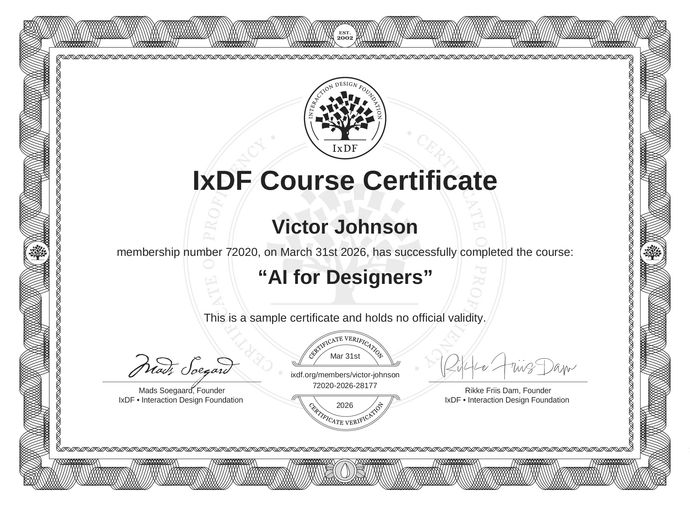
Course Certificate Example

Be in distinguished company, alongside industry leaders who train their teams with the IxDF and trust IxDF Course Certificates.

Our clients: IBM, HP, Adobe, GE, Accenture, Allianz, Phillips, Deezer, Capgemin, Mcafee, SAP, Telenor, Cigna, British Parliament, State of New York

All Free IxDF Articles on Endowment Effect

Read full article
Loss Aversion Theory - The Economics of Design - Article hero image
Interaction Design Foundation logo

Loss Aversion Theory - The Economics of Design

If people were rational then the feelings invoked by losing something or gaining something (of equal value) ought to be the same. We should feel as pleased that our friend has just given us $100 for our birthdays as we feel bad that we have lost $100 when we forgot to take it from an ATM machine.In

Social shares
738
Published
Read Article
Read full article
Endowment Effect - The Economics of Design - Article hero image
Interaction Design Foundation logo

Endowment Effect - The Economics of Design

The Endowment Effect is a contradiction of the classical economic idea that people always behave rationally within an economic system. It is the surprising idea that we are prepared to pay more money to retain something that we already own than we would pay for the item if we did not own it. It is o

Social shares
585
Published
Read Article
Read full article
6 Common Pitfalls in Prototyping and How to Avoid Them - Article hero image
Interaction Design Foundation logo

6 Common Pitfalls in Prototyping and How to Avoid Them

Prototyping is an indispensable part of the design thinking process. However, it’s crucial to know how to prototype the right way and avoid some common pitfalls. If not, your prototyping efforts might be for nothing as your biases and inefficiencies will lead to a suboptimal design solution. Let’s l

Social shares
986
Published
Read Article
Read full article
Be Afraid! The Silent Role of Fear in Decision Making - Article hero image
Interaction Design Foundation logo

Be Afraid! The Silent Role of Fear in Decision Making

Fear plays such a dominant role in our lives that several businesses and products have succeeded on the back of this single emotion. Here’s a look at some of the fears that affect our decision making, how businesses and products exploit these tendencies to their advantage, and how, as a designer, yo

Social shares
709
Published
Read Article

Endowment Effect - The Economics of Design

Endowment Effect - The Economics of Design

The Endowment Effect is a contradiction of the classical economic idea that people always behave rationally within an economic system. It is the surprising idea that we are prepared to pay more money to retain something that we already own than we would pay for the item if we did not own it. It is often also shown that we are unwilling to trade something that we already own in exchange for something of equal value (regardless of whether that item is more or less desirable than the item we already own).

Experimental Evidence of the Endowment Effect

Daniel Kahneman, the Nobel Prize winning economist, Jack Knetsch and Richard Thaler, who are also highly respected economists, in their 1990 paper; “Experimental Tests of the Endowment Effect and the Coarse Theorem” showed the Endowment Effect in action.

They conducted a series of experiments in which participants were offered the chance to buy a mug. They were asked to assign a value that they would be willing to pay for the mug. Then they were given (they did not have to pay for it) the mug.

They were then asked if they wanted to trade their mug for objects of equal value, pens. They were invited to decide how many pens they wanted in exchange for their mug. They determined that on average participants wanted twice as many pens for their mug. That is, they valued the mug twice as much when it was already theirs than they valued it when it wasn’t theirs.

Author/Copyright holder: Pixabay. Copyright terms and licence: Free to Use.

Why Does the Endowment Effect Exist?

There are many explanations for the endowment effect. Daniel Kahneman’s own research offers 3 possible explanations: that it involves loss aversion (the idea that we feel the pain of loss twice as strongly as we feel pleasure at an equal gain), reference-dependence (the idea that we weigh a loss before a gain and thus weigh it more heavily than the gain), and a neoclassical effect (the idea that we are indifferent to the change and thus expect to be compensated more highly for the effort involved).

There are other theories that involve psychological concepts and others still that believe this is an evolutionary effect.

Whichever, explanation we accept – it is fairly certain that the endowment effect exists. However, it is worth noting that there are criticisms of the idea too. And that in particular, Michael Hanemann (pictured below) in 1991, demonstrated that the endowment effect only appears to be present when exchanges of similar goods of equal value are being considered.

Author/Copyright holder: Xlouteiro. Copyright terms and licence: CC BY-SA 4.0

Why Does the Endowment Effect Matter to Designers?

If you know that someone feels the loss of something they own more severely than they anticipate the gain of something of equal value and you know that this is likely to make them pay more to retain what they own – you can increase product adoption and user retention.

For example, if you have a digital product such as an app or a magazine subscription. You can offer a free-trial for that product. This reduces the initial cost, and thus initial risk, of the decision making process to zero. Someone is more likely to become a user of your product when there is no risk to doing so. And don’t forget people like free stuff too – Sandra Bullock, the Oscar winning actress says; “I’ll do anything for free stuff.”

However, it also makes it less likely that when the free-trial is over that the user will give up the product. The endowment effect means that they are going to feel some pain about surrendering the product.

Interestingly, the endowment effect also suggests that because we value a product about twice as much when it is ours than when it is not – someone may be willing to pay more for a product following a free-trial than they would if they had to pay for the product without such a trial.

Author/Copyright holder: Pramod Patil. Copyright terms and licence: Fair Use.

The endowment effect is also invoked by offering a money back guarantee. While this requires that the user adopts the product and takes some risk when they do so – it offers security that they can, for a period of time, reverse that decision.

Yet again, the endowment effect suggests that once the person owns the product they would pay twice as much to keep it than they would have paid for it originally. Thus they are unlikely to take advantage of the money back offer because the money back is only worth what they have originally paid for it.

There are many other ways, in theory, to manipulate the endowment effect but these are the two most commonly used to encourage product adoption and then retention of that product.

It is worth noting that the endowment effect, in these instances, is only likely to apply if the product is perceived to have value to the user in the first place. If your product is a buggy, frustrating mess – users are still going to return it.

The Take Away

The endowment effect is the idea that we value something we already own more highly than something of equivalent that we do not. This effect can be exploited by designers looking to increase adoption and retention of use with products for example by offering a free-trial or a money back guarantee.

References

Daniel Kahneman, Jack L. Knetsch and Richard H. Thaler (1990). "Experimental Tests of the Endowment Effect and the Coase Theorem". Journal of Political Economy 98 (6): 1325–1348.

Hanemann, W. Michael (1991). "Willingness To Pay and Willingness To Accept: How Much Can They Differ? Reply". American Economic Review 81 (3): 635–647.

Kahneman, Daniel; Tversky, Amos (1979). "Prospect Theory: An Analysis of Decision under Risk".Econometrica 47 (2): 263.

Feel Stuck?
Want Better Job Options?

AI is replacing jobs everywhere, yet design jobs are booming with a projected 45% job growth. With design skills, you can create products and services people love. More love means more impact and greater salary potential.

At IxDF, we help you from your first course to your next job, all in one place.

See How Design Skills Turn Into Job Options
Privacy Settings
By using this site, you accept our Cookie Policy and Terms of Use.
Customize
Accept all

Be the One Who Inspires

People remember who shares great ideas.

Share on:

Academic Credibility — On Autopilot

Don't waste time googling citation formats. Just copy, paste and look legit in seconds.