You know what products and services you offer, or intend to offer. You likely have certain types of users in mind; you may have some demographic data and you may also have drawn a few personas. But do you know why people will buy your products? Why would they choose your product over your competitors’? If you understand your users’ underlying motivation to buy, you can improve your value propositions, communicate more effectively and thus increase user engagement and conversions.
Milkshakes for Breakfast
Business consultant and professor of business administration at Harvard Business School Clayton Christensen narrated a story that has since become popular the world over as “Milkshake Marketing”. Here’s how it goes.
A fast-food restaurant wanted to increase sales of their milkshakes. So, they asked their customers about their preferences. Would they like their milkshake chocolatier, creamier, chunkier, cheaper…?
Their customers gave them suggestions, and the fast-food restaurant tweaked the milkshake recipe. But no matter what they did to the milkshakes, it didn’t affect their sales.
Enter Rory McDonald — researcher and associate professor of business administration at Harvard Business School.
McDonald spent a day at the restaurant, to observe its customers. He noticed that milkshake sales were the highest between 6:30 am and 8:00 am. The customers who bought them were alone. They’d buy the milkshake, and nothing else. And immediately leave.
Curious, the researcher went back the next day and asked the customers why they bought the milkshake. As it turned out, the customers all had something in common — a long, boring commute, and they wanted something to do along the way. They left home early and weren’t quite hungry yet. But they knew that they would feel hungry by about 10 o’clock.
The milkshake gave customers something to do while they waited in traffic — the thick liquid took as long as 20 minutes to sip through a thin straw. And once they were done with it, they no longer felt hungry.
When McDonald probed further, he found that customers had experimented with other foods for the job. Donuts were greasy. Bagels were messy. And bananas weren’t filling enough. One customer who had tried a Snickers bar ended up feeling guilty. The milkshake was the most convenient breakfast. And the best part, it fit the car’s cup holder. Sure, coffee could fit, but it didn’t last as long.
The fast-food company’s milkshake wasn’t competing against other restaurants’ milkshakes. It was competing against other breakfast items. Armed with this insight, the company made their shakes thicker and added chunks of fruit so that it took commuters even longer to finish. And since commuters were on their way to work, the company tweaked their checkout process to let commuters get their milkshake faster. The thicker shakes and faster checkouts led to a 7-fold increase in sales of the milkshake.
What Can “Why” Do For You?
Improve Product Experience
When you understand why your users buy from you (or your competitors), you can tweak your product to better suit the users’ needs. Our fast-food restaurant went from “improve the milkshake” to “make breakfast for people on-the-move”.
While the commuters bought milkshakes for breakfast on-the-go, the restaurant discovered another group of customers who bought milkshakes for a different reason — parents who bought them as a treat for their children. In this case, the company made the milkshakes thinner, so parents didn’t have to wait for half an hour as the kids made their way to the bottom of the cup.
Improve Communication
You can incorporate your users’ “why” directly into your communication strategy — on landing pages, product descriptions and advertisements. Here’s an advertisement from Steak ‘n’ Shake:
“Why have cereal with just milk, when you can have it with a milkshake? And why have cereal just at home, when you can eat it on the go without making a mess?
That’s right — we’ve combined our famous hand-scooped milkshakes with your favorite cereals for a convenient, great tasting, and filling breakfast that will take you all the way through lunch.”
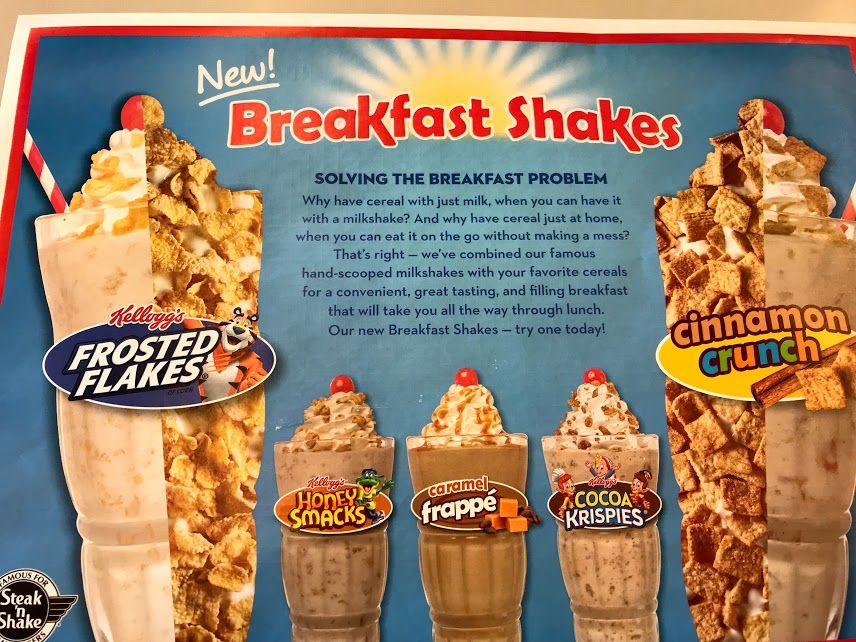
This advertisement sounds very familiar.
© Nana Kris, Copyright unknown.
The 5 Whys
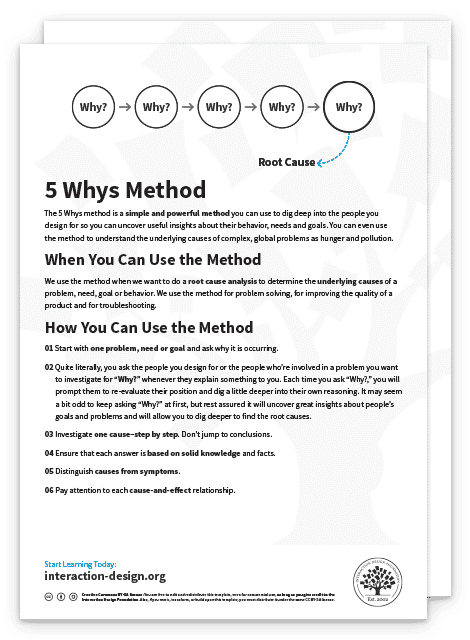
To unearth the true reasons behind people’s behavior, you can use the “5 Whys” method when you interview your (and your competitors’) users.
The “5 Whys” method is an iterative interrogative technique first developed at Toyota Motor Corporation in the 1930s to explore the cause-and-effect relationships underlying a particular problem.
“5 Whys” in Action
Let’s assume that you are in conversation with a customer of Mailchimp — an email delivery service. Here’s a hypothetical excerpt:
Q: Why did you choose this service?
A: I wanted to send professional-looking emails.
Q: What would you consider a professional-looking email?
A: Like emails which I can format nicely and I can send them out in bulk.
Q: Ah okay, so how do you use these professional emails? (or, why do you need to send these professional emails?)
A: I have this newsletter about money management that I send out to some people in my network.
Q: Oh that’s nice... So, why do you run this newsletter? I mean, what do you get out of it?
A: I want to position myself as an expert on tax laws.
Q: Why do you want to position yourself as an expert on tax laws?
A: I’d like to be able to get some leads for my accounting firm.
We found the ultimate goal for our user was to sell their financial services.
While this is an example that we made up, Mailchimp possibly had similar conversations with their users (or their competitors’ users). Armed with such insights, Mailchimp evolved — it added new features to its product and revised its communication to better serve its users’ requirements: users didn’t need HTML email; they wanted a way to market themselves.
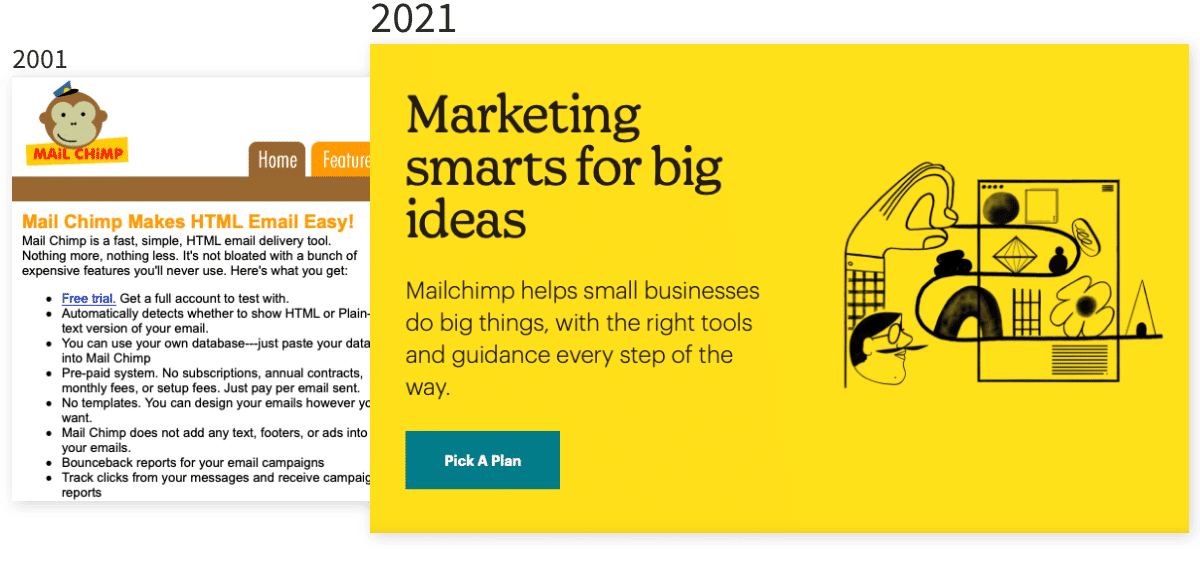
Mailchimp in 2001 vs Mailchimp in 2021. From an HTML-email delivery tool to a complete marketing solution.
© Mailchimp, Fair Use.
Let’s look back at our fictitious conversation, Notice that both the “5” and the “why” in 5 Whys is only a guideline. You don’t have to force 5 questions and you don’t strictly have to start your questions with “why”. Just let the conversation flow naturally, and where there is scope to probe for the underlying reason for a statement, ask “why”.
How many “whys” you need will depend on the context of your product and the question you ask. The key is to ask as many “whys” as you need to reach the “source of truth”. Ask “why” even if you think you know the answer — their reason might surprise you.
At first, it might seem awkward to keep asking “why”. With practice, you will feel more comfortable and phrase your “whys” more tactfully. Take care not to share your opinions or sound judgmental in any way. If you are naturally curious and ask with an open mind, your users will feel at ease and be willing to share their reasons. This is especially important if the reasons are deeply personal or emotional (which is more common than we might realize).
The Take Away
When you understand what motivates users to purchase a product or service, you can take steps to better serve their requirements.
The “5 Whys” method is an effective way to unearth insights from your users. When you conduct user interviews, you can begin with a question and then ask “why” successive times based on the participants’ responses. At first, it may seem awkward to repeatedly ask “why”. With practice, you will feel comfortable.
The underlying reasons why people act in certain ways can often be deeply personal and/or emotional. Make sure your interviewees are comfortable. If you are naturally curious and keep your opinions, assumptions and judgments away from the interview, your users will be more comfortable sharing what truly matters to them, giving you insights that you can plug into your work.
References & Where to Learn More
Carmen Nobel describes Clayton Christensen’s “Milkshake Marketing” in this article in Harvard Business School Working Knowledge:
Clayton Christensen, Rory McDonald, Laura E Day, and Shaye Roseman. "Integrating Around the Job to Be Done." Harvard Business School Module Note 611-004, August 2010. (Revised November 2020):
Starting with “Why” is a good practice in design and leadership. Watch Simon Sinek’s TED Talk: How great leaders inspire action (~18 min)
“5 Whys” is one of several techniques used to empathize with users. Learn more techniques in the course Design Thinking: The Ultimate Guide
Images
Hero image: © Interaction Design Foundation, CC BY-SA 3.0