An hour into your design review, everybody's going in circles. The lead designer loves the new mechanic. The artist thinks it's flat. The producer keeps checking their phone. You've heard the word "fun" 17 times and you're no closer to a decision than when you started. The problem isn't the mechanic. The problem is the word. "Fun" means something different to every person in that room, and no amount of discussion will bridge that gap because you're all arguing from different definitions.
The teams that solve engagement problems fastest are the ones with a shared vocabulary. The engageability framework helps you and your team have objective and productive conversations about engagement.
In this video, Celia Hodent, PhD, Game UX Strategist and Author of the best-selling book The Gamer's Brain, reveals how to move beyond subjective debates about "fun" and give your team a practical framework to identify and solve engagement issues together.
From "Fun" to Engageability
"Fun" is too subjective to work with as a team. Every discipline brings a different definition to the table, which is why those debates run long and end nowhere.
The engageability framework replaces "fun" with something your whole team can measure and act on: whether players are motivated to keep playing, emotionally invested in what happens, and absorbed enough to lose track of time.
© Interaction Design Foundation, CC BY-SA 4.0
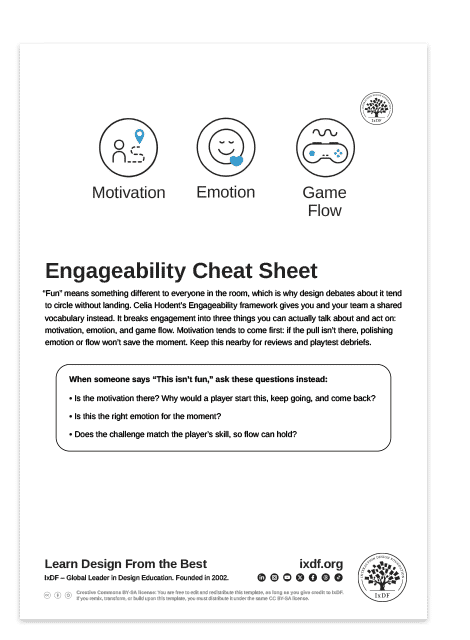
Celia's engageability framework considers motivation, emotion, and game flow.
The framework has three principles:
Motivation: why players start, continue, and return. Nothing else in the framework works without it.
Emotion: the feelings the game creates, from excitement and tension to relief and wonder. Emotion is what makes a moment memorable. If a mechanic works correctly but feels flat, the problem may not be usability; it may be that players might not be feeling what you intended.
Game flow: the state of deep focus and immersion where players lose track of time entirely. Flow breaks when the game is too easy, too hard, or constantly interrupts the player. When it holds, players want to keep playing.
You can use the engageability cheat sheet below as a guide to diagnose what might be breaking down and decide what to investigate next.
In practice, think about a game like Dark Souls. Players return despite constant failure because the motivation (growing mastery, progress, pride of accomplishment) is powerful enough to carry them through. The emotion (tension, relief, triumph) makes each victory feel earned. And the flow state kicks in during combat when every decision demands full attention.
All three principles are working, and they're working together. Notice that none of those observations use the word "fun." Each one points at something specific your team could actually change.
The Take Away
"Fun" sounds like a design goal but behaves like a dead end in a team conversation, because everyone's version of fun is different and none of them are wrong.
You can use Celia's engageability framework to turn vague feedback into design questions the team can work with that are related to motivation, emotion, and game flow. So, instead of stopping at "this isn't fun," ask what's breaking down. Does the player have a reason to keep playing? Are players feeling what you intended? Is something interrupting the flow?
Once you frame the issue that way, the next step is easier to define. You can decide what to adjust and what not to touch.
References and Where to Learn More
Want more? If you haven't already, sign up for Game UX Design: The Ultimate Guide to learn directly from Celia Hodent, PhD, former Fortnite UX Director, and author of the best-seller The Gamer's Brain.
Read The Gamer's Brain by Celia Hodent.
Read Theory of Fun by Raph Koster.
Read The Art of Game Design by Jesse Schell.
Watch the How to Design for the Human Mind: Cognitive Science for UX Master Class by Celia Hodent.
Watch the How to Become a Games User Researcher Master Class by Steve Bromley, Games Researcher and Author.
Watch the AI for Game UX: Speed Up Research, Ideas, and Prototypes Master Class by Om Tandon, UX Design Leader at Nordeus (Zynga/Take-Two).
Watch the Level Up Your Career: How to Land a Job in the Game Industry Master Class with Om Tandon, UX Design Leader at Nordeus (Zynga/Take-Two).
Watch the UI Design for Games: Starter Edition Master Class with Stéfano Girardelli, Senior Visual Designer at Wildlife Studios.
Hero image: © Interaction Design Foundation, CC BY-SA 4.0