MatchDog Build Your Portfolio Project: Preliminary Analysis and Conceptual Model Definition

by Daniel Rosenberg • 7 min read

448 Shares

Project Brief

Review the full project brief for MatchDog.

You may draw ideas from the examples in the book regarding various MatchDog conceptual model options. The book intentionally scaffolds this project with examples and discussion within the framework layer chapters. However, you are the designer, and the CM should reflect your desired and optimized grammar. The CM is your idealized view that you communicate to the user, which may be different from the samples in the book. The Grammar chapter contains 5 sample user stories to get you started.

Goal of This Exercise

Because UX Magic is a dedicated deep dive on just the design portion of the product lifecycle, you will need to first take on the role of the Product Manager and User Researcher to generate additional requirements artifacts that will lead into the synthesis process to inform the entire project before focusing specifically on the GUI screen design.

Activities You’ll Perform in This Exercise

In this step, you’ll carry out a:

  • Functional analysis;

  • User story generation; and

  • Conceptual Model Definition.

Equipment You’ll Need in This Exercise

  • A computer with a word processor

  • Microsoft PowerPoint and/or Excel

  • Pen and paper, if you prefer to write your notes and analysis on paper

Preliminary Analysis to Generate Additional Requirements

  1. Review the MatchDog design brief. The brief enumerates the high-level functional requirements.

  2. Review the personas provided. They reflect the majority of user empathic needs categories.

  3. Step into the role of product manager and draft up to 50 user stories to complete the first UX synthesis step. Your input is the design brief, but you could also do your own user research with potential pet owners if you have time and resources.

  4. Convert your user stories to a conceptual grammar by abstracting (highlighting) the nouns, verbs and adjectives. This defines the candidate list for your objects, actions and attributes.

  5. Minimize the number of candidate objects by determining if they can be pivoted to become an attribute of some other object.

  6. Drop any object that smells like a UI design pattern (e.g., Calendar, Feed, Chart). These are not appropriate, and you would be starting the next phase prematurely if you kept any.

  7. Drop any non-transactional actions from the grammar.

  8. Make business/market policy assumptions for the organization. The exact decisions don’t matter, since this is not a real product. What does matter is that you gain experience in optimizing your design to support the marketing assumptions and business objectives you set in advance.

MatchDog: Conceptual Model Definition

Use your favorite spreadsheet to create the templates (or the ones provided in our template below) for the matrices and tables needed to define and refine your conceptual model. They should look similar to tables 4–7 in the book. Note: table 4, the starting point which is repeated below, is too sparse. Your desired target grammar density is similar to the version in table 5.
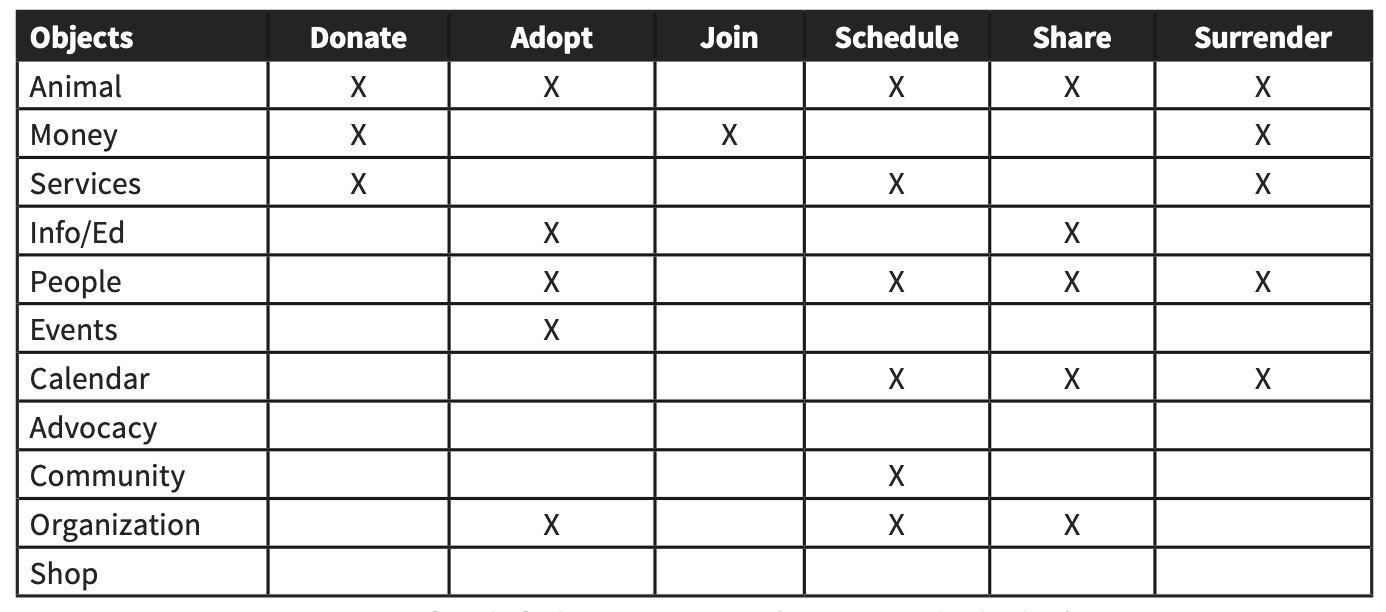
Table 4 from UX Magic: A first-draft Object-Action matrix (too sparse and redundant)

Table 5 from UX Magic: Compact Object-Action matrix
Advance Your Career With This Free Template for “Conceptual Model Templates”
Conceptual Model Templates
We respect your privacy
Get 1 powerful email each week: Design a life you love!

  1. Define your first draft Object-Action matrix.
    Iterate.
    Refine and compact until you achieve a high density. It should not be much bigger than the example shown in table 5.

  2. Make your own decision on the education dimension of the CM. You may refer to tables 11 and 12, which show how task prioritization can affect the conceptual model choices you make. There could be other solutions beyond the two variations shown in these tables.

  3. Try to create an equally dense alternative grammar (optional).

  4. Enumerate as many attributes as possible for each object in the final grammar. You will need to use your imagination because the brief does not include this level of data structure detail. You can learn all about dogs on the web if you don’t own one.

  5. Fill the UX strategy role and make the policy decisions regarding the rules for allowing a pet adoption and qualifying suitable owners.

  6. Create a prioritization matrix that balances the user, business model and UX strategy per the PM decisions you made in the prior steps.

It's important that you don’t start sketching! Try to do the complete CM definition and grammar layer abstractly based on syntax and semantics alone. If you need to sketch UX’s to think through a possible CM definition, you have not internalized this foundational step. You're trying to complete the assignment by reverse engineering. In 7 years of teaching this material in the classroom, we have observed that making this breakthrough to work at the abstract CM level is hardest for those with a background in graphic design and easier for those with a background in the social sciences. Lean on your right brain now; there will be lots of opportunity to leverage your left brain in framework layers 2 and 3. Framework layer 4 will require both left and right brain power.

When you believe your CM is as dense as possible, set it aside for the time being and read the next chapter regarding Visualization and selection of design patterns.

Wrap up This Exercise

Congratulations on completing this first step of the journey to becoming a certified UX Magician. This is by far the hardest step because it involves (for most students and practitioners) a new way of thinking about user experience design through the foundation of interaction semantics. You now have learned the first tool to minimize cognitive load and have taken the first step on the path to creating a UX design for the MatchDog client with the highest level of usability possible.

Author / Copyright holder: Teo Yu Siang and the Interaction Design Foundation. Copyright terms and license: CC BY-NC-SA 3.0


Learn More in This Course:

AI for Designers

10 days
12 % booked
View Course

What You Should Read Next

  • Read full article
    Why Care about Statistical Significance? - Article hero image
    Interaction Design Foundation logo

    Why Care about Statistical Significance?

    The categorical data depicts the success and failure rate of the low-fidelity wireframe above. There is not a large enough difference between the two to determine if the designs were successful.There is an element of error involved in measuring anything. So, when we want to compare measurements, how

    Social shares
    431
    Published
    Read Article
  • Read full article
    Web Fonts: Definition and 10 Recommendations - Article hero image
    Interaction Design Foundation logo

    Web Fonts: Definition and 10 Recommendations

    Web fonts bring digital content to life. They enhance readability, set the tone, and ensure consistency across various platforms—all vital ingredients. When you understand web fonts and their impact, it can help you with effective website creation—and greatly so. We’ll provide a comprehensive overvi

    Social shares
    780
    Published
    Read Article
  • Read full article
    How to Screen Research Participants - Article hero image
    Interaction Design Foundation logo

    How to Screen Research Participants

    Finding the right participants is crucial for gathering user research. We usually need to do research with participants having a particular set of needs or experience. In this short video, you will find out about the basic need for screening and how we make sure that we have suitably qualified parti

    Social shares
    449
    Published
    Read Article
  • Read full article
    Pitfalls in Recruiting Participants for User Research - Article hero image
    Interaction Design Foundation logo

    Pitfalls in Recruiting Participants for User Research

    The level of participant engagement is an important part of the user research results. Our results are dependent on proper engagement with our participants. In this video we look at some of the issues around participant recruitment and hear practical examples that arose in a large online study.[[vid

    Social shares
    418
    Published
    Read Article
  • Read full article
    How to Fit Quantitative Research into the Project Lifecycle - Article hero image
    Interaction Design Foundation logo

    How to Fit Quantitative Research into the Project Lifecycle

    Quantitative research methods fit into the project lifecycle at different stages of the process.In this video, we see where different quantitative research methods fit into a typical project lifecycle. Bear in mind that even with an iterative process such as Agile, the short cycles still address dif

    Social shares
    509
    Published
    Read Article
  • Read full article
    How to Resolve Conflicts Between Design Thinking and Marketing - Article hero image
    Interaction Design Foundation logo

    How to Resolve Conflicts Between Design Thinking and Marketing

    In the past, designers often reported to marketing managers and were neither expected nor allowed to make business decisions. When traditionally-structured companies transition to a design-driven mindset, there can be friction between the marketing and design teams. Let’s take a closer look at this

    Social shares
    682
    Published
    Read Article
  • Read full article
    Stop the Generic Portfolio Trap! Design a Stand-Out Portfolio for Your UX/UI Niche: User Research - Article hero image
    Interaction Design Foundation logo

    Stop the Generic Portfolio Trap! Design a Stand-Out Portfolio for Your UX/UI Niche: User Research

    User research is indispensable—and without it, well... UX design is guesswork. When you’re a user researcher, you know this well—but it can be hard to communicate your work in a way that grabs the viewer and holds their attention. And that’s what a portfolio is all about—grabbing the attention of yo

    Social shares
    381
    Published
    Read Article
  • Read full article
    Top Service Blueprint Templates - Article hero image
    Interaction Design Foundation logo

    Top Service Blueprint Templates

    Service blueprint tools are vital for effective customer experience design—and for designers to make experiences that are exceptional. Here, we’ll discuss why these tools are so important. What’s more, we’ll explore templates and practical resources to create high-quality, efficient service blueprin

    Social shares
    637
    Published
    Read Article
  • Read full article
    How to Write Research Questions that Lead to Confident Design - Article hero image
    Interaction Design Foundation logo

    How to Write Research Questions that Lead to Confident Design

    Designing with Data provides an extensive background to A/B testing.As with all other research methods, we need to start with a research question. A/B testing concerns itself with changes in user behavior, meaning that our questions need to be centered on measurable goals. In many cases, these will

    Social shares
    449
    Published
    Read Article
  • Read full article
    Getting Started - Article hero image
    Interaction Design Foundation logo

    Getting Started

    We start our introduction to A/B and multivariate testing (MVT) by looking at their basic principles and their differences. Note that the video mentions Google Optimize, which has been withdrawn. Google Firebase can be used for mobile platforms. Third-party solutions are needed for A/B testing on th

    Social shares
    222
    Published
    Read Article

Top Articles

Top Topic Definitions

Feel Stuck?
Want Better Job Options?

AI is replacing jobs everywhere, yet design jobs are booming with a projected 45% job growth. With design skills, you can create products and services people love. More love means more impact and greater salary potential.

At IxDF, we help you from your first course to your next job, all in one place.

See How Design Skills Turn Into Job Options
Privacy Settings
By using this site, you accept our Cookie Policy and Terms of Use.
Customize
Accept all

Be the One Who Inspires

People remember who shares great ideas.

Share on:

Academic Credibility — On Autopilot

Don't waste time googling citation formats. Just copy, paste and look legit in seconds.

Feel Stuck? Want Freedom?

Join 326,432+ designers who get one powerful email each week. Learn to design a life you love.

Next email in
7
days
9
hrs
30
mins
26
secs

Free forever. No spam. Unsubscribe anytime.