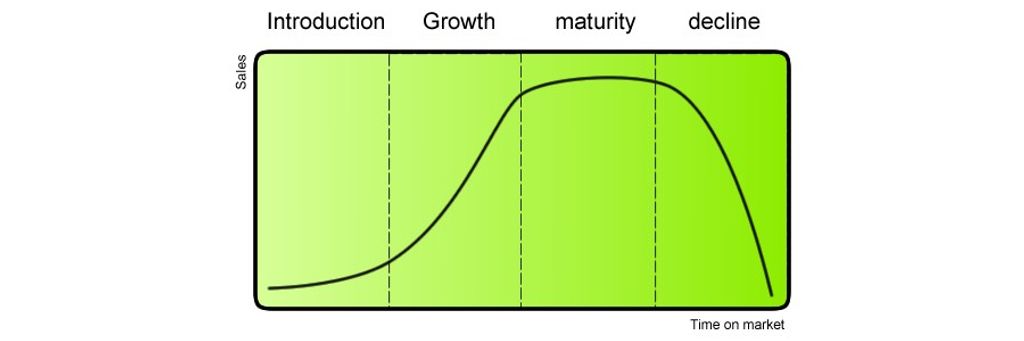
The product life cycle is an important tool for marketers, management and designers alike. It specifies four individual stages of a product’s life and offers guidance for developing strategies to make the best use of those stages and promote the overall success of the product in the marketplace.
About the Product-Life Cycle
Linda Gorchels in her book “The Product Manager’s Handbook” defines the product-life cycle and offers some key assumptions upon which it is based. The assumptions that are made are:
Products, in general, have a limited life span. All products will thus end up passing through a product life cycle.
Each phase of that life cycle presents the business with a set of opportunities and challenges to take advantage of and to overcome.
Products will require different efforts from design, development, marketing, purchasing, etc. during each phase of their life cycle.
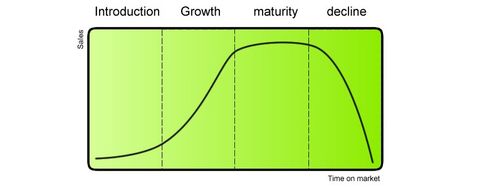
The Product Life Cycle
The Phase of the Product Life Cycle | Defining Characteristics of that Stage |
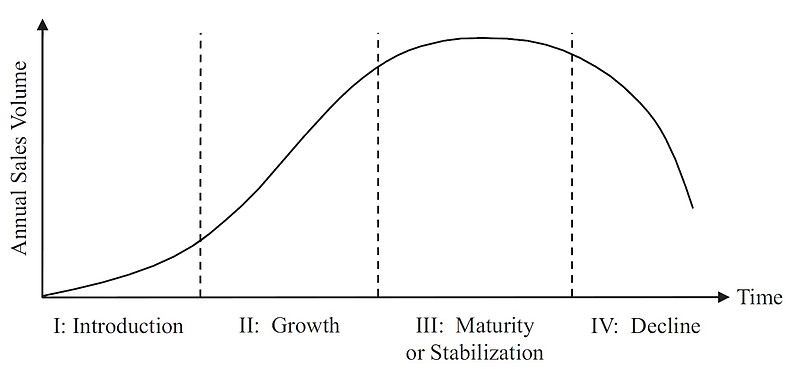
Market Introduction Product branding and quality will be determined. Any intellectual property protection is obtained. Pricing may be either be low (to gain market share) or high (to quickly recoup development costs) Distribution is selective (pending market acceptance of the product) Marketing is targeted at innovators and early adopters to try and encourage rapid awareness building for the product | At the point of market introduction: 1.Costs will be highest. This is because economies of scale are yet to be realized and there are few (if any) sales to drive costs down. 2.Sales volumes will be relatively slow to begin with. Market adoption takes time to achieve. 3.Little or no competition. It is hoped, though not always the case, that there will be little competition for a new product. 4.Demand needs creating. Marketing is particularly important to create demand 5.Customers need to be encouraged and educated to use the product. 6.Profitability, if any, will be low |
Growth Quality is maintained and development prioritizes additional features, complementary products and support Pricing will be maintained as the product is likely to enjoy a competitive advantage Distribution is increased to accommodate increased demands Marketing focuses on a wider audience | At the point of growth: 1.Costs begin to decline as economies of scale kick in. 2.Sales volumes rise appreciably compared to the introduction phase. 3.Profitability will rise 4.Brand/product awareness will rise 5.Competitors are likely to enter the market |
Maturity Product features will normally be enhanced to enable strong differentiation of the product from competing products Prices may have to be cut to ward off competitive threats Distribution will become more intense and new incentives may be introduced to try and encourage sales vs. competitors’ products Marketing focuses on the differentiation of the product in the market | At the point of maturity: 1.Costs decrease to reflect rising sales volumes and the experience of the business in producing the product 2.Sales volume reaches a peak and market saturation is attained 3.Further competitors enter the market 4.Prices will drop based on competition 5.Brand differentiation and product diversification becomes a possible strategy to protect market share 6.Profitability begins to decline |
Decline Product goes into a maintenance phase Attempts are made to recreate the product through new uses or by significantly changing the product The product may become a legacy offering sold to a niche group Costs are reduced as far as possible Finally, the product is discontinued when it is no longer economically viable to sell | At the point of decline: 1.Costs begin to become less than optimal 2.Sales volumes decline significantly 3.Prices fall further 4.Profitability depends less on sales than the efficiencies of production and distribution efforts |
It is worth noting that while products are often discontinued at the end of the lifecycle; the business will usually remain and will be involved in other products by this stage.
Author/Copyright holder: Malakooti, B. Copyright terms and licence: CC BY-SA 4.0
How to Tell What Stage in the Product-Life Cycle a Product is At
It is important to note that the diagram of the product-life cycle represents an idealized product-life cycle and that most products do not follow the curve in a perfect manner. There may be sudden dips, in sales during growth or maturity, which do not accurately reflect the position of the product in the lifecycle, for example.
Thus there are no absolute indicators for the position of a product during the life cycle. However, there are general indicators which can be applied – in the context of your own observations over time – which will give some indication of a product’s position in its lifecycle. These can be summarized as follows:
Indicative Feature | Life Cycle Stage |
Introduction | Growth | Maturity | Decline |
Sales Volumes | Low | High | Maximum | Low |
Investment Costs | Maximum | High | Low | Low |
Competition | Low | Low – Medium | High | Maximum |
Profitability | Low | Maximum | High | Low |
Challenges of Using the Product-Life Cycle
It is important to note that a product life cycle is a complex thing. Some products have life cycles measured in months or years whereas others may be measured in decades or centuries.
Rising sales do not always indicate growth, falling sales do not always indicate decline. Some products may not experience a decline at all within the lifetime of the business management team (think about Coca-Cola for example which has enjoyed relatively consistent sales for over 100 years).
 Author/Copyright holder: Sean Loyless. Copyright terms and licence: CC BY 2.0
Because of this, it is important to use the product-life cycle as a guideline to which large quantities of common sense must be applied rather than to use it as a rigid tool for decision making. Maturity and decline, in particular, can be difficult to identify with any form of precision and strategic decisions must be approached with caution to deliver the expected outcomes.
The Take Away
The product-life cycle provides guidance to a business as it progresses a product from introduction, through growth and maturity to decline. It is not designed to be a rigid tool and it is important that common sense and general understanding of the market be used alongside the product-life cycle in order to get the most value from it. Designers are most likely to be involved with the stages of introduction, growth and maturity and be moving on to new projects when a product is in decline.
Never forget Philip Kotler, the world famous marketer’s, advice though; “Watch the product life cycle; but more important, watch the market lifecycle.” It’s not just products that come to an end but markets can too.
References & Where to Learn More:
Course: Get Your Product Used: Adoption and Appropriation
Gorchels, L. (2002) “The Product Manager’s Handbook: The Complete Product Management Resource” , McGraw-Hill, ISBN 978-0658800 13522
Day, G. (1981) The product life cycle: Analysis and applications issues, Journal of Marketing, vol 45, Autumn 1981
Levitt, T. (1965) Exploit the product life cycle, Harvard Business Review, vol 43, November–December 1965
Hero Image: Author/Copyright holder: Mwpnl. Copyright terms and licence: CC BY-SA 3.0