An augmented reality display of rising water around real people as they observe the landscape around them.

How to Create Memorable Stories in AR

by Riley Hunt • 21 min read

436 Shares

Augmented Reality (AR) is particularly effective for place-based stories. Because of how human memory works, place-based narratives are powerful tools for education and entertainment. UX designers for AR look for opportunities to turn seemingly uninteresting spaces into engaging stories or tedious tasks into playful and memorable narratives.

Copyright
Transcript

What Makes AR Memorable?

Augmented reality's earliest uses were in entertainment, and the medium's strength remains in place-based storytelling. In a way, augmented reality is an evolution of open-air theater and public art, which turn public spaces into stages or exhibitions. As a designer, you should consider narrative an essential element of your design. Part of why storytelling in AR is so compelling is that it is immersive and memorable.

This is due to two main phenomena related to the science of memory, or mnemonics.

  1. We remember stories better than facts. Teachers have used the "mnemonic linking method" or "chain method" for generations to teach the planets, geography and other difficult-to-remember facts. One example of this is the English mnemonic device to remember the colors of the rainbow:

"Richard Of York Gave Battle In Vain."

It helps us remember the following:

"Red, Orange, Yellow, Green, Blue, Indigo, Violet."

Countless phrases like this in many languages and cultures reflect our shared interest in narrative throughout history.

  1. Humans associate memories with physical space: This phenomenon is called the "method of loci" and describes how memories link to familiar places. You can feel this effect whenever you enter a room and forget why you entered it in the first place. The ancient Greeks used this method to develop "memory palaces," imaginary spaces to store memories. This is particularly relevant in UX for AR, where digital content exists in physical space.

In this example, AR artist John Craig Freeman turns a simple fact into a memorable story experience.

The augmented reality art installation "Windsor Mill" by John Craig Freeman.

© John Craig Freeman, Fair Use

Tips for Narrative Design in AR

With AR experiences, consider the environment a story space or stage, and think of your user journey as a narrative. Where does the user experience begin and end? How can you introduce conflict, and how will you resolve it? Why does this interaction happen in this place in particular?

Provide cues, spark emotions and guide discovery to evoke an emotional response from your users. User research methods like journey maps and personas will help visualize that journey. Storyboards, improv and bodystorming exercises can also help make a compelling story and visualize what it will look like in real space. Designers will have to think like screenwriters and craft a narrative structure that is satisfying and engages users. The success of the narrative also depends on how it works in the physical space and the hardware and software the design will be experienced with. That’s why spatial cognition and field of view (FOV) is especially important in Extended Reality (XR).

Screenwriters often employ a narrative structure like the one below. Here's an example of what the story arc for Cinderella looks like.
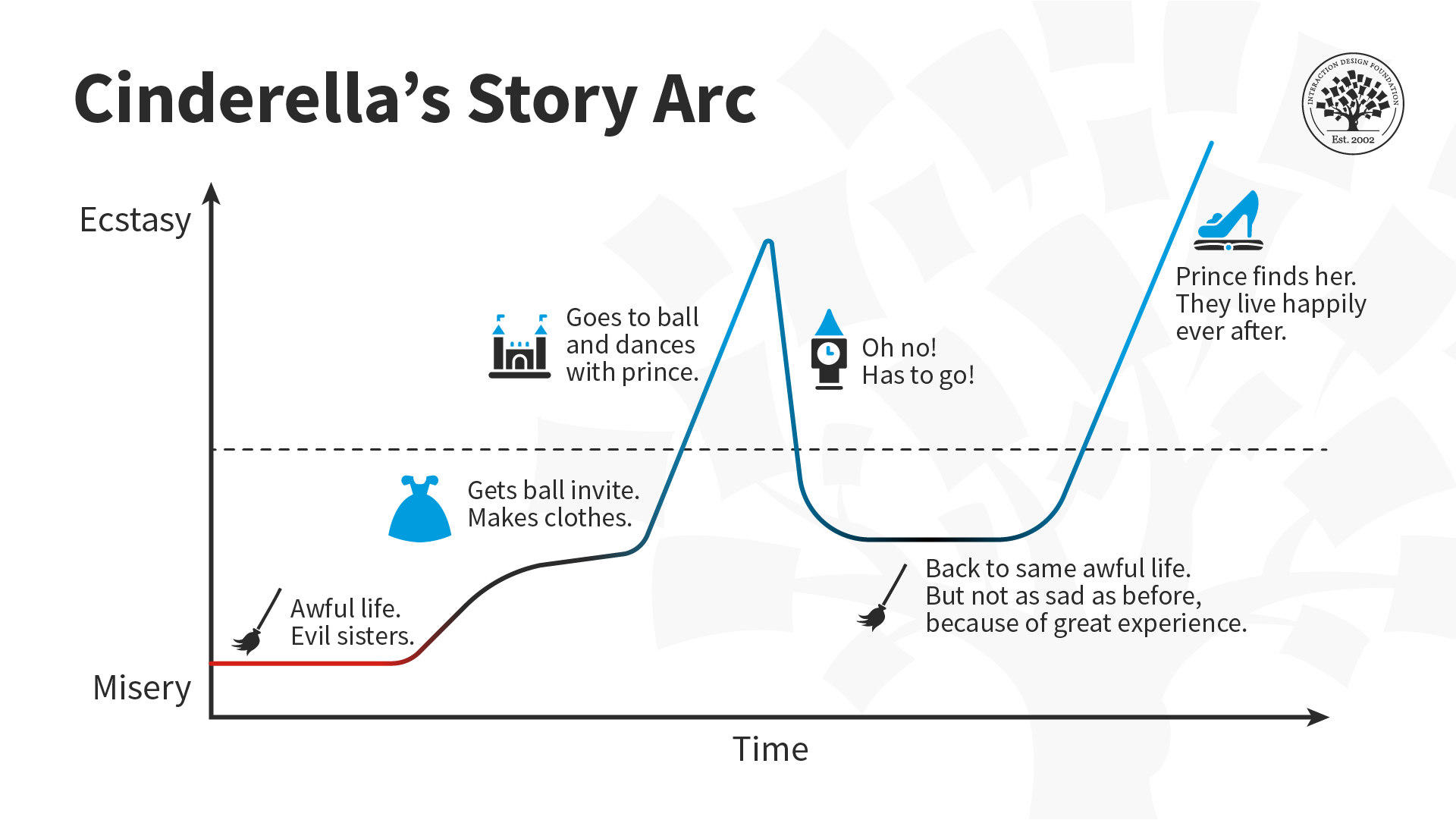
A line graph version of the story of Cinderella. A line graph with the X-axis as

A graphical representation of the story of Cinderella, originally based on a doodle by author Kurt Vonnegut.

© Interaction Design Foundation, CC BY-SA 4.0

For interactive mediums like AR, we can map specific tasks to areas in the narrative. For example, the exposition stage introduces both the setting and characters and the mechanics of the experience, like how to move and interact with the environment.
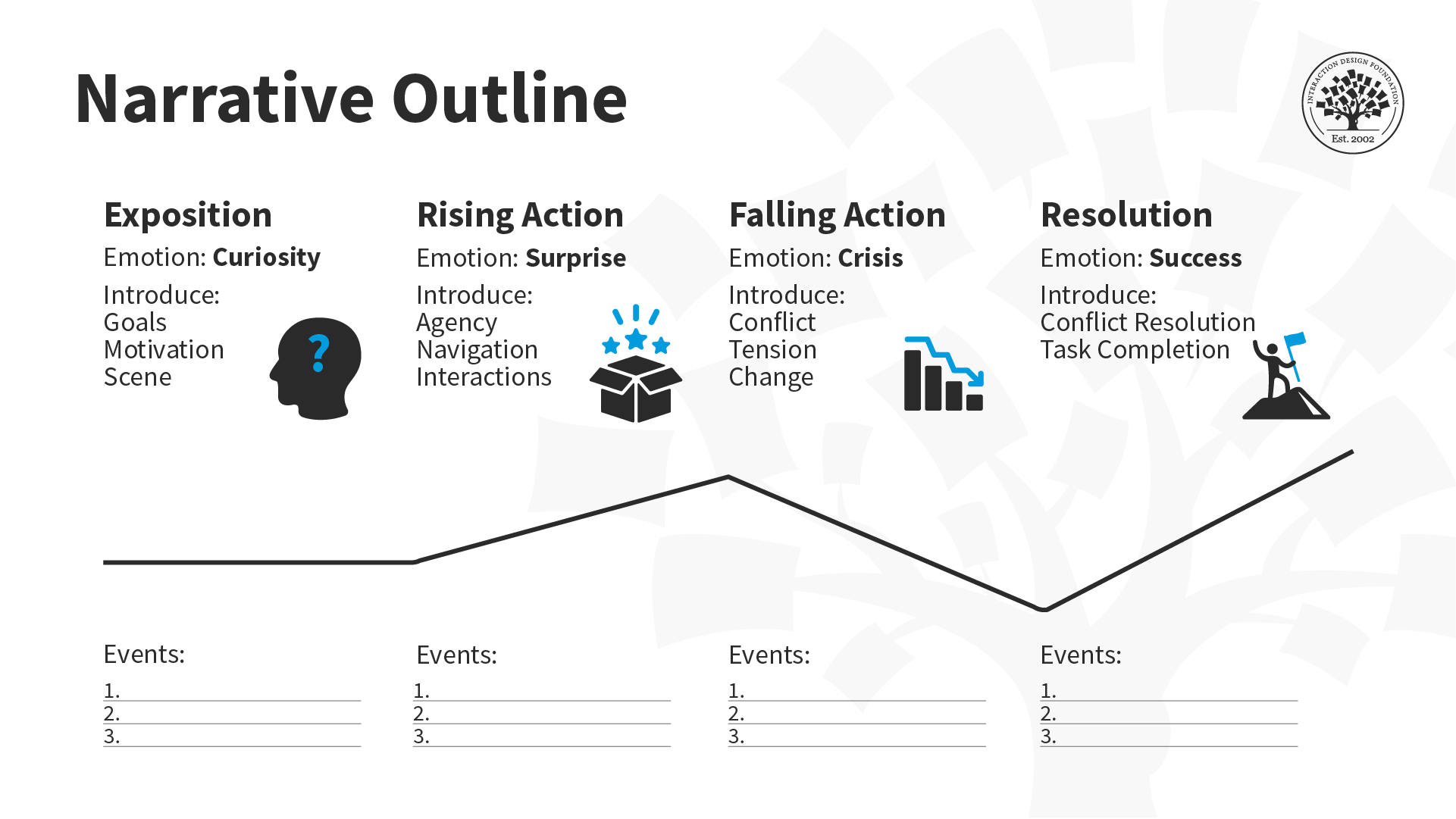
A line graph of a narrative outline includes events at each stage and the user's emotional state. It begins with

This adapted narrative graph for AR experiences includes the intended emotional state for each stage.

© Interaction Design Foundation, CC BY-SA 4.0

Download our Narrative Outline Template to Get Started Now

Narratives can be a powerful tool to map out the stages of an interactive story. Learn how you can use narrative to improve your user experience in our template:
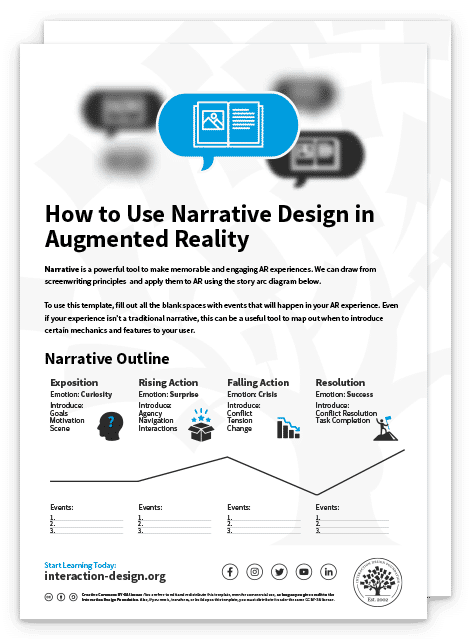
Advance Your Career With This Free Template for “How to Use Narrative Design in Augmented Reality”
How to Use Narrative Design in Augmented Reality
We respect your privacy
Get 1 powerful email each week: Design a life you love!

When you storyboard or write a script for your narrative, create a modified user journey map like the one above. Each stage should elicit certain emotions; specific tasks belong in each emotional stage.

  1. Curiosity / Exposition: In this stage, introduce goals to the user, and motivate them to continue exploring. Establish the world the story takes place in.

  2. Surprise / Rising Action: Next, open up the experience and introduce the functions available to the user. Let them know how they can move around and interact with the narrative. This includes movement, navigation, and input. Introduce the conflict the user has to solve.

  3. Crisis / Climax: Introduce an obstacle to the user's goals. Have the user address the conflict and try to resolve it. Change the environment in a way that causes tension.

  4. Success / Falling Action and Resolution: Allow users to resolve conflicts, complete tasks, and enjoy rewards.

The user has agency in the narrative, so the story should react to their actions and draw them deeper into the experience. Use real spaces as stages, and the experience will stick with your user long after they close the app.

The Take Away

To make an AR experience meaningful, it must also be memorable. Narratives are an excellent way to increase immersion and user engagement. Storytelling should be considered a design tool to create more memorable experiences.

AR is particularly suited for memorable experiences because human brains naturally tie memories to physical space and retain stories better than abstract facts. To craft AR narratives, think about narrative cues that guide discovery, and be deliberate about the emotions you evoke at each stage of the user's journey.

References and Where to Learn More

Watch our Master Class on The Power of Storytelling in UX.

Watch journalist and US memory champion Josh Foer's Ted talk, Feats of memory anyone can do.

For more on Josh Foer's Article on Mnemonic methods, read Forget Me Not: How to Win the U.S. Memory Championship.

Watch a virtual roundtable on how AR is a new form of public art in Public Art in the Digital Age: A Curated Conversation on Augmented Reality.

See how ancient Greeks used Mnemonics in Method of Loci: Ancient Mnemonic Technique Used by Greeks and Romans Effectively Double Brain's Memory Storage Skills.

Read John Butcher's book on storytelling in VR and AR Storytelling for Virtual Reality: Methods and Principles for Crafting Immersive Narratives.

For more on how screenwriters think about stories, read The Pixar Storytelling Formula: What You Need To Know.

Hero Image: ©John Craig Freeman, Fair Use

Learn More in This Course:

AI for Designers

9 days
19 % booked
View Course

What You Should Read Next

  • Read full article
    Why Care about Statistical Significance? - Article hero image
    Interaction Design Foundation logo

    Why Care about Statistical Significance?

    The categorical data depicts the success and failure rate of the low-fidelity wireframe above. There is not a large enough difference between the two to determine if the designs were successful.There is an element of error involved in measuring anything. So, when we want to compare measurements, how

    Social shares
    432
    Published
    Read Article
  • Read full article
    Web Fonts: Definition and 10 Recommendations - Article hero image
    Interaction Design Foundation logo

    Web Fonts: Definition and 10 Recommendations

    Web fonts bring digital content to life. They enhance readability, set the tone, and ensure consistency across various platforms—all vital ingredients. When you understand web fonts and their impact, it can help you with effective website creation—and greatly so. We’ll provide a comprehensive overvi

    Social shares
    781
    Published
    Read Article
  • Read full article
    How to Screen Research Participants - Article hero image
    Interaction Design Foundation logo

    How to Screen Research Participants

    Finding the right participants is crucial for gathering user research. We usually need to do research with participants having a particular set of needs or experience. In this short video, you will find out about the basic need for screening and how we make sure that we have suitably qualified parti

    Social shares
    450
    Published
    Read Article
  • Read full article
    Pitfalls in Recruiting Participants for User Research - Article hero image
    Interaction Design Foundation logo

    Pitfalls in Recruiting Participants for User Research

    The level of participant engagement is an important part of the user research results. Our results are dependent on proper engagement with our participants. In this video we look at some of the issues around participant recruitment and hear practical examples that arose in a large online study.[[vid

    Social shares
    419
    Published
    Read Article
  • Read full article
    How to Fit Quantitative Research into the Project Lifecycle - Article hero image
    Interaction Design Foundation logo

    How to Fit Quantitative Research into the Project Lifecycle

    Quantitative research methods fit into the project lifecycle at different stages of the process.In this video, we see where different quantitative research methods fit into a typical project lifecycle. Bear in mind that even with an iterative process such as Agile, the short cycles still address dif

    Social shares
    510
    Published
    Read Article
  • Read full article
    How to Resolve Conflicts Between Design Thinking and Marketing - Article hero image
    Interaction Design Foundation logo

    How to Resolve Conflicts Between Design Thinking and Marketing

    In the past, designers often reported to marketing managers and were neither expected nor allowed to make business decisions. When traditionally-structured companies transition to a design-driven mindset, there can be friction between the marketing and design teams. Let’s take a closer look at this

    Social shares
    682
    Published
    Read Article
  • Read full article
    Stop the Generic Portfolio Trap! Design a Stand-Out Portfolio for Your UX/UI Niche: User Research - Article hero image
    Interaction Design Foundation logo

    Stop the Generic Portfolio Trap! Design a Stand-Out Portfolio for Your UX/UI Niche: User Research

    User research is indispensable—and without it, well... UX design is guesswork. When you’re a user researcher, you know this well—but it can be hard to communicate your work in a way that grabs the viewer and holds their attention. And that’s what a portfolio is all about—grabbing the attention of yo

    Social shares
    383
    Published
    Read Article
  • Read full article
    Top Service Blueprint Templates - Article hero image
    Interaction Design Foundation logo

    Top Service Blueprint Templates

    Service blueprint tools are vital for effective customer experience design—and for designers to make experiences that are exceptional. Here, we’ll discuss why these tools are so important. What’s more, we’ll explore templates and practical resources to create high-quality, efficient service blueprin

    Social shares
    638
    Published
    Read Article
  • Read full article
    How to Write Research Questions that Lead to Confident Design - Article hero image
    Interaction Design Foundation logo

    How to Write Research Questions that Lead to Confident Design

    Designing with Data provides an extensive background to A/B testing.As with all other research methods, we need to start with a research question. A/B testing concerns itself with changes in user behavior, meaning that our questions need to be centered on measurable goals. In many cases, these will

    Social shares
    450
    Published
    Read Article
  • Read full article
    Getting Started - Article hero image
    Interaction Design Foundation logo

    Getting Started

    We start our introduction to A/B and multivariate testing (MVT) by looking at their basic principles and their differences. Note that the video mentions Google Optimize, which has been withdrawn. Google Firebase can be used for mobile platforms. Third-party solutions are needed for A/B testing on th

    Social shares
    225
    Published
    Read Article

Top Articles

Top Topic Definitions

Feel Stuck?
Want Better Job Options?

AI is replacing jobs everywhere, yet design jobs are booming with a projected 45% job growth. With design skills, you can create products and services people love. More love means more impact and greater salary potential.

At IxDF, we help you from your first course to your next job, all in one place.

See How Design Skills Turn Into Job Options
Privacy Settings
By using this site, you accept our Cookie Policy and Terms of Use.
Customize
Accept all

Be the One Who Inspires

People remember who shares great ideas.

Share on:

Academic Credibility — On Autopilot

Don't waste time googling citation formats. Just copy, paste and look legit in seconds.

Feel stuck? Want Freedom?

Get one powerful email each week, like 325,752 others.

Learn to design a life you love.

Next email in:
5
days
13
hrs
0
mins
52
secs