It’s fairly safe to assume you want your products to actually work, right? Then you need to start the design process with empathy — one of the most important elements in both design thinking and the wider area of human-centered design. But what is empathy exactly, and why is it so vital? Let’s take a look at what empathy means and how it can help you, as a design thinker, create solutions that actually work for people. While we’re at it, let’s also explore how a lack of empathy can result in product failure — something we all want to avoid! By the end, you’ll come to understand the empowering notion that everyone can increase their empathy and, by doing so, start to design solutions which are truly human-centric.
Empathy is our ability to see the world through other people's eyes — to see what they see, feel what they feel and experience things as they do. Of course, none of us can fully experience things the way someone else does, but we can attempt to get as close to this as possible. We achieve this empathic state as we put aside our own preconceived ideas about the world and choose to understand the ideas, thoughts and needs of others instead.
IDEO’s Human-Centered Design Toolkit explains that, in the world of design thinking, empathy is a “deep understanding of the problems and realities of the people you are designing for.” In other words, empathy requires you to learn about the difficulties people face and uncover their latent needs and desires to explain their behaviors. You need to gain an understanding of their environment, as well as their roles and interactions within it if you want to truly empathize with them.
When you empathize with people, you can transform even the most stressful situations into delightful ones for your end-users. In this video, you will see examples of well-designed and poorly-designed airports and the power of empathy in design.
Empathy helps you:
Appreciate people's emotional and physical needs.
Gain insight into the way people see, understand and interact with the world around them.
Realize how lives are impacted within the contexts being investigated.
Find out what people mean rather than just what they say — empathic research is inherently subjective and is concerned with motivations and thoughts, rather than facts.
Don’t Confuse Empathy With Sympathy
Empathy is often confused with sympathy — a mistake you definitely don’t want to make in the world of design thinking! Sympathy is about your ability to show concern for the well-being of another, but does not necessarily require you to experience what others do. Now you have begun to understand what empathy means, you can see there is a clear difference!
What’s more, sympathy often involves a sense of detachment and superiority; when we sympathize, we tend to project feelings of pity and sorrow onto another person. These feelings do not only have the potential to rub people up the wrong way, but also prove useless in the design thinking process. In design thinking, your goal is to understand the people for whom you design, not react to their current predicament in an emotional way. The Empathize stage of design thinking requires you to visit your users in their natural environments, learn about how they behave and conduct interviews with them — all so you can create a solution which helps solve a problem they face. You need empathy to achieve that, not sympathy.
In this RSA Short, research professor and author Brené Brown highlights the difference between empathy and sympathy, and reminds us we can only create a genuine empathic connection if we are brave enough to really get in touch with our own fragilities.
© Brené Brown and RSA Events, CC BY-NC-ND 2.0
Now you have a good understanding of what empathy is (and isn’t), let’s move on to why it’s so important in the design thinking process.
Empathize is the first of five stages in the design thinking process. The other four are Define, Ideate, Prototype and Test.
© Interaction Design Foundation, CC BY-SA 3.0
“Empathize” is actually the first stage of the design thinking process — what could be more important than that?! It makes sense really when you think about it. Your goal, as a designer, is to gain an empathic understanding of the people you design for, after all! You should have a burning desire to observe, engage and empathize with the people you design for to understand their experiences and motivations. What’s more, you’ll need to immerse yourself in their physical environment if you want to have any chance at gaining a deeper personal understanding of the issues, needs and challenges involved in their day-to-day lives.
When you immerse yourself in the environment and in the context of the people you design for, you can often get a completely different perspective than what you might expect. What might seem like good weather for you (say, warm and sunny) may well be a not-so-nice day for someone else. We'll let HCI expert Alan Dix explain this.
Empathy is simply crucial to a human-centered design process such as design thinking as it helps you set aside your own assumptions about the world to gain insight into your users and their needs instead. The Empathize stage of the design thinking process is a time for you to collect as many experiences, insights and observations as possible, so you can build a solid foundation for the rest of your design project.
We cannot stress enough how important it is for you as a designer to develop the best possible understanding of your users, their needs and the problems that your product or service is trying to solve! You and your team can gain huge insight via the practical Empathize methods below, and, if time and money allows for it, it may also be worth getting some experts on board to help you fully understand the people you want to design for.
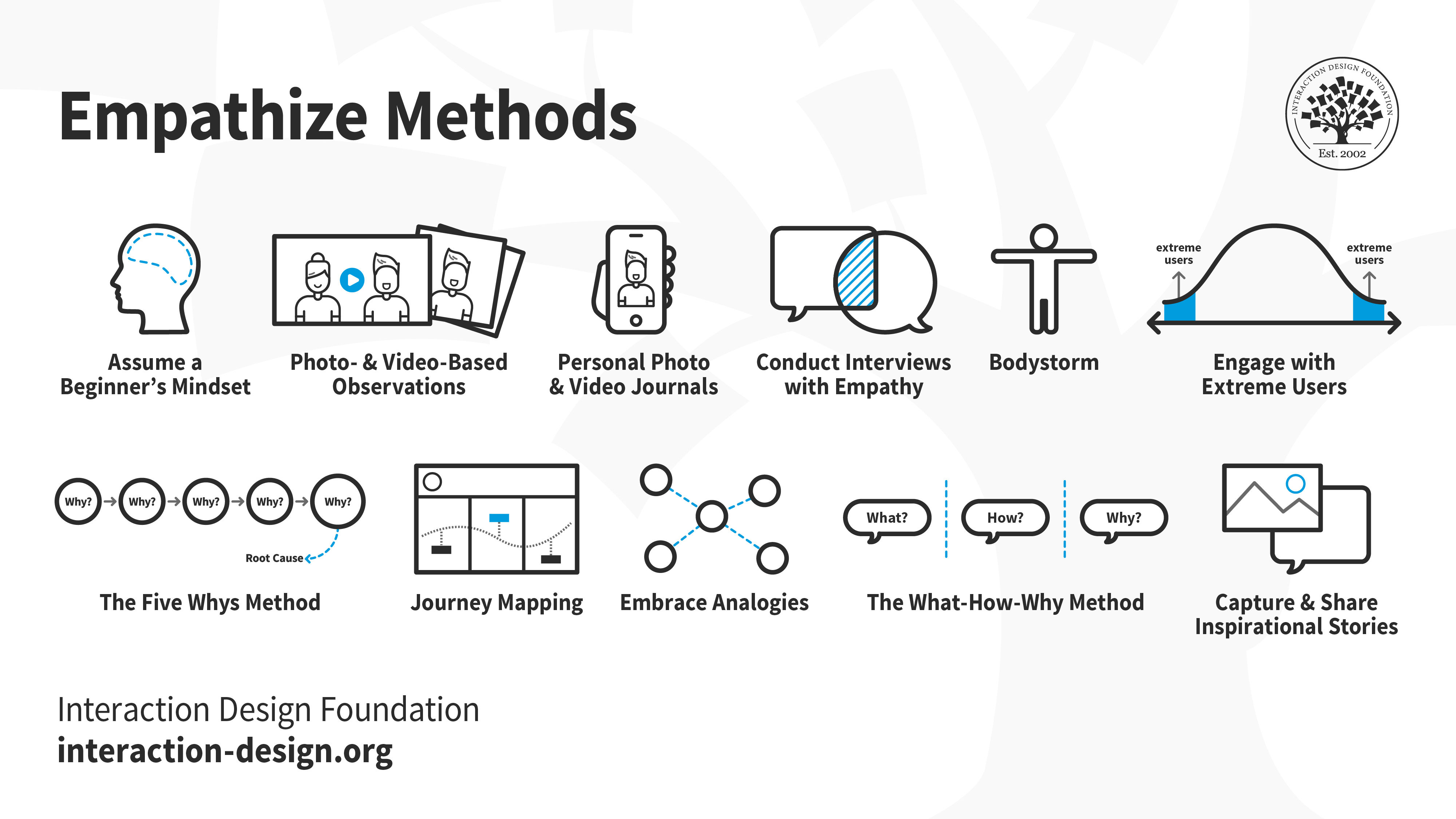
We favor eleven empathize methods at the Interaction Design Foundation — when you use a variety of methods to gain empathy with your users, you end up with deep and meaningful insights.
© Interaction Design Foundation, CC BY-SA 4.0
What’s good to note is this empathic phase of design thinking is named differently depending on which version of the methodology you follow. Different schools and companies which use design thinking have called empathic research "the Empathize stage" (as we do), "the understand phase," "the hear phase," and simply "looking," as well as a number of other terms. Regardless of which phrase you’re familiar with, the core is essentially the same — empathy is deeply human-centric and is essential at the start of any design process.
Empathy is Crucial to Business Success
Empathy can also be deemed an essential component of business solutions when you look at things from the perspective of profit. You may create solutions which completely miss the mark if you develop solutions in isolation — you need to gain essential insights about your users if you want to remain relevant in the market.
“People ignore design that ignores people.”
— Frank Chimero, author of The Shape of Design
Many leaders within the fields of innovation, learning and entrepreneurship have pointed to three key parameters which define a successful product or service: desirability, feasibility and viability.
It’s not enough that the technology exists (i.e., feasibility is present) and that profits or business benefits may be derived (i.e., it is viable). Users need to feel a sense of desirability towards a solution. We can only design a desirable product or service when people's needs, experiences, wants and preferences are properly understood.
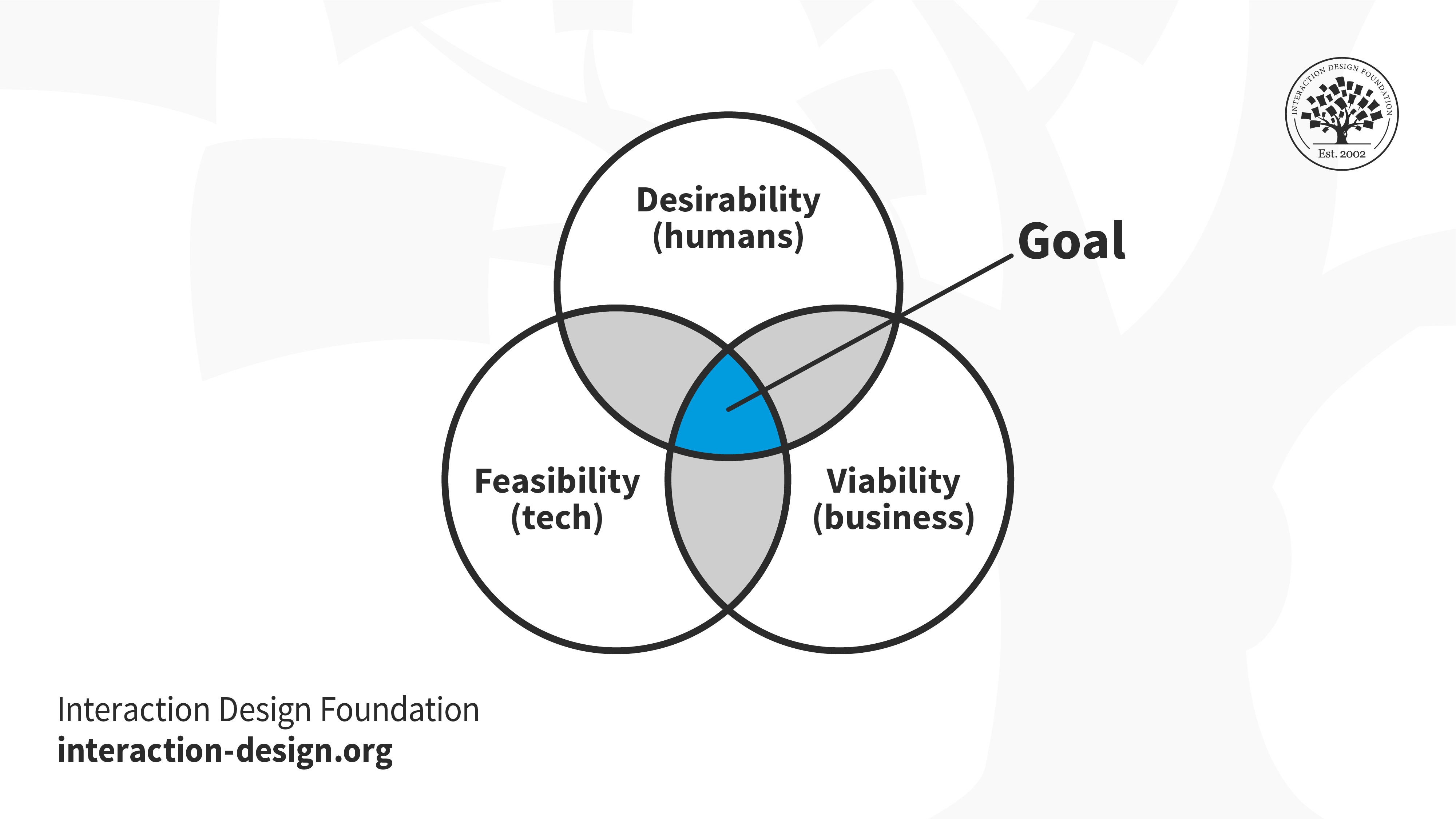
When you design products and services, you should aim for the sweet spot between feasibility, viability and desirability. This can only be achieved when you have built empathy for your users.
© Interaction Design Foundation, CC BY-SA 4.0
One clear example of this is the iPod. Many MP3 players came and went throughout the late 1990s, and didn’t create much of an impact. Then, along came the iPod in 2001. It not only provided a technological solution, but also delivered a completely desirable and viable experience. This meant Apple took the lead in the market and continued to hold it for many years to come, generating huge profits along the way.
Empathy Helps You Read Between the Lines
Empathy is also the only way to thoroughly understand what people mean, rather than just absorb what they say. You’ll have noticed by now people do not necessarily always cover the details when they share stories and other information. They may withhold information out of fear, distrust or another inhibiting factor — be it internal or based on those with whom they engage — and they may express themselves in a less than articulate way. As a designer, you therefore need to:
Make sense of what is not being said, or what is being hinted at beneath the external expressions and words.
Develop intuition, imagination, emotional sensitivity and creativity so you can dig deeper into people’s experiences.
Extract the right kinds of insight to ensure you make a meaningful difference.
Empathy is the difference between what your users say at face value and what IDEO Executive Design Director Jane Fulton Suri describes as “thoughtless acts.” Thoughtless acts are small, subtle acts people exhibit that reveal how their behaviors are shaped by their environment. For example, when people hang their sunglasses on their shirt or wrap colored stickers around their keys to differentiate them, it’s a sign of how an imperfectly tailored environment forces us to make an almost unconscious reaction. Empathy can help us find opportunities for new insights and new solutions to help people with these suboptimal, unconscious acts.
Become Conscious of Your Empathy
If you’re worried you’re unable to master being fully empathic towards the people you design for, there’s good news! Neuroscientists have recently discovered empathy is hard-wired into the way humans are made, and is therefore an integral part of our physiology. Humans who observe others, show brain activity which resembles someone actually engaged in the activity being observed. In other words, empathy is an innate quality we can all make use of to design for the people around us!
Think about it: Have you experienced a flurry of emotions or rush of adrenalin when you’ve observed someone else engaged in an activity? This is because we are empathic beings by our very nature. Our social contexts and methods of learning often work to remove this inbuilt empathy to a large extent or, at the very least, tame it. But when you engage with the people you design for, this wall starts to break down and you become more conscious about your levels of empathy, especially if you keep an open mind.
However, keep in mind that gaining empathy isn’t something you get and then you have it forever. It is a skill that needs to be constantly practiced and honed.
Not everyone can grasp empathy easily. For some people, it is harder than it is for others. Neurodiversity, which refers to the broad spectrum of natural variations in brain function, cognitive processing, and behavioral traits, can affect how readily empathy is learned and understood. This is regarded as part of normal variation in the human population.
So, no matter what, practice, practice, practice to up your empathy skills game. Empathy isn’t just for users; it’s also for stakeholders, and teammates.

Empathy requires you to pay attention to subtle cues in a person’s behavior.
© RODNAE Productions and Pexels, CC BY-SA 4.0
Designing Without Empathy: Augmented Reality Glasses

Why doesn’t everyone wear augmented reality (AR) glasses as they go about their daily lives? Probably because we find it ever so slightly awkward to shout out commands in public! Did designers even empathize with their users when they designed this product? It’ll be interesting to see what the future holds for these wearable computers.
© Google, Fair Use
In this video, a product tester describes their experience using smart glasses with notifications and information intended for everyday use.
© Tech Insider, Fair Use
The Take Away
Empathy is important for us as designers, and particularly within the field of design thinking, because it allows us to truly uncover and understand the latent needs and emotions of the people we design for. The Empathize stage actually makes up the first stage of the design thinking process, and it allows us to design solutions that meet all three parameters of a successful product or service: desirability, feasibility and viability.
References and Where to Learn More
What happens when we ignore individuals and focus on data and averages? When it comes to pilot safety, the results can be fatal. Read Todd Rose’s book The End of Average.
Images
© Interaction Design Foundation, CC BY-SA 4.0