"Players have goldfish attention spans now," your creative director says. "Add more popups, more notifications, and more UI alerts to keep them engaged." You do. Players quit within 10 minutes, overwhelmed. The problem? You believed a myth. Attention is limited and your design just overloaded it.
Brain myths spread everywhere: social media, design blogs, team meetings. And they cost you time and good design decisions. The tricky part is that you won't always recognize them as myths, because they sound scientific and they're repeated by smart people. They might seem to explain behavior, but they'll lead you toward solutions that can't work.
In this video, Celia Hodent, PhD, Game UX Strategist and Author of the best-selling book The Gamer's Brain, reveals which brain myths are costing you good design decisions and what the science-backed truth means for your work.
Now you know the truth about the 10% brain myth, the left-brain/right-brain myth, and the goldfish attention myth. But these three aren't the only brain myths out there. You'll encounter new brain claims constantly throughout your career, often disguised as cutting-edge insights or "proven" strategies. The brain is incredibly complex. We're only just beginning to understand it, and that complexity creates space for myths to flourish. When you can separate myth from science, you'll gain a skill that will enhance your career. You'll waste less time pursuing approaches that can't work, and ask better questions to identify the real root problems.
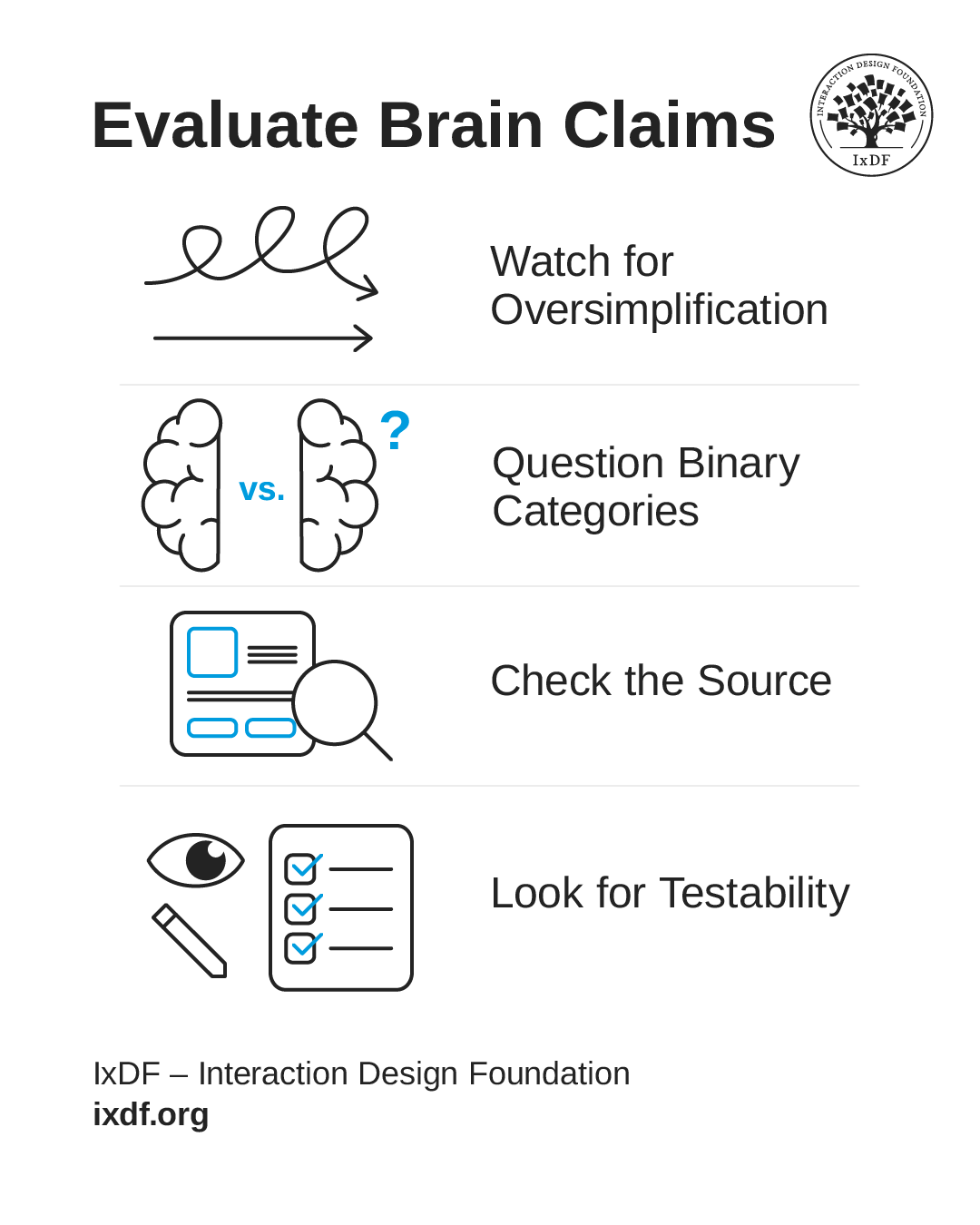
Here's how you can evaluate claims about the brain:
© Interaction Design Foundation, CC BY-SA 4.0
Watch for oversimplification: If someone claims complex behavior comes down to one brain chemical or region, be skeptical. Real brain processes involve networks across the entire brain.
Question binary categories: Claims about "types" of people based on brain differences (left-brain vs. right-brain, visual vs. auditory learners) rarely hold up. Brains differ between individuals, but don't fit into neat categories.
Check the source: Peer-reviewed research is more reliable than social media. When someone says, "neuroscience shows," ask which research.
Look for testability: Real cognitive science leads to predictions you can test. "Working memory may efficiently hold and process about three items" predicts players struggle tracking too many things at the same time. "Unlock your brain's potential" predicts nothing.
The Take Away
Brain myths are dangerous because they sound like plausible explanations. They give you a simple reason for player behavior, but they can lead you toward the wrong design solution. Remember that the brain is very complex.
The next time someone shares the latest "brain hack," you'll know how to evaluate it and distinguish it from peer-reviewed science. This skill will help you throughout your career to make better UX decisions grounded in how brains actually function. You'll catch problems others miss and design with more confidence because you're building on evidence, not assumptions or the latest neurohype.
The brain is endlessly fascinating, so do stay curious about it. But stay skeptical too. Question claims that sound too simple and seek evidence-backed research. And above all, test ideas against player behavior. That's your competitive advantage.
References and Where to Learn More
Want more? If you haven't already, sign up for Game UX Design: The Ultimate Guide to learn directly from Celia Hodent, PhD, former Fortnite UX Director, and author of the best-seller The Gamer's Brain.
Read The Gamer's Brain by Celia Hodent.
Watch the How to Design for the Human Mind: Cognitive Science for UX Master Class by Celia Hodent.
Watch the How to Become a Games User Researcher Master Class by Steve Bromley, Games Researcher and Author.
Watch the AI for Game UX: Speed Up Research, Ideas, and Prototypes Master Class by Om Tandon, UX Design Leader at Nordeus (Zynga/Take-Two).
Watch the Level Up Your Career: How to Land a Job in the Game Industry Master Class with Om Tandon, UX Design Leader at Nordeus (Zynga/Take-Two).
Watch the UI Design for Games: Starter Edition Master Class with Stéfano Girardelli, Senior Visual Designer at Wildlife Studios.
Hero image: © Interaction Design Foundation, CC BY-SA 4.0