Dieter Rams quote "“You cannot understand good design if you do not understand people”

What is Good Design?

by Daniel Skrok • 14 min read

650 Shares

Design matters. It enables us to understand, communicate and improve the world around us. When done right, design has the power to improve the everyday lives of users. When done wrong, design can disrupt and frustrate users. As a designer, you have the power to improve the everyday lives of your users if you practice good design.

“You cannot understand good design if you do not understand people.”

— Dieter Rams

So, what is good design? Are there any instructions on how to create it? Dieter Rams, a German industrial designer known for his “less but better” approach to design, attempted to answer these questions. Let’s watch.

© Gary Hustwit and Film First, Fair-Use (Link)

Dieter Rams is considered one of the most influential industrial designers of the late twentieth century. His work has influenced the way most of today's consumer products look and function. Dieter’s iconic work at Braun and Vitsoe touched the lives of millions of people. His design aesthetics championed simplicity, honesty and restraint — which is evident in the products he designed including the Braun coffee maker, shaver, stereo, calculator, speakers, alarm clock and Oral-B toothbrush. In fact, the computer or phone you're reading this on looks the way it does because of Dieter Rams.

In the late 1970s, Dieter Rams became increasingly interested in the state of the world around him — “an impenetrable confusion of forms, colors and noises.” Aware that he was a significant contributor to that world, he asked himself an important question: is my design good design? His answer is expressed in his ten principles for good design.

According to Dieter Rams, good design:

  1. Is innovative.

  2. Makes a product useful.

  3. Is aesthetic.

  4. Makes a product understandable.

  5. Is unobtrusive.

  6. Is honest.

  7. Is long-lasting.

  8. Is thorough down to the last detail.

  9. Is environmentally friendly.

  10. Involves as little design as possible.

These principles have become iconic and have inspired designers across the world. Let’s see each of them in a little more detail.

Good design is innovative. 

The possibilities for innovation are not, by any means, exhausted. Technological development is always offering new opportunities for innovative design. But innovative design always develops in tandem with innovative technology, and can never be an end in itself.

Good design makes a product useful. 

A product is bought to be used. It has to satisfy certain criteria, not only functional, but also psychological and aesthetic. Good design emphasizes the usefulness of a product whilst disregarding anything that could possibly detract from it.

Good design is aesthetic. 

The aesthetic quality of a product is integral to its usefulness because products we use every day affect our person and our well-being. But only well-executed objects can be beautiful.

Good design makes a product understandable. 

It clarifies the product’s structure. Better still, it can make the product talk. At best, it is self-explanatory.

Good design is unobtrusive. 

Products fulfilling a purpose are like tools. They are neither decorative objects nor works of art. Their design should therefore be both neutral and restrained, to leave room for the user’s self-expression.

Good design is honest. 

It does not make a product more innovative, powerful or valuable than it really is. It does not attempt to manipulate the consumer with promises that cannot be kept.

Good design is long-lasting. 

It avoids being fashionable and therefore never appears antiquated. Unlike fashionable design, it lasts many years — even in today’s throwaway society.

Good design is thorough down to the last detail. 

Nothing must be arbitrary or left to chance. Care and accuracy in the design process show respect towards the user.

Good design is environmentally friendly. 

Design makes an important contribution to the preservation of the environment. It conserves resources and minimizes physical and visual pollution throughout the lifecycle of the product.

Good design is as little design as possible. 

Less, but better — because it concentrates on the essential aspects, and the products are not burdened with non-essentials. Back to purity, back to simplicity.

We’re inspired by the relevance of the principles above. If you are too, feel free to download our Ten Principles of Good Design Poster to reference or even print and hang on your wall. And don’t worry — we’ve included both a light and dark theme poster, so you can match your personal aesthetics. :)
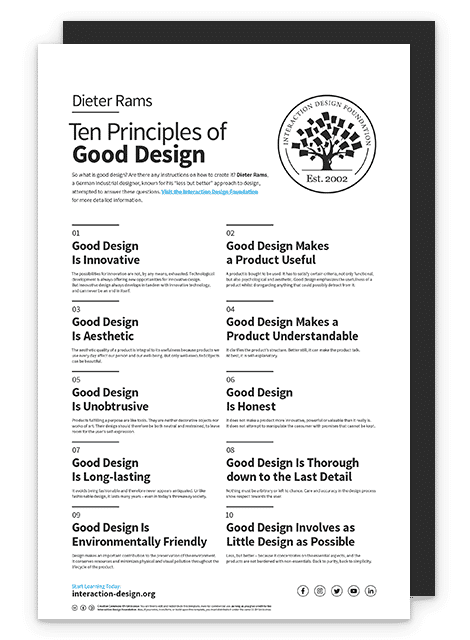
Advance Your Career With This Free Template for “Ten Principles of Good Design”
Ten Principles of Good Design
We respect your privacy
Get 1 powerful email each week: Design a life you love!

The Take Away

Good Design enables us to understand, communicate and improve the world around us. When done right, it has the power to improve the everyday lives of users. Dieter Rams’s 10 Principles of Good Design are proof of his minimalist and functional approach to design, but, more than that, they are proof of his professional stand. This is why we can easily make these principles our values, our philosophy of how design — hence, UX design — should be for any product or service.

“You cannot understand good design if you do not understand people.”

— Dieter Rams

We, as designers, need to be creative engineers who solve people’s needs and respect the 10 principles:

Good design is innovative. Good design must be useful. Good design is aesthetic design. Good design makes a product understandable. Good design is honest. Good design is unobtrusive. Good design is long-lasting. Good design is consistent in every detail. Good design is environmentally friendly. And, last but not least, good design is as little design as possible.

References and Where to Learn More

Learn more about the power of good design and Dieter Rams’s ideology at Vitsœ.

Watch the exciting documentary film, Rams, by Gary Hustwit and Film First.

Images

© Interaction Design Foundation, CC BY-SA 3.0

Topics in This Article

Learn More in This Course:

AI for Designers

11 days
13 % booked
View Course

What You Should Read Next

  • Read full article
    Bad Design vs. Good Design: 5 Examples We Can Learn From - Article hero image
    Interaction Design Foundation logo

    Bad Design vs. Good Design: 5 Examples We Can Learn From

    Looking at examples of bad design alongside counter-examples of good design is not only fun but also draws important lessons for designers. They highlight pitfalls for designers to avoid and let us understand how to translate design theories into solutions that work in the real world. Jared Spool, t

    Social shares
    1.5k
    Published
    Read Article
  • Read full article
    The Grid System: Building a Solid Design Layout - Article hero image
    Interaction Design Foundation logo

    The Grid System: Building a Solid Design Layout

    Now that we’ve seen some grids at work in the Rule of Thirds article, let’s examine them a little more deeply. As a concept that deals so fundamentally with the fabric and background of our work as designers, it’s easy to overlook the power of grids and think more about the elements we want to creat

    Social shares
    1.4k
    Published
    Read Article
  • Read full article
    The Key Elements & Principles of Visual Design - Article hero image
    Interaction Design Foundation logo

    The Key Elements & Principles of Visual Design

    Visual design is about creating and making the general aesthetics of a product consistent. To create the aesthetic style of a website or app, we work with fundamental elements of visual design, arranging them according to principles of design. These elements and principles together form the building

    Social shares
    1.4k
    Published
    Read Article
  • Read full article
    Dieter Rams: 10 Timeless Commandments for Good Design - Article hero image
    Interaction Design Foundation logo

    Dieter Rams: 10 Timeless Commandments for Good Design

    Let’s pay a virtual visit to a famous industrial designer’s workshop. By examining the principles of his winning approach, we can incorporate vital elements into our designs in the “less is more” age.As user experience practitioners, most of us have worked with Nielsen and Molich’s 10 heuristics or

    Social shares
    1.3k
    Published
    Read Article
  • Read full article
    UX Roles: The Ultimate Guide – Who Does What and Which One You Should Go For? - Article hero image
    Interaction Design Foundation logo

    UX Roles: The Ultimate Guide – Who Does What and Which One You Should Go For?

    Do you have the ambition and enthusiasm for a career in UX design but don’t know where to start? You’ll be pleased to know there are many paths you can take. Even as a relatively new field, user experience (UX) design has both general and specialist job roles. This variety means there is a role wait

    Social shares
    1.2k
    Published
    Read Article
  • Read full article
    The 10 Most Inspirational UI Examples in 2026 - Article hero image
    Interaction Design Foundation logo

    The 10 Most Inspirational UI Examples in 2026

    Users typically take just 50 milliseconds to assess the visual appeal of a website. The UI of your website has a massive impact on whether they choose to stay or depart, and it acts as the bridge between users and technology. Beyond visual appeal, its design and functionality often determine a platf

    Social shares
    1.1k
    Published
    Read Article
  • Read full article
    Complementary Colors: The Ultimate Guide in 2026 - Article hero image
    Interaction Design Foundation logo

    Complementary Colors: The Ultimate Guide in 2026

    Part of the magic of how colors work together in impressive designs lies in the art of color selection. Designers often use complementary colors to craft visually appealing and efficient UX (User Experience). Complementary colors sit on the opposite ends of the color wheel, such as orange and blue,

    Social shares
    1.1k
    Published
    Read Article
  • Read full article
    Symmetry vs. Asymmetry - Recalling basic design principles - Article hero image
    Interaction Design Foundation logo

    Symmetry vs. Asymmetry - Recalling basic design principles

    Now we’re going to look at two powerful design principles that may, at first glance, seem too simple and second nature to us to warrant too much thought. However, we would be wise not to underestimate their capabilities and the benefits of their effects. Always keeping a firm appreciation for symmet

    Social shares
    1.1k
    Published
    Read Article
  • Read full article
    Flow Design Processes - Focusing on the Users' Needs - Article hero image
    Interaction Design Foundation logo

    Flow Design Processes - Focusing on the Users' Needs

    It can be really tempting to start a design project by leaping into the deep end and starting to sketch out pages and work on the information architecture of the final product. However, it’s almost certainly the wrong approach to take. To create great user experiences – designers must focus on the u

    Social shares
    1k
    Published
    Read Article
  • Read full article
    Top 10 UI Trends Every Designer Should Know - Article hero image
    Interaction Design Foundation logo

    Top 10 UI Trends Every Designer Should Know

    People get easily bored with trends, and every few years, the pendulum swings from one way to another. We have all seen the rise and fall of iconic fashion pieces or art movements. The same thing happens in User Interface (UI) design. UI trends go from interfaces that mimic real-world objects to sup

    Social shares
    1k
    Published
    Read Article

Top Articles

Top Topic Definitions

Feel Stuck?
Want Better Job Options?

AI is replacing jobs everywhere, yet design jobs are booming with a projected 45% job growth. With design skills, you can create products and services people love. More love means more impact and greater salary potential.

At IxDF, we help you from your first course to your next job, all in one place.

See How Design Skills Turn Into Job Options
Privacy Settings
By using this site, you accept our Cookie Policy and Terms of Use.
Customize
Accept all

Be the One Who Inspires

People remember who shares great ideas.

Share on:

Academic Credibility — On Autopilot

Don't waste time googling citation formats. Just copy, paste and look legit in seconds.

Feel Stuck? Want Freedom?

Join 326,035+ designers who get one powerful email each week. Learn to design a life you love.

Next email in
1
day
10
hrs
17
mins
51
secs

Free forever. No spam. Unsubscribe anytime.