A young gamer with headphones on, visibly enjoying a gaming session, accompanied by the quote: "We play games for the pleasure of playing them."

Design for Joy: Why Games Break Traditional UX Rules

by Laia Tremosa • • 13 min read

209 Shares
Save

Think about the last time you played a game you loved. You weren't trying to "complete a task" or "finish efficiently." You were playing for the pure pleasure of it. That's the fundamental difference you'll learn as a game UX designer: Designing not for productivity, but for joy.

Imagine telling a traditional UX designer that you're going to deliberately slow users down, add obstacles they don't need, and make things harder on purpose. They'd think you're breaking every rule in the book. But in game UX? That approach powers the world's favorite pastime: video games, the most significant player in the entertainment industry, which brings in more than $280 billion a year, more than music and film combined.

In this video, Celia Hodent, PhD, Game UX Strategist and Author of the best-selling book The Gamer's Brain, explains why games must be more than just usable, and introduces the framework that will guide your design decisions throughout your career.

Transcript

Game UX Design vs. Traditional UX Design: Why You'll Design Differently

Let's establish what makes your work as a game UX designer different from traditional UX design.
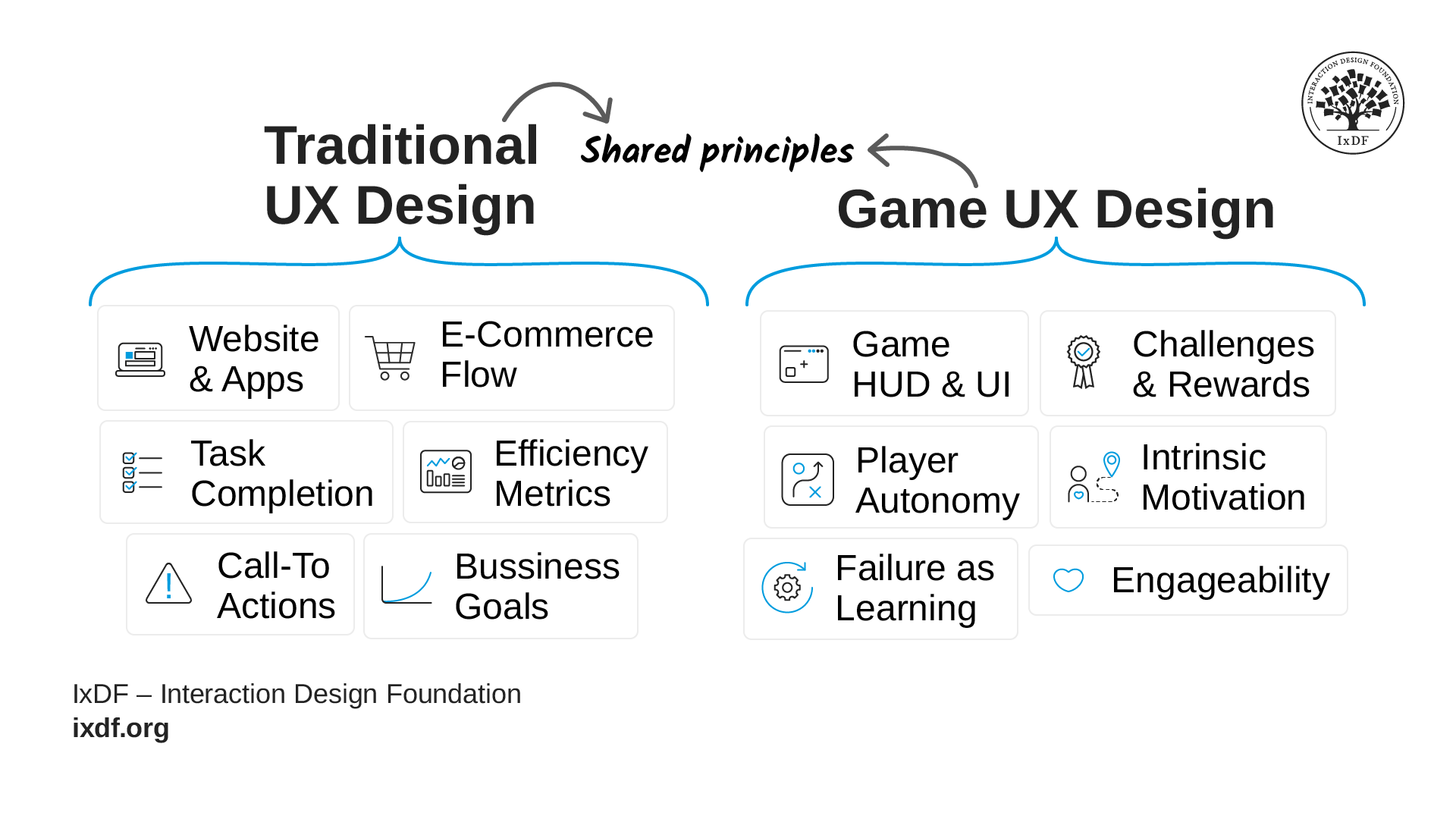
A diagram comparing Traditional UX Design qualities on the left and Game UX Design qualities on the right, with their shared principles bridging the two in the middle.

© Interaction Design Foundation, CC BY-SA 4.0

Traditional UX design helps users accomplish tasks like pay a bill, book a flight, or find information as smoothly and efficiently as possible. Success means you remove friction, speed things up, and minimize effort. Users want to get in, accomplish their goal, and get out.

As a game UX designer, you'll design for a different purpose entirely. As Celia explains in the video, "We don't play video games to accomplish a task as we would with software and many apps; we play games for the pleasure we get when we play them."

This fundamental difference changes how you approach UX design:

  • Traditional UX removes obstacles. You'll create obstacles that are worth the effort to overcome.

  • Traditional UX optimizes for efficiency. You'll optimize for satisfaction.

  • Traditional UX minimizes mental effort. You'll balance challenge with capability.

Think about Mario Kart. The chaos of banana peels and red shells creates friction, but it's intentional. That friction generates the thrill and the tension of barely staying in first place.

Of course, games still need to be usable. Players need clear controls and intuitive interfaces to be able to enjoy the experience. But usability isn't enough. You'll also need to design for engagement. Celia's engageability framework helps you break down engagement into three concrete elements you can design for: Motivation (why players engage), Emotion (what they feel), and Flow (staying focused).

This way, when a playtester says "this isn't fun," you'll know what questions to ask:

  • Is the motivation clear?

  • Is this the right emotion for the moment?

  • Does the difficulty match their skill?

The Take Away

Traditional UX and game UX both care about the user, but they often work toward different goals. In traditional UX, you usually help people accomplish a task with less unnecessary effort. In game UX, usability is still essential, as without clear controls and intuitive interfaces, players can't access your game. But, you also need to take engagement into account. With Celia's engageability framework you'll look at motivation, emotion, and flow, so you can break engagement down into specific elements that you can design for.

A player may only be able to tell you the game doesn't feel right. As a game UX designer, your job is to understand what's behind that reaction and help the team decide what to change.

References and Where to Learn More

Want more? If you haven't already, sign up for Game UX Design: The Ultimate Guide to learn directly from Celia Hodent, PhD, former Fortnite UX Director, and author of the best-seller The Gamer's Brain.

Read The Gamer's Brain by Celia Hodent.

Watch the How to Design for the Human Mind: Cognitive Science for UX Master Class by Celia Hodent.

Watch the How to Become a Games User Researcher Master Class by Steve Bromley, Games Researcher and Author.

Watch the AI for Game UX: Speed Up Research, Ideas, and Prototypes Master Class by Om Tandon, UX Design Leader at Nordeus (Zynga/Take-Two).

Watch the Level Up Your Career: How to Land a Job in the Game Industry Master Class with Om Tandon, UX Design Leader at Nordeus (Zynga/Take-Two).

Watch the UI Design for Games: Starter Edition Master Class with Stéfano Girardelli, Senior Visual Designer at Wildlife Studios.

To learn more about play, visit the "Library of Play" website.

Hero image: © Interaction Design Foundation, CC BY-SA 4.0

Learn More in This Course:

User Experience: The Beginner's Guide

1 day
64
Lessons

Learn Design and AI From the Best

Get one powerful email each week, like 315,178 others.

Next email in:

What You Should Read Next

  • Read full article
    Design League Savings, AI Tutor, and Pricing Updates - Article hero image

    Design League Savings, AI Tutor, and Pricing Updates

    Rikke and I started IxDF in 2002 with nothing. We lived in a bamboo hut in Thailand with no investors, no safety net, and no plan B. We had a conviction that world-class design education should not be a privilege reserved for people who could afford a $15,000 degree.That conviction has never changed

    Social shares
    84
    Published
    Read Article
  • Read full article
    AR Heuristics to Avoid Common UX Pitfalls - Article hero image

    AR Heuristics to Avoid Common UX Pitfalls

    User testing may be the final word in usability, but usability guidelines, or "heuristics," are rubrics designers use to evaluate their designs. These guidelines are the product of decades of research and experience. They have traditionally been applied to mobile or desktop interfaces but were updat

    Social shares
    517
    Published
    Read Article
  • Read full article
    15 Inspiring UX Quotes for Innovation and Design - Article hero image

    15 Inspiring UX Quotes for Innovation and Design

    In design—and anywhere else that innovation is involved—words can often paint a picture far more vividly than strokes on a canvas ever could, and that’s true in UX design (user experience design), where inspiration often comes from straightforward phrases. These brief quotes are way more than just w

    Social shares
    823
    Published
    Read Article
  • Read full article
    Graphic Artist vs. Graphic Designer: What's the difference? - Article hero image

    Graphic Artist vs. Graphic Designer: What's the difference?

    Graphic art versus graphic design is pretty much still a bone of contention, and that’s after a long-standing debate that just keeps going on and on—more a source of intrigue than anything negative. Some believe the two overlap with a great deal of things that are interchangeable between them—but, f

    Social shares
    882
    Published
    Read Article
  • Read full article
    Spatial UI Design: Tips and Best Practices - Article hero image

    Spatial UI Design: Tips and Best Practices

    UX design for Augmented Reality (AR) has some different guidelines than what is used for screen-based UX. Designers must consider the space and the physical limits of what is comfortable for the human body. Also, as AR overlays physical space, you must be very aware of the cognitive load because you

    Social shares
    660
    Published
    Read Article
  • Read full article
    Object-Oriented UI Design: How You Can Collaborate Seamlessly with Developers and Build Better Products - Article hero image

    Object-Oriented UI Design: How You Can Collaborate Seamlessly with Developers and Build Better Products

    You’re at your routine health checkup, sipping an iced coffee on a hot day. Suddenly, you get a sharp pain in your head. The doctor looks up from her notes, a sympathetic expression on her face. “You’re experiencing sphenopalatine ganglioneuralgia.” Your heart sinks. The coffee cup drops to the floo

    Social shares
    148
    Published
    Read Article
  • Read full article
    Copy These 3 Industry-Leading Apps and Turn Object-Oriented Design into Your Secret Career Advantage - Article hero image

    Copy These 3 Industry-Leading Apps and Turn Object-Oriented Design into Your Secret Career Advantage

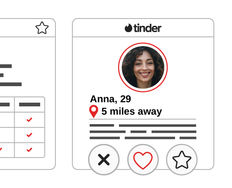
    Which apps do you use throughout your day? Maybe you manage your projects on Trello, use Notion as an internal docs site, and maybe, just maybe, you do some swiping on Tinder during your lunch break. Despite looking nothing alike, these three highly successful apps are organized around the same idea

    Social shares
    141
    Published
    Read Article
  • Read full article
    7 Reasons Object-Oriented UI Design Will Grow Your Career - Article hero image

    7 Reasons Object-Oriented UI Design Will Grow Your Career

    Vacation time! You book your flight. You have a reservation. It's real. You paid for it. And yet, when you open the airline's app to look at it, it's surprisingly elusive. You don't want to check in, you don't want to change it, you just want to find it and check the details. It's not on the home sc

    Social shares
    141
    Published
    Read Article
  • Read full article
    Should UX Designers Learn to Code? - Article hero image

    Should UX Designers Learn to Code?

    As with every design decision, the answer to the question “Should UX designers learn to code?” is: “It depends.” When you work with digital products, you may not always need to write lines of code, but it is an added advantage to know how to build the product that you design.In the early days of web

    Social shares
    672
    Published
    Read Article
  • Read full article
    What are the Stages of Creativity? - Article hero image

    What are the Stages of Creativity?

    Let’s explore the various stages of creativity so you can get a firmer idea of its true nature as such a powerful human resource. Graham Wallas was the first to create an overview of a creative process back in 1926. As you can imagine, lots of iterations have emerged since then. Some of these theori

    Social shares
    1.1k
    Published
    Read Article

Top Articles

Top Topic Definitions

39% of Today's Skills Will Change by 2030

The World Economic Forum expects 39% of today's skills to be transformed or become outdated by 2030.

The good news is that jobs in UX / UI design and AI are among the fastest-growing professions globally.

Build Skills That Keep You Relevant

Privacy Settings

By using this site, you accept our Cookie Policy and Terms of Use.
Customize
Accept all

Be the One Who Inspires

People remember who shares great ideas.

Share on:

Academic Credibility — On Autopilot

Don't waste time googling citation formats. Just copy, paste and look legit in seconds.

Learn Design and AI From the Best

Get one powerful email each week, like 315,178 others.

Next email in: