Creativity is a process designers use to drive their abilities towards making artistic innovations (regarding aesthetics) and technical ones (about tackling design problems). Vital in ideation, creativity involves diversity and structure, splits into stages and types, is learnable and has a variety of methods to try.
See what creativity involves as a vital ingredient in design.
There’s More than Meets the Eye to Creativity
Generally, Creativity is often mislabeled as a phenomenon rather than a process, and classic misconceptions about it include:
Only imaginative individuals can produce good, unique and useful ideas.
The artistic, right-side brain governs creativity.
In user experience (UX) design, creativity is closely linked with innovation and—rather than be a natural-born talent—it involves a set of techniques and approaches anyone can learn. Because users’ problems are typically complex and intricately linked to the many contexts they find themselves in, the ideas designers strive for to solve these rarely “just happen”. Indeed, there’s a formula for creativity:
Creativity = Diversity + Structure
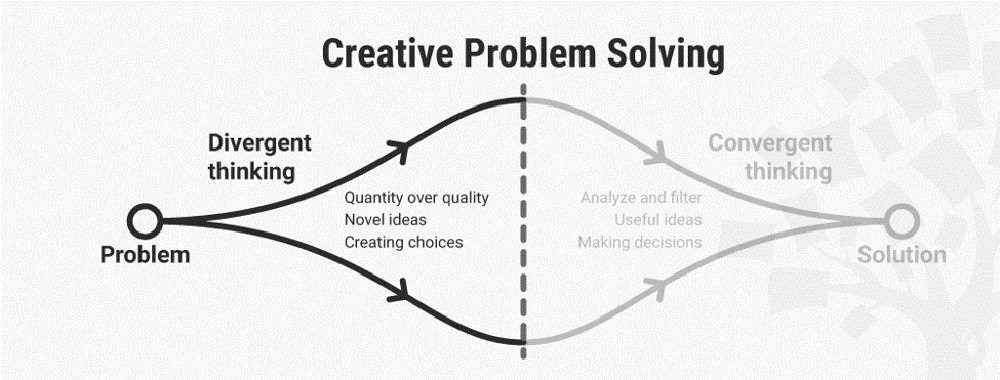
So, you can train your mind to be more creatively productive, leveraging techniques that expand in scale from simple methods up to the creativity-nurturing routine and environment you choose. Creative mindsets can seem anarchic and unruly, but there’s always a method to the madness involved somewhere (along with stages of creativity to grasp). Particularly, it’s important to learn how to tap into divergent thinking—to explore the horizon, including the wild, weird and downright wacky ideas—and then fine-tune your view of what might actually work using convergent thinking. Overall, creative ideas must be novel (i.e., involving a level of novelty that goes beyond anything you knew before making discoveries) and useful (i.e., truly practical for you to develop and ultimately beneficial to your users).
© Teo Yu Siang and Interaction Design Foundation, CC BY-NC-SA 3.0
Types of Creativity
Discover how various types of creativity apply to design.
Creativity divides into two chief spheres that share certain areas:
Artistic creativity
Technical creativity
You would use this to (e.g.) design an attractive logo.
You would use this to (e.g.) solve a problem or put together a strategy as you explore (and push at the edges of) the design space.
Renowned cognitive scientist Margaret Boden has classified two additional types of creativity:
H-creativity: historic creativity
P-creativity: personal creativity
New for humanity, such as first-in-the-world discoveries (e.g., the smartphone).
Something that’s new for the person who makes the discovery. P-creativity is what you use when addressing a specific problem. Whether or not your idea becomes a “world first” is another matter, but H- and P-creativity do share common ground when designers make personal discoveries that later become historically important advances.
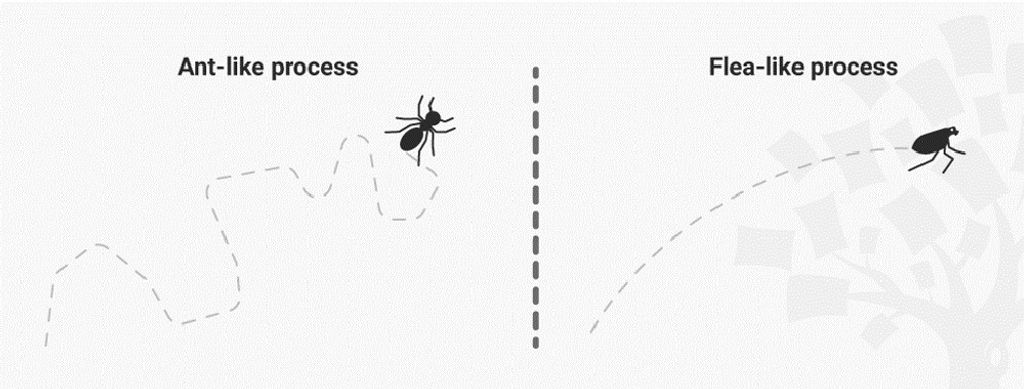
From a process aspect, we can add a further pair of types of creativity, as defined by Alan Dix:
Ant-like creativity
Flea-like creativity
You take small and many iterative steps that collectively lead to a novel and useful design. Working carefully, you’ll typically have a solution in sight from early on and leverage convergent thinking to evolve your idea incrementally in a number of versions towards it.
You think wide and wild and jump at an idea that seems revolutionary. It’s the bold type of creativity—and hence often means you’ll go down the wrong avenues searching for optimal solutions—but risks can pay off and unlock doors to reveal radically brilliant insights and solutions.
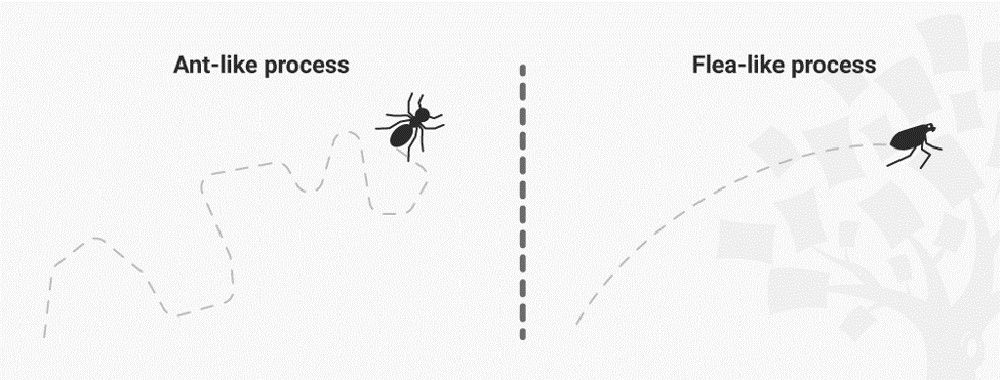
© Teo Yu Siang and Interaction Design Foundation, CC BY-NC-SA 3.0
Tips for Getting Creative
To set out on a fresh pathway and journey towards truly unique and innovative ideas, you have a variety of options to explore (including learning how to overcome bias). It’s perfectly human to experience creative blocks, however, so here are some important things to consider:
Quantity breeds quality – “More is more” in terms of idea generation. Brainstorming, for example, frees you to thoroughly investigate every possible dimension where a great solution might exist, no matter how silly things may first appear.
Look within – Get in touch with your inner self by listing pain points, etc.; which pain points could you solve and how?
Look without – Make detailed observations of what’s going on around you (e.g., your office) and describe or sketch others and what they’re doing.
Break your habits/routine – Change something about your day-to-day life and examine any differences that arise from it. This can encourage the creative juices to flow.
Stop thinking – Just shut off and see if a distraction (e.g., a long walk) breaks the block.
Smother bad ideas – In the pursuit of sheer quantity over quality, sometimes you can bury yourself under an avalanche of thought relating to even just one bad idea. Try getting tough with it to see if it’s actually worth the effort. Maybe it is of questionable value. However, perhaps you can find good aspects or “secret staircases” within it that can take you up or down a level to reveal fresh insights.
Overall, allow yourself to fail – as creativity is an iterative (and enjoyably rewarding) learning process. Sooner or later, you’ll find yourself getting better at exploring your design space, finding intriguing hidden aspects of a problem, learning from mistakes along the way and, ultimately, tightening your grasp as you get a handle on what users really want from a product or service.
"Creativity is intelligence having fun."
— Albert Einstein