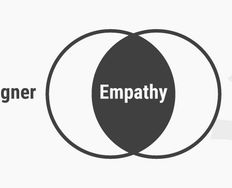
A group of five people, but only one is in focus. It is accompanied by the text, “Empathy is geared toward individuals.”

How Personas Shape Stronger Design Decisions

by William Hudson • 16 min read

413 Shares

Why bother with personas? Why not "users"? Because the way you see someone shapes the way you design for them. We are accustomed to referring to people by their roles, but this practice is dehumanizing. When you use role labels, you quickly forget that these are real people, just like your family or friends. And just like your acquaintances, these real people have different abilities, behaviors, and needs.

There is good psychological evidence that our brains are wired to empathize more easily with individuals than with groups. In this video, William Hudson, User Experience Strategist and Founder of Syntagm Ltd, presents the evidence.

Transcript

When you design for a specific person, the benefits don’t stop with psychological effects. If you treat your personas as individuals, you will make them more concrete in terms of the needs and behaviors you've established through research. Otherwise, "users" as a group are infinitely flexible! That's why you quickly lose focus when you design for users rather than personas.

Cognitive Empathy: Why Personas Matter

Cognitive empathy, the appreciation that other people may see or understand things differently, is also a human characteristic that comes into play. The phrase "you are not the user" captures a persistent issue in creating user-centered products and services.

“You are not the user” can be a challenging idea for software development teams or technology-driven organizations. In this video, William discusses his research on cognitive empathy in the IT industry.

Transcript

As mentioned in the video, William used standardized questionnaires from autism research for his study. He discovered that people who work on the more technical side of IT exhibit lower cognitive empathy. The questionnaires measured empathy as the "EQ," or empathy quotient.

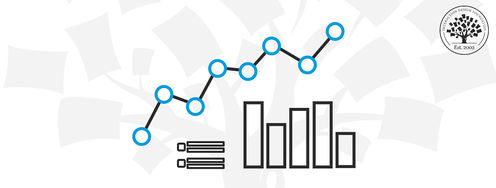
The original study, summarized below, shows a distinct downward trend for EQ as participants moved into more technology-oriented roles. Conversely, the systemizing quotient, "SQ," is higher for men and women who identify as working primarily in technical roles within IT.

This discovery aligns with expectations, except for the final point on the P-T (People-Technology) scale for women. Here, we see a sudden drop in both EQ and SQ. The anomaly may be due to the relatively small number of women working primarily in technology. The situation is further complicated by the social pressures on women to be empathetic and sociable, an issue William discusses in the article Asperger's Syndrome, Autism and Camouflaging.

The original study and the later article are in the references section below.
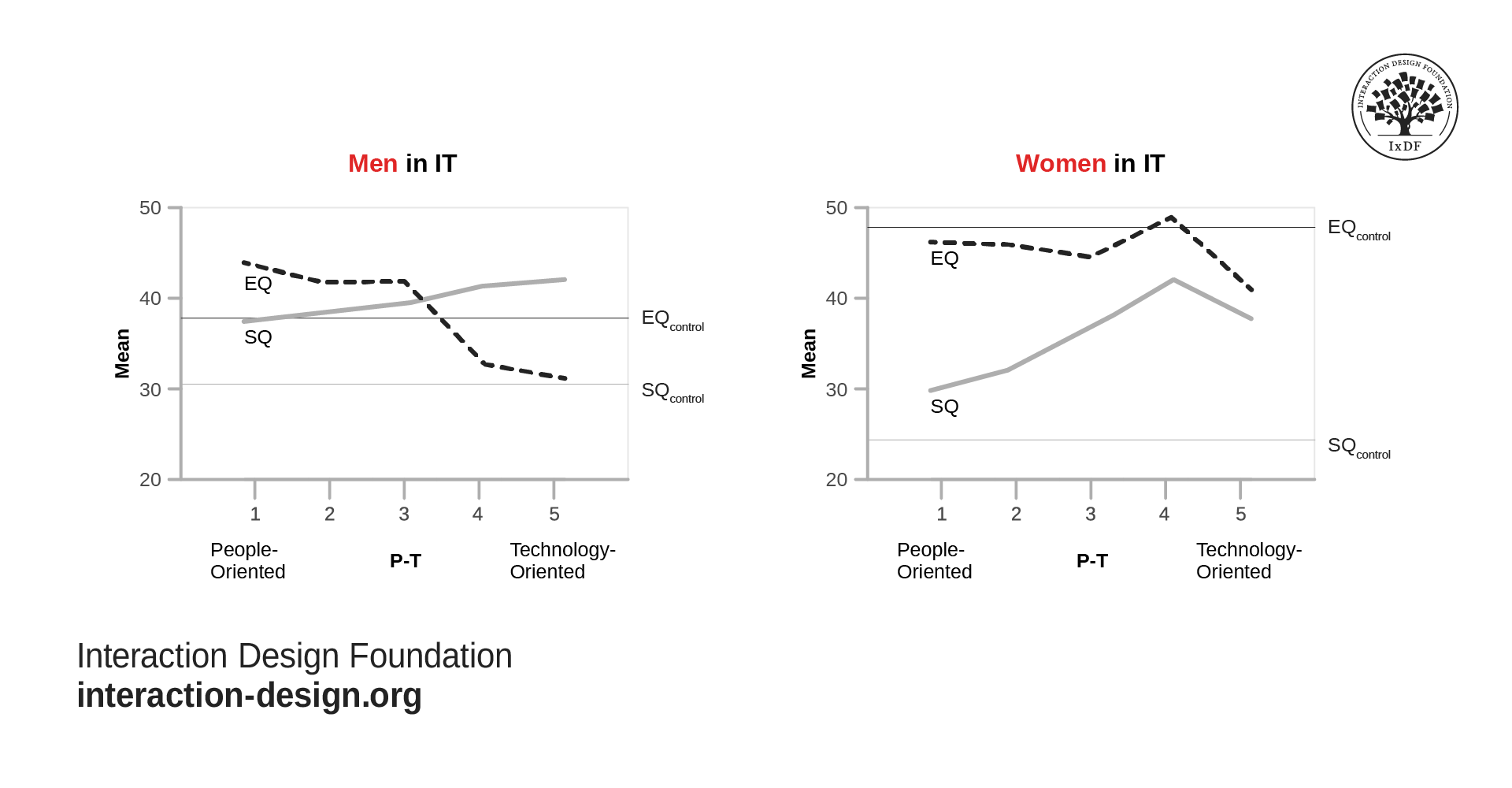
William’s study showed that men with more technology-oriented roles in the IT industry demonstrated lower cognitive empathy in self-reported assessments. The results for women with more technology-oriented roles are inconclusive, likely due to the low number of technology-oriented respondents.

© Interaction Design Foundation, CC BY-SA 4.0

The Take Away

As designers, we solve problems for humans—real, complex humans with individual behaviors and needs. This is why we advocate for personas. They are a crucial tool in user-centered design, helping shift away from the generic and impersonal "users" to a more specific, individualized approach. There are several justifications for this from a psychological perspective:

  • Human empathy is associated with individuals, not groups.

  • Team members may have conflicting or unrealistic ideas about the needs and behaviors of users.

  • Research shows that individuals in technology-focused roles may struggle to recognize that not everyone shares their level of technical skills and understanding.

Personas help address these issues. They make users more real, with specific behaviors and needs, and are designed to emphasize a solution's important features. This emphasis makes it easier to prioritize limited development resources.

References and Where to Learn More

Read William’s original research findings and analysis on how Reduced Empathizing Skills Increase Challenges for User-Centered Design

Explore William’s follow-up article, Asperger's Syndrome, Autism, and Camouflaging: Reduced Empathy Revisited

Discover the person-positivity bias in David Sears’s paper from the Journal of Personality and Social Psychology.

Learn from Loran F. Nordgren and Mary-Hunter Morris McDonnell about The Scope-Severity Paradox and Why Doing More Harm Is Judged to Be Less Harmful.

Hero image: © Interaction Design Foundation, CC BY-SA 4.0

Learn More in This Course:

Personas and User Research: Design Products and Services People Need and Want

0
1
24
7
98 % booked
View Course

What You Should Read Next

  • Read full article
    The 5 Stages in the Design Thinking Process - Article hero image
    Interaction Design Foundation logo

    The 5 Stages in the Design Thinking Process

    Design thinking is a methodology that provides a solution-based approach to solving problems. It’s extremely useful when used to tackle complex problems that are ill-defined or unknown—because it serves to understand the human needs involved, reframe the problem in human-centric ways, create numerou

    Social shares
    2k
    Published
    Read Article
  • Read full article
    Empathy Map – Why and How to Use It - Article hero image
    Interaction Design Foundation logo

    Empathy Map – Why and How to Use It

    Here’s an interesting fact you may—or may not—know: users are more likely to choose, buy, and use products that meet their needs than products that just meet their wants. And an Empathy map will help you understand your user’s needs while you develop a deeper understanding of the persons you’re desi

    Social shares
    1.4k
    Published
    Read Article
  • Read full article
    Stage 1 in the Design Thinking Process: Empathise with Your Users - Article hero image
    Interaction Design Foundation logo

    Stage 1 in the Design Thinking Process: Empathise with Your Users

    Design Thinking cannot begin without a deeper understanding of the people you are designing for. In order to gain those insights, it is important for you as a design thinker to empathize with the people you’re designing for so that you can understand their needs, thoughts, emotions and motivations.

    Social shares
    1.3k
    Published
    Read Article
  • Read full article
    What Is Empathy and Why Is It So Important in Design Thinking? - Article hero image
    Interaction Design Foundation logo

    What Is Empathy and Why Is It So Important in Design Thinking?

    It’s fairly safe to assume you want your products to actually work, right? Then you need to start the design process with empathy — one of the most important elements in both design thinking and the wider area of human-centered design. But what is empathy exactly, and why is it so vital? Let’s take

    Social shares
    1.3k
    Published
    Read Article
  • Read full article
    14 UX Deliverables: What will I be making as a UX designer? - Article hero image
    Interaction Design Foundation logo

    14 UX Deliverables: What will I be making as a UX designer?

    What does a UX designer actually produce? Here, we will explore the concept of UX deliverables, a term that describes the outputs of a UX design process during its various stages. The deliverables produced by UX designers vary according to their role in the design team and also depending on the meth

    Social shares
    1.2k
    Published
    Read Article
  • Read full article
    Data Analysis: Techniques, Tools, and Processes - Article hero image
    Interaction Design Foundation logo

    Data Analysis: Techniques, Tools, and Processes

    Data analysis is one of those terms that “is what it sounds like,” although there’s more to it than may meet the eye. In any case, it’s a valuable skill for making better decisions—a skill that you can bring to bear on both your professional and personal life, from personal budgeting to analyzing cu

    Social shares
    1.2k
    Published
    Read Article
  • Read full article
    10 Insightful Design Thinking Frameworks: A Quick Overview - Article hero image
    Interaction Design Foundation logo

    10 Insightful Design Thinking Frameworks: A Quick Overview

    If you’ve just started to embark on your journey into the field of design thinking, you may have noticed different frameworks cropping up here and there. This is nothing to worry about—it’s simply the result of different people’s perceptions of the design thinking process. To help you get your head

    Social shares
    1.2k
    Published
    Read Article
  • Read full article
    Flow Design Processes - Focusing on the Users' Needs - Article hero image
    Interaction Design Foundation logo

    Flow Design Processes - Focusing on the Users' Needs

    It can be really tempting to start a design project by leaping into the deep end and starting to sketch out pages and work on the information architecture of the final product. However, it’s almost certainly the wrong approach to take. To create great user experiences – designers must focus on the u

    Social shares
    1k
    Published
    Read Article
  • Read full article
    How to Develop an Empathic Approach in Design Thinking - Article hero image
    Interaction Design Foundation logo

    How to Develop an Empathic Approach in Design Thinking

    Empathy requires us to put aside our learning, culture, knowledge, opinions, and worldview purposefully in order to understand other peoples’ experiences of things deeply and meaningfully. It requires a strong sense of imagination for us to be able to see through another person’s eyes. It requires h

    Social shares
    1k
    Published
    Read Article
  • Read full article
    User Experience (UX) Surveys: The Ultimate Guide - Article hero image
    Interaction Design Foundation logo

    User Experience (UX) Surveys: The Ultimate Guide

    Imagine you’re a business owner who wants to know what’s working and what’s not on your website—and, oh yes, where you need improvements. Sure, there are a bunch of research methods you can try—like user interviews, usability tests, and A/B testing, but read on and see how a user experience (UX) sur

    Social shares
    1k
    Published
    Read Article

Top Articles

Top Topic Definitions

Feel Stuck?
Want Better Job Options?

AI is replacing jobs everywhere, yet design jobs are booming with a projected 45% job growth. With design skills, you can create products and services people love. More love means more impact and greater salary potential.

At IxDF, we help you from your first course to your next job, all in one place.

See How Design Skills Turn Into Job Options
Privacy Settings
By using this site, you accept our Cookie Policy and Terms of Use.
Customize
Accept all

Be the One Who Inspires

People remember who shares great ideas.

Share on:

Academic Credibility — On Autopilot

Don't waste time googling citation formats. Just copy, paste and look legit in seconds.

Feel Stuck? Want Freedom?

Join 326,029+ designers who get one powerful email each week. Learn to design a life you love.

Next email in
1
day
13
hrs
24
mins
8
secs

Free forever. No spam. Unsubscribe anytime.