Celia Hodent stands center-frame against a blue-and-purple-lit brick wall, with four floating screens around her showing scenes from films and games she's about to reference

Long-Term Memory: What Players Recall vs. What They Do Automatically

by Laia Tremosa • • 14 min read

209 Shares
Save

You haven't played Street Fighter in years. Someone hands you a controller and asks you to execute that combo you used to nail every time. You can't remember the button labels. You couldn'texplain the sequence if you tried. But your fingers? They remember. They execute the combo perfectly without conscious thought.

That's the difference between explicit memory (facts that can fade fast without use) and implicit memory (skills that may stick longer even when you haven't practiced in years).

In this video, Celia Hodent, PhD, Game UX Strategist and Author of the best-selling book The Gamer's Brain, shares how long-term memory works and why players might forget recent tutorials but remember combos they practiced years ago.

Copyright
Transcript

The Street Fighter example shows what those two types of long-term memory look like in practice. To sum up:

  • Explicit memory is the memory for events, souvenirs, and facts players can recall, such as what each icon means, where that rare item is, or the plot twist they can't stop thinking about.

  • Implicit memory is the memory for actions (muscle memory) and skills we can perform automatically without thinking; for instance, pulling off a dodge at the perfect moment or chaining that fighting-game combo like a pro.

© Interaction Design Foundation, CC BY-SA 4.0

Long-term memory operates through two systems. Explicit memory supports what players can recall, such as facts, events, and what an icon means. Implicit memory supports what players can do automatically, such as dodging, aiming, or executing a combo without thinking through every step.

How to Design for Long-Term Memory

Here's how to design with long-term memory in mind:

  • Support explicit memory through clear explanations and periodic reminders. Minimize what players have to remember by keeping critical information visible and accessible. For example, you could display button prompts when players need them, show objectives on the HUD, and remind players of relevant mechanics or systems they haven't used recently.

  • Support implicit memory through repeated practice in varied contexts. Players can't learn implicit skills from explanations alone. They have to practice until the action becomes automatic. Give players multiple opportunities to practice the same action in different situations. A dodge mechanic practiced against slow projectiles, then faster enemies, then during boss fights reinforces the skill more effectively than a single tutorial prompt. Space out practice across different challenges so the skill becomes automatic through repetition.

© Interaction Design Foundation, CC BY-SA 4.0

Design tutorials that support both implicit and explicit memory. Show players what to do (explicit: "Press X to dodge"), then make them do it in a safe, low-pressure environment. Once they'vesucceeded a few times, weave that action into varied gameplay situations.

Use this cheat sheet to design with long-term memory in mind.
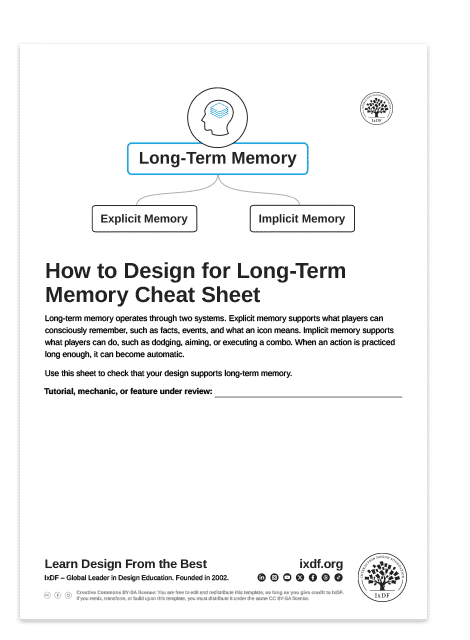
Advance Your Career With This Free Template for “Long Term Memory Cheat Sheet”
Long Term Memory Cheat Sheet
Optional
Optional
We respect your privacy
Get 1 powerful email each week: Learn Design and AI From the Best.

The Take Away

Long-term memory operates through two systems, and each one calls for a different design approach. Explicit memory stores facts players recall (button functions, objectives), while implicit memory stores actions they perform automatically (combo execution, dodge timing).

You can support explicit memory through clear explanations and visible reminders so critical information stays accessible, and implicit memory through repeated practice in varied contexts so skills can become automatic. If you design tutorials that address both, players will have a much better chance of retaining what to do and executing it without conscious thought. Furthermore, implicit memory can be especially durable: players who practiced a skill enough may still be able to perform it years later, even if they can't remember the button labels.

References and Where to Learn More

Want more? If you haven't already, sign up for Game UX Design: The Ultimate Guide to learn directly from Celia Hodent, PhD, former Fortnite UX Director, and author of the best-seller The Gamer's Brain.

Read The Gamer's Brain by Celia Hodent.

Watch the How to Design for the Human Mind: Cognitive Science for UX Master Class by Celia Hodent.

Watch the How to Become a Games User Researcher Master Class by Steve Bromley, Games Researcher and Author.

Watch the AI for Game UX: Speed Up Research, Ideas, and Prototypes Master Class by Om Tandon, UX Design Leader at Nordeus (Zynga/Take-Two).

Watch the Level Up Your Career: How to Land a Job in the Game Industry Master Class with Om Tandon, UX Design Leader at Nordeus (Zynga/Take-Two).

Watch the UI Design for Games: Starter Edition Master Class with Stéfano Girardelli, Senior Visual Designer at Wildlife Studios.

Hero image: © Interaction Design Foundation, CC BY-SA 4.0

Learn More in This Course:

Learn Design and AI From the Best

Get one powerful email each week, like 313,262 others.

Next email in:

What You Should Read Next

  • Read full article
    Structure First: The Inverted Pyramid and Visual Organization - Article hero image

    Structure First: The Inverted Pyramid and Visual Organization

    This clip examines two principles that work hand in hand to make web content readable: the inverted pyramid approach to information order and the use of visual structure to help users scan efficiently. William Hudson, UX Strategist and Founder of Syntagm Ltd, describes the theoretical basis and prac

    Social shares
    125
    Published
    Read Article
  • Read full article
    What Is Card Sorting? - Article hero image

    What Is Card Sorting?

    In this video, William Hudson, UX Strategist and Founder of Syntagm Ltd, introduces card sorting: what it is, where it comes from, and the broad range of problems it can help solve.Card sorting is a research technique in which participants organize a set of items into groups that make sense to them,

    Social shares
    110
    Published
    Read Article
  • Read full article
    Design Accessible Navigation for Keyboards and Screen Readers - Article hero image

    Design Accessible Navigation for Keyboards and Screen Readers

    Accessibility is often treated as a finishing touch, but for navigation, it belongs at the foundation. Menus are how users reach everything else on a site, so a menu that works only with a mouse quietly shuts out anyone who depends on a keyboard, a screen reader, or another form of assistive technol

    Social shares
    114
    Published
    Read Article
  • Read full article
    The Scent of Information: Give Users the Confidence to Click - Article hero image

    The Scent of Information: Give Users the Confidence to Click

    William Hudson, UX Strategist and Founder of Syntagm Ltd, introduces the scent of information as a model for understanding how users navigate toward their goals, and sets out the principles for writing navigation links that strengthen that scent.Information Foraging and the Scent of InformationThe s

    Social shares
    113
    Published
    Read Article
  • Read full article
    4 UI Design Tips Every Designer Needs to Know - Article hero image

    4 UI Design Tips Every Designer Needs to Know

    User interface (UI) design can make or break any digital product. A user often won’t even notice when they interact with a great UI. They feel the visual appeal and simply trust it. On the contrary, a bad UI design can prevent the user from interacting with a product intuitively or at all and lead t

    Social shares
    644
    Published
    Read Article
  • Read full article
    How to Design Use Cases in UX - Article hero image

    How to Design Use Cases in UX

    Imagine a new mobile app or an e-commerce site gets launched; it looks great, sure, and it should be a hit because it at least looks like it’s got what it takes, but—drumroll—it tanks in the marketplace, all because people find it hard to complete even the simplest tasks. That’s rough, but—behind th

    Social shares
    802
    Published
    Read Article
  • Read full article
    How to Become a Product Manager: Best Career Advice - Article hero image

    How to Become a Product Manager: Best Career Advice

    Pick any product and you’ll find that product management is vital to how successful it is—and product managers are who make sure that a product’s life cycle runs smoothly, and it means they know how to align strategy, vision, and user needs. Product managers split into multiple roles that have got u

    Social shares
    600
    Published
    Read Article
  • Read full article
    Bad UX Exposed: A Comprehensive Guide to Avoiding Pitfalls - Article hero image

    Bad UX Exposed: A Comprehensive Guide to Avoiding Pitfalls

    In today’s vibrant digital design landscape, creating meaningful connections with users goes beyond offering innovative products or services. It leads us into the world of user experience design (or UX design). This critical factor shapes our interaction with the users and plays a big role in making

    Social shares
    974
    Published
    Read Article
  • Read full article
    Understand the Various Types of Creativity - Article hero image

    Understand the Various Types of Creativity

    When you want to be more creative, you’ll want to learn the techniques for creative thinking and understand the various forms of creativity and creative processes. This video will give you an overview of some of the different forms of creativity. For example, you’ll learn that there are two types of

    Social shares
    574
    Published
    Read Article
  • Read full article
    Design Podcasts to Learn UX on the Go - Article hero image

    Design Podcasts to Learn UX on the Go

    As digital designers, we know the bulk of our day is spent looking at screens. Give your eyes some rest, and tune into podcasts instead. They are a great way to stay updated, gain insights, be inspired or experience “A-ha” moments. The best part about podcasts is that unlike reading or watching vide

    Social shares
    641
    Published
    Read Article

Top Articles

Top Topic Definitions

39% of Today's Skills Will Change by 2030

The World Economic Forum expects 39% of today's skills to be transformed or become outdated by 2030.

The good news is that jobs in UX / UI design and AI are among the fastest-growing professions globally.

Build Skills That Keep You Relevant

Privacy Settings

By using this site, you accept our Cookie Policy and Terms of Use.
Customize
Accept all

Be the One Who Inspires

People remember who shares great ideas.

Share on:

Academic Credibility — On Autopilot

Don't waste time googling citation formats. Just copy, paste and look legit in seconds.

Learn Design and AI From the Best

Get one powerful email each week, like 313,262 others.

Next email in: