UX Cover Letters

Your constantly-updated definition of UX Cover Letters and collection of videos and articles.
Be a conversation starter: Share this page and inspire others!

98 Shares

What are UX Cover Letters?

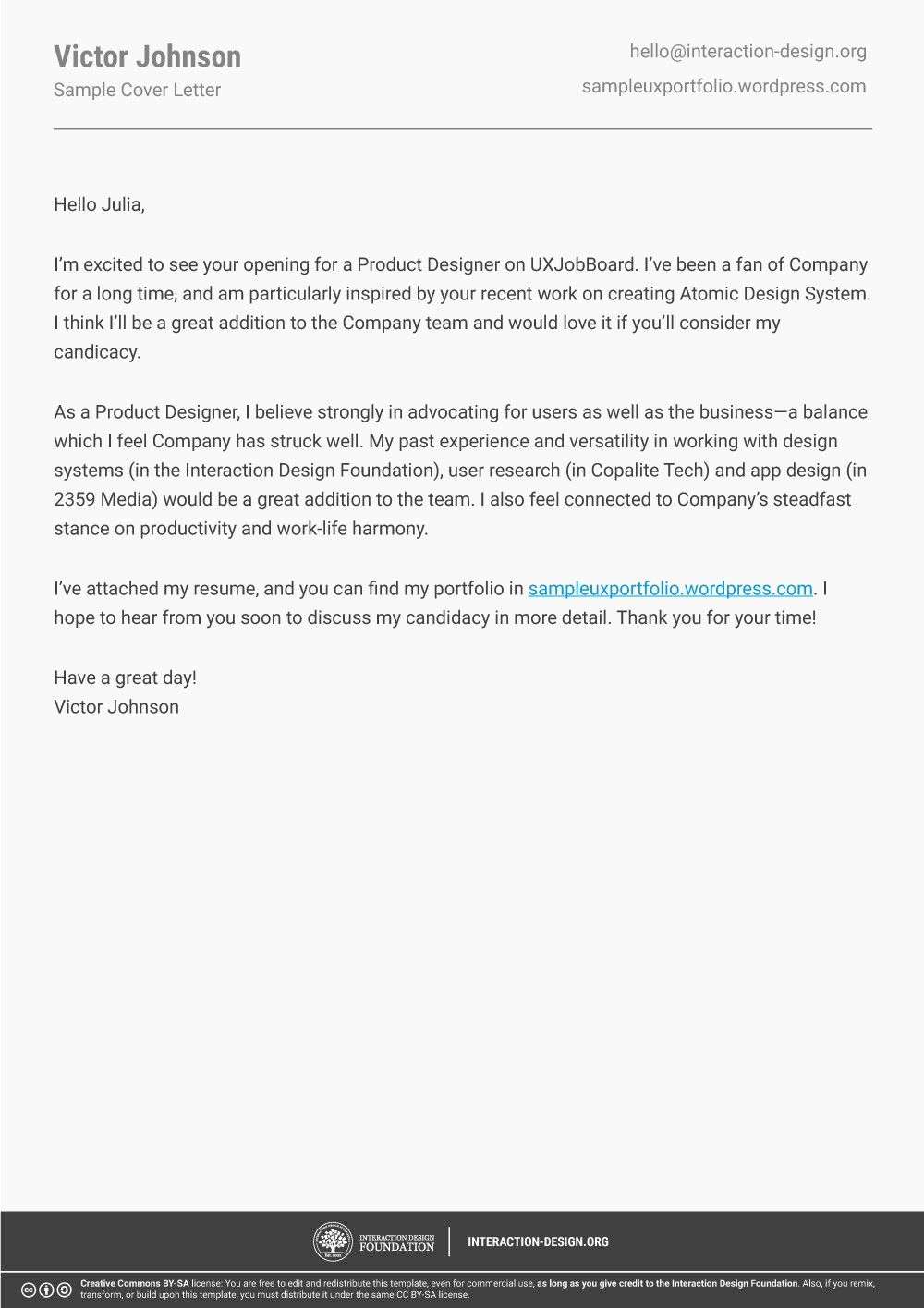
UX cover letters are short letters or emails that designers send with their portfolios and resumes to apply for jobs. Designers personalize these to introduce themselves and briefly explain why they are a good fit for the business. These cover letters or emails often give recruiters their first impression of designers.

“A great, relevant cover letter can make me think twice even about weak candidates—think what it can do for strong ones.”

—Joel Califa, Senior Product Designer at GitHub

Hook Recruiters with Powerful UX Cover Letters

When you apply for a job as a user experience designer, you need a cover letter to introduce yourself and support your UX portfolio and UX resume. A cover letter is therefore a vital spearhead in your initial contact with any recruiter. It must pack maximum persuasion into the least space and in the right words to make the best first impression. As recruiters consider applicants for UX roles, they evaluate what they declare and how. In one page, you should convince a recruiter why you’re the best fit for:

1. The UX role offered.

2. Their organization overall.

When you bring your passion and dedication to life on your cover letter, you’ll help a recruiter envision how you might be the best candidate for that role and their team and working culture. Your UX portfolio and resume should reinforce that impression. While your portfolio will carry the most weight as recruiters consider your application, your cover letter is how you get them interested enough to do so.

Author/Copyright holder: Yuval Yeret. Copyright terms and licence: CC BY-SA 3.0

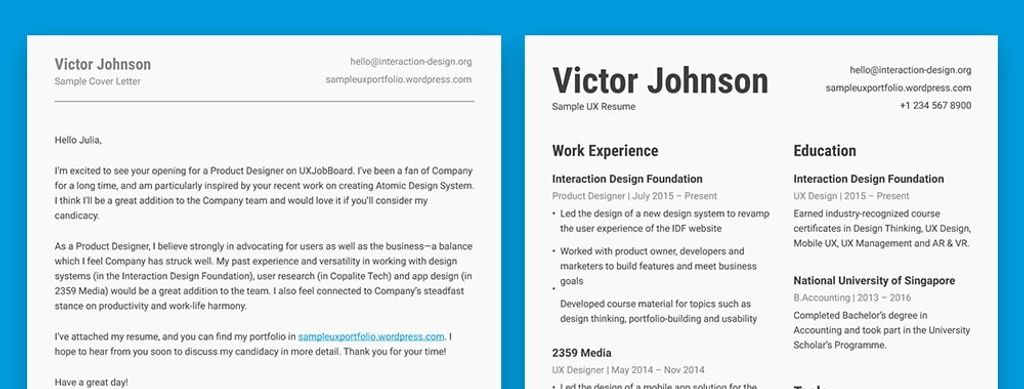
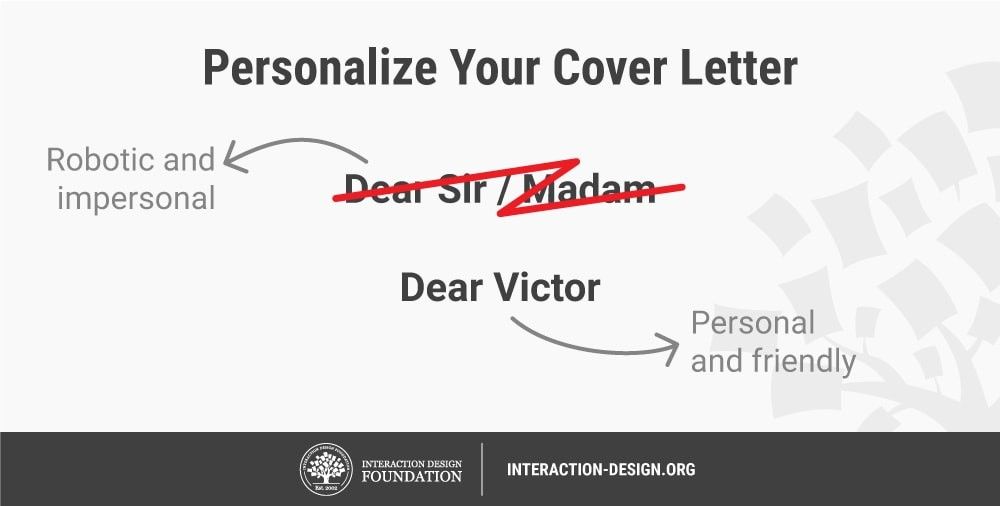
Make your cover letter / email stand out and sound friendlier when you personalize it to the person who will receive it.

How to Write a UX Cover Letter

Email generally suits most situations. However, judge how formal your approach should be when you research the organization (e.g., banks may require paper letters) regardless of if someone you know has put you in touch with a recruiter. In any case, you should:

  1. Personalize your letter.

    • Don’t begin with Dear Sir/Madam. This sounds lifeless and gives the impression you’re applying to a generic recruiter in a scattershot approach. To prove a dedicated effort to reach that recruiter, find and use the name of the contact (typically in HR). Decide whether to use a title-and-surname approach (safer) or a first-name approach to access them in a friendly, professional way.

    • Match your tone of voice with the company’s personality. If your recruiter is trendy and bubbly, reflect that nature in your email. If it’s a more traditional organization, a formal writing style is better.

  1. Keep it short and sweet.

  2. Use one page. Recruiters are usually time-starved individuals who won’t handle lengthy letters. This puts pressure on you to fine-tune a concise message in which you show extensive knowledge about the company and role.

  1. Show why you’re a good fit by explaining:

    1. Why you want to work for their organization. Say what they have that attracts you: e.g., their values, teamwork style.

    2. Why you want that UX role. Ensure you show you’d love it as a valuable next step in your career, rather than somewhere to escape to because you dislike your current situation.

    3. How they will benefit from hiring you. You should declare your strengths and interests by showing how these can add value to a team. Flip your words around to hear how you sound from their side. Try to portray a proactive problem-solver who wants to grow with team-mates.

  1. Read and re-read the job posting carefully.

  2. Provide the materials they request. To filter out inattentive applicants, many recruiters include a question or prompt to mention a word/phrase.

  1. Proofread, re-read and read it aloud.

  2. One tiny typographical error will almost certainly ruin your application. So, use your spellchecking and grammar-checking software, re-read your letter and read it aloud until you’re sure about it.

Remember, your cover letter is critical to what happens next with your application. You have only moments to represent yourself to the recruiter through it—every word must count.

Questions About UX Cover Letters?
We've Got Answers!

Do I even need a UX cover letter?

Yes. It gives you a chance to tell your story; something your resume alone can’t do. While hiring managers often skim resumes and UX portfolios, they read cover letters to get a sense of who you are, how you think, and why you're a great fit for the role. In UX, storytelling is key, and your cover letter shows you can do that well. Plus, it will complement the storytelling in your resume and portfolio.

A strong UX cover letter highlights your user-centered mindset, explains how you solve problems, and shows your passion for design. Even if a job post says it’s optional, sending one shows effort and sets you apart. In a competitive field like UX, standing out matters.

Discover what effective storytelling means, in this video with Morgane Peng: Designer, speaker, mentor, and writer who serves as Director and Head of Design at Societe Generale CIB:

Transcript

How long should a UX cover letter be?

A UX cover letter should be no longer than one page, or around 250 to 300 words. Hiring managers often review dozens of applications, so a concise, focused letter shows respect for their time and strong communication skills, both crucial in UX design.

Stick to three short paragraphs: start with a strong hook that connects you to the role, follow with one paragraph that showcases your UX skills through a story or achievement, and end with a clear, confident call to action. Always tailor your message to the company and role.

Explore the sort of portfolio you will want to complement your cover letter with in The 10 Most Inspirational UX Design Portfolio Examples in 2025.

How do I show my UX skills in a cover letter, not just my resume?

To show your UX skills in a cover letter, tell a brief story that proves how you solve real user problems. Don’t just list skills; demonstrate them. For example, describe how you conducted user research, identified pain points, or improved a product’s usability. Highlight your thought process and the impact of your work.

Use action verbs like “designed,” “tested,” or “launched” to keep it dynamic. Show that you think like a UX designer: empathetic, analytical, and user-focused. And always connect your story to the company’s goals or product. That makes your letter personal and relevant.

This approach shows you understand UX isn’t just about tools; it’s about outcomes and users. Remember, keep it concise.

How do I explain a career change into UX in a cover letter?

To explain a career change into UX in a cover letter, focus on transferable skills and your motivation. Start with a compelling reason for your shift—perhaps you’ve always cared about user experience or solved problems with a human-first mindset. Then, highlight past experiences that relate to UX, such as research, communication, or design thinking.

Use one strong story that connects your old role to your new UX path. For example, if you were a teacher, describe how you redesigned a curriculum based on student feedback, just like iterating a product based on user testing. Show you've done the work to transition—mention courses, projects, or a portfolio.

Hiring managers love career changers who bring fresh perspectives. Own your journey with clarity and confidence.

Get more mileage from your non-design experience, in this video with Morgane Peng:

Transcript

What mistakes do people often make in UX cover letters?

Common UX cover letter mistakes include being too generic, too long, or too focused on tools. Many applicants use copy-paste templates that don’t match the company or role. That annihilates your chances. Others just list skills from their resume without showing how they’ve used them. UX is about storytelling; your letter should reflect that.

Another mistake is ignoring the user: the hiring manager. If your letter doesn’t speak to their needs, it misses the mark. Also, don’t skip proofreading. Typos make you look careless, which is deadly in UX.

Remember, the cover letter is a design in itself, so always tailor it, focus on results, and keep it concise. Show, don’t tell. Write with empathy and clarity, the same way you’d design for a user.

Explore more in How to Approach a Cover Letter for Your Dream Design Job.

How do I write a UX cover letter if I don’t know the hiring manager’s name?

If you don’t know the hiring manager’s name, skip “To Whom It May Concern.” It feels cold and outdated. Instead, use a friendly, professional greeting like “Dear UX Hiring Team” or “Dear [Company] Design Team.” This shows you’ve thought about the audience, not just followed a template.

Better yet, do a quick LinkedIn search or check the company website. If you can find the head of UX or design, address the letter to them. That extra step signals genuine interest, a trait every UX professional should show.

Job-hunting can be tedious and stressful, but the key is to stay human and user-centered and not let any dismissiveness show or hint of a scattershot approach to landing a role. A warm, thoughtful opening helps your letter feel personal even if you don’t know the exact name, and if the substance of the letter shows you’ve done your “homework,” then so much the better.

Get more clued up on how to approach things in How to Create the Perfect UX Resume and Cover Letter.

How formal should my UX cover letter be?

Your UX cover letter should be professional, but not stiff. Aim for a tone that’s confident, clear, and friendly, just like good UX writing. You’re not writing a legal memo, so skip the jargon and overly formal phrases like “Dear Sir or Madam” or “I am writing to express.” If you’re to be part of a UX team, you certainly won’t want to come across like a nineteenth-century lawyer or butler, for example.

Instead, use a conversational tone that still respects the company culture. If it’s a corporate environment, be a bit more formal. For startups or creative teams, a relaxed tone can help you feel more relatable. Above all, keep your message user-centered; think about how it reads to the person on the other side. And remember, if you’re asked to interview, you’ll want to stay “in character.”

Good UX design balances clarity and personality; your cover letter should too.

Discover more about how to empower yourself so you can land more interviews; enjoy our Master Class How to Build a Successful Portfolio with Chris Clark, Design Director, Interaction Design Foundation (IxDF).

Should I talk about my passion for UX design in my cover letter?

Yes, absolutely talk about your passion for UX design, but make it real. Don’t just say “I’m passionate about UX.” Show it through a quick story, a project that inspired you, or a moment when you realized the impact of great design. Hiring managers look for genuine enthusiasm backed by action.

Passion shows commitment, curiosity, and drive; they’re qualities every design team values. Just keep it balanced and remember you only have so many words in a cover letter. Pair your passion with proof: mention your work, user research, or designs that made a difference. When your passion connects to real outcomes, it becomes memorable.

In UX, empathy and motivation go hand in hand. Your cover letter is the perfect place to show both.

Find out why empathy is a keyword in UX design from this video:

Transcript

What if I only have student or personal UX projects?

If you only have student or personal UX projects, that’s still valuable; use them. What matters most is how you talk about your work. Show your process: how you researched, designed, tested, and iterated. Treat your personal projects like client work: frame them around user problems and your design solutions.

Hiring managers know everyone starts somewhere. They want to see how you think, not just big-brand names. Highlight real impact, even if it was for a school project or a made-up app. What insights did you find? What changed because of your design?

Great UX portfolios often start with personal projects. Show dedication, detail, and user focus, and those projects will speak volumes.

Take some sound advice from Morgane Peng in this video about how to engage hiring managers with a design portfolio:

Transcript

How soon should I follow up after sending my UX cover letter and application?

Follow up 7 to 10 days after sending your UX cover letter and application. That gives the hiring team enough time to review materials while keeping your name fresh in their minds. A short, polite message works best; reaffirm your interest and ask if they need anything else from you.

UX is about communication and timing. Following up shows you’re proactive and genuinely engaged, not just clicking “apply” randomly. Keep the tone friendly and respectful; never pushy. And don’t let irritation show; as frustrating as it can be to feel you’ve been left “dangling,” addressing them in an angry or forceful tone because they seem too rude to respect you won’t help matters.

If the job posting lists a deadline, wait until a few days after that to follow up. And always check if the company asks applicants not to follow up.

Enjoy our Master Class How to Deal with People Who Don't Get Design with Morgane Peng.

Earn a Gift Earn a Gift, Answer a Short Quiz!

1
2
3
4
1
2
3
4
Question 1
Question 2
Question 3
Get Your Gift
Interaction Design Foundation logo

Question 1

What is the purpose of a UX cover letter?

1 point towards your gift

  • To detail your technical skills
  • To introduce yourself and explain why you are a good fit for the role
  • To list all your past job experiences
Interaction Design Foundation logo

Question 2

What is essential in a UX cover letter?

1 point towards your gift

  • A detailed description of your daily tasks
  • A list of references
  • A personalized greeting to the recipient
Interaction Design Foundation logo

Question 3

How should you convey that you are a good fit for the UX role in your cover letter?

1 point towards your gift

  • Elaborate on how your skills and experiences align with the job requirements
  • List all job experiences, unrelated or not
  • State your desire for a job change

Learn More About UX Cover Letters

Make learning as easy as watching Netflix: Learn more about UX Cover Letters by taking the online IxDF Course AI for Designers.

Why? Because design skills make you valuable. In any job. Any industry.

In This Course, You'll

  • Get excited about how quickly you can create meaningful results when you turn AI into your new superpower and combine it with timeless human-centered design skills. As an AI-powered designer, you’ll increase your efficiency and salary potential, and as a human-centered leader, you'll create ethical AI-powered products people love. When these abilities come together, you’ll solve real-world problems faster and make the world a better place. Studies show that AI-driven productivity accelerates growth and helps busy professionals like you achieve in months what once took decades. Now's the time to master the powerful combination that keeps you in demand.

  • Make yourself invaluable when you use AI to accelerate repetitive tasks while applying your irreplaceable human strengths like empathy, critical thinking, and ethical decision-making to guide every solution toward what users truly need. Leaders seek professionals with AI fluency because the people who thrive combine AI efficiency with deep human insight that machines can't replicate. You'll learn to automate and streamline repetitive tasks, make data-driven decisions, and optimize your workflow for innovation and cost savings. No matter your background, you'll easily master AI for Designers. With clear guidance and real-world examples, you'll apply your skills immediately.

  • Gain confidence and credibility as you master the art of text prompts for design. You'll learn how to deal with bias in AI and how to use AI tools to create intuitive user experiences that drive business success. You can fast-track your portfolio of AI-enhanced case studies with step-by-step guidance, practical tips for real-life projects, and downloadable templates. This course gives you the hands-on knowledge to guide AI with timeless human-centered design skills, and that's how you stay in demand in any industry!

It's Easy to Fast-Track Your Career with the World's Best Experts

Master complex skills effortlessly with proven best practices and toolkits directly from the world's top design experts. Meet your experts for this course:

  • Ioana Teleanu: Founder of UX Goodies and former Lead Product Designer (AI) at Miro.

  • Rafael Hernandez: Lead Product Designer at T. Rowe Price.

  • Jarvis Moore: Senior Design Lead, Design Systems at Microsoft.

  • Niwal Sheikh: Product Design Lead at Netflix.

  • Vitaly Friedman: Senior UX Consultant for the European Parliament, and Creative Lead, Smashing Magazine.

  • Pablo Stanley: Designer and CEO of Musho and Lummi.

Get an Industry-Recognized IxDF Course Certificate

Increase your credibility, salary potential and job opportunities by showing credible evidence of your skills.

IxDF Course Certificates set the industry gold standard. Add them to your LinkedIn profile, resumé, and job applications.

Course Certificate Example

Be in distinguished company, alongside industry leaders who train their teams with the IxDF and trust IxDF Course Certificates.

Our clients: IBM, HP, Adobe, GE, Accenture, Allianz, Phillips, Deezer, Capgemin, Mcafee, SAP, Telenor, Cigna, British Parliament, State of New York

All Free IxDF Articles on UX Cover Letters

Read full article
How to Create the Perfect UX Resume and Cover Letter - Article hero image
Interaction Design Foundation logo

How to Create the Perfect UX Resume and Cover Letter

Your cover letter helps sell you as a good fit for the company and serves to introduce your resume and portfolio. The cover letter plays a major role because this is your first chance to help the recruiter know that you’re the perfect fit for the company and job role. You need your UX design portfol

Social shares
725
Published
Read Article

How to Create the Perfect UX Resume and Cover Letter

How to Create the Perfect UX Resume and Cover Letter

Your cover letter helps sell you as a good fit for the company and serves to introduce your resume and portfolio. The cover letter plays a major role because this is your first chance to help the recruiter know that you’re the perfect fit for the company and job role. You need your UX design portfolio and resume to back that up. Your UX resume is a quick summary of your work experiences and educational background. Your most important asset in your job application is your UX design portfolio. Recruiters evaluate your skills through reading your UX case studies. However, a recruiter may not even look into your UX case studies if your cover letter isn’t dedicated and well-written.

Here we’ll go through how you create the perfect UX resume and cover letter that will impress your recruiter. We even have a nifty hack that allows you to create your UX resume in 5 seconds!

Are Resumes and Cover Letters Still A Thing?

Yes, you still need a cover letter. In recent times, you might not need a formal resume and old-fashioned cover letter anymore. In many cases, it’s perfectly acceptable when a candidate writes an introductory email instead of a cover letter. A cover letter and an introductory email serve the same essential purpose: they help you explain why you’re a great fit for the company and the position you’re applying for. This is your very first contact with your new employer, and it’s therefore your first chance to impress. If the cover letter or email is not dedicated and well-written, the recruiter won’t even look at your resume or portfolio.

And, yes, you also still need to craft a resume. Your resume helps you give your employer a quick overview of your previous work experience and educational background.

Here, we’ll share some tips on how to create a great resume and cover letter. Read to the end to download a sample UX resume and cover letter!

How to Create an Impressive Cover Letter

As we mentioned above, you probably don’t need a formal cover letter. A great job application email will often work better. Whether you choose to write a formal cover letter or an introductory email is up to you—you may judge how formal or informal you think each company you apply with is. That’s why we made sure our tips below apply for both formal cover letters and introduction emails.

Tip 1: Personalize It

Don’t start with “Dear Sir/Madam”. You’ll make yourself sound like a robot—and a million other job applicants! Take some time to Google the name of the person who will (hopefully) hire you—this could be the HR manager, the design team lead or the CEO in a startup—and address them directly.
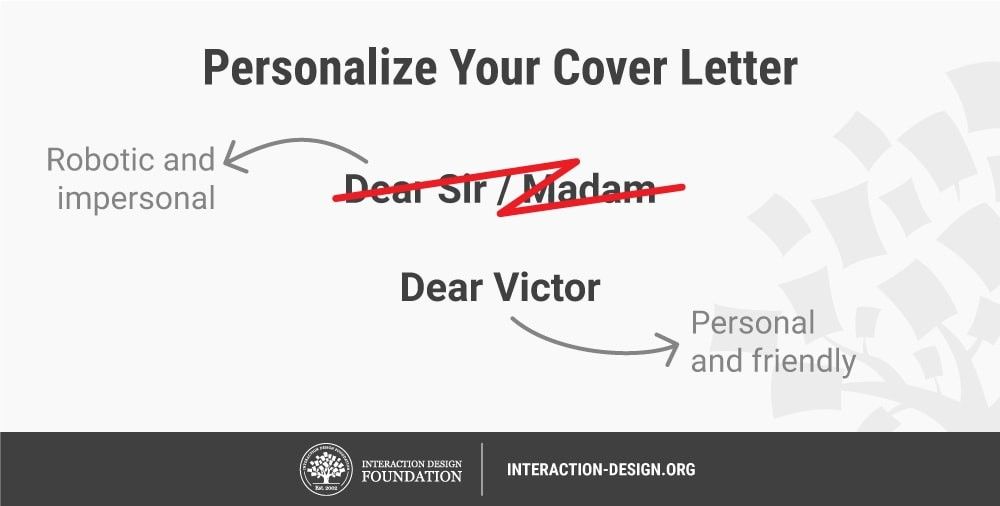
Make your cover letter / email stand out and sound friendlier when you personalize it to the person who will receive it. Author / copyright holder: Teo Yu Siang and the Interaction Design Foundation. Copyright terms and license: CC BY-NC-SA 3.0.

Match your tone of voice with the company’s personality. For instance, if you’re applying to a company known for being hip and cheerful, then your letter should reflect the same kind of cheerfulness. In this case, you would normally choose to write an introduction email. On the other hand, if you’re applying to work in the UX team of a banking corporation, perhaps your tone of voice should sound more professional, and you would normally choose to write a cover letter. Likewise—and a vital point here—address the person appropriately. Depending on the industry and factors such as the age of whoever reads what you’ve sent, a first-name approach may turn them off. Sometimes it’s better to use (e.g.) “Mr.” and let the person decide if you can call him (e.g.) “Geoff” for when you get to the interview.

Tip 2: Be Short and Sweet

Your cover letter should not exceed one page. Recruiters simply have no time to read lengthy letters. With that said, your cover letter is your chance to show that you’ve done your research well and that you know what the company and job role is all about―and how and where you fit in perfectly. That leads us right over to tip 3.

Tip 3: Tell Your Recruiter Why You’re a Good Fit

Pay close attention to this tip, and you’ll be much closer to getting invited to your dream job interview. Your cover letter should explain why you want to work for that particular company, not just a company. What do you like about the company? Their values? The way they work in their teams?

Secondly, explain why you want that particular job role. What part of the job post caught your eye?

Thirdly, explain how the company will benefit from hiring you, as opposed to how you will benefit from the new job. You’ll be surprised to see how many applicants only explain why they themselves would love to get the job. Put yourself in your recruiter’s shoes. Tell how and why you can make a difference in their team. And don’t forget to let your passion shine through while you do so. For instance, explain how you would be delighted to grow with the team as you leverage your skill set and passion for perfection.

Tip 4: Read the Job Posting Carefully!

Read the company’s job posting, and then re-read it and do so once again before you send your cover letter. Did the job posting require you to answer certain questions? Did they ask for specific documents—such as a cover letter or resume?

Some companies include questions or prompts in their job postings that they want applicants to answer or include. In most cases, recruiters do this to filter applicants—they’ll likely delete your application if you forget to answer the question or include their “magic” word or phrase. For example, we do this here at the Interaction Design Foundation to see whether a candidate has sufficient attention to detail. So, if they ask you to include, for example, “Beige banana”, do it.

Tip 5: Check for Spelling and Grammatical Errors

This is key! Spelling and grammatical errors create a bad impression. Spend a few minutes to check your cover letter—type it on a word processor with a spell checker function—and remove any errors you can find. Then, read it aloud to do a final check, at the same time listening to how you come across. Not only will you get a final idea as to how well it all flows, you’ll also have a safety net to catch anything your software may have overlooked.

How to Create Your UX Resume

What Your UX Resume Should Contain

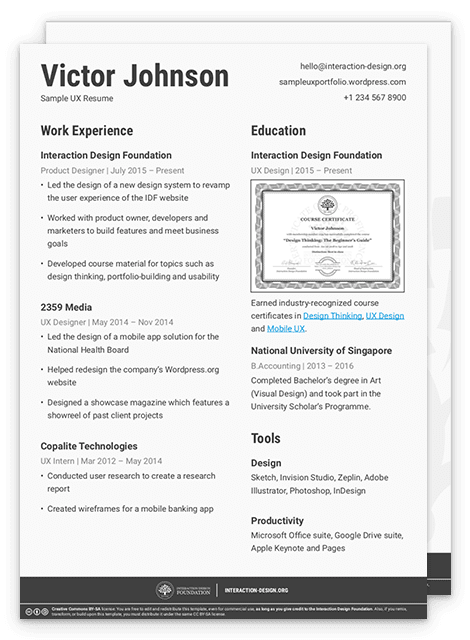
We recommend that you create your UX resume in such a way that it reflects the visual design you use in your portfolio. You should take all the opportunities you get to impress your recruiter. Likewise, if you do craft a formal cover letter, then please make sure to be consistent in your visual style.

Here’s what your UX resume should contain:

  • Information about you: your name, current job title (if you have one) and contact information such as your email or website.

  • Work experience: list your current and previous jobs in reverse chronological order, so the latest job appears first. Include only relevant work experience—your recruiter will not be impressed by your 6-month stint as a part-time waiter (as that would be irrelevant to your UX design role)! However, if you’ve worked as a professional skydiver or photographer, it’ll show something valuable about your personality, so you should always evaluate what would impress your recruiter.

  • Education: keep it to university-, trade school- and college-level education. You should also include design-related bootcamps and online courses—for example, if you’ve completed some courses at the Interaction Design Foundation. Remember to include the industry-recognized course certificate you get for each course you complete―and the individual link you get so recruiters can verify the authenticity.

  • Your picture: choose a picture where you’re in your professional work environment where your face is visible, or choose a professional headshot photo like the one you use for your LinkedIn profile.

  • [Optional] Write-up about yourself: if you want to, you may include a short write-up about yourself. Always consider how you would see what you write if you were a potential employer, someone who doesn’t know you.

  • [Optional] Your skills and tools: this is more valuable if you have niche skills (such as in user research, compared with something as broad as “UX design”) or if you are proficient in a wide range of industry-specific tools.

  • [Optional] Anything else: include anything else you think is going to impress your recruiter. Earned a prestigious design award? Taught design in a class before? Wrote popular articles on Medium? Speak multiple languages fluently? It’s your UX resume after all, and you have free reign to customize it to sell yourself in the best possible way. Again, remember to consider how you would come across to a complete stranger who wants to see what you can do for them.

  • Link to your LinkedIn profile: You should also add the link to your LinkedIn profile. Why? If recruiters are interested in inviting you for a job interview, they’ll look for your LinkedIn profile. So, do them a favor and give them the direct URL, so they don’t have to spend time on it themselves. And do yourself a favor: make sure that your resume and LinkedIn profile are consistent. You would be surprised to see how many inconsistencies we find when we look for new colleagues here at the Interaction Design Foundation. So, you’re one step ahead if you show consistency across LinkedIn and your resume. As always, honesty is the best policy. You can—and should—word who you are and what you do in a positive light, but don’t dress up a craft where you have no proficiency as something at which you’re skilled. In a professional setting, you can’t cram overnight to build up a knowledge base you claimed to have; employers can tell when people “wing it”.

Speaking about LinkedIn, let’s look into a quick hack if you’re in a hurry. We don’t recommend this, but we do recognize that sometimes you’ll discover a position you want to apply for―at the very last minute.

Quick Hack: How to Create Your UX Resume in 5 Seconds

To begin, you need to have an updated LinkedIn profile. And, by the way, you should always make sure that it’s updated. Once you do, you can make use of LinkedIn’s hidden “save to PDF” function. Go to your profile, click on the “More…” button and select “Save to PDF”. Bam, you’re done!
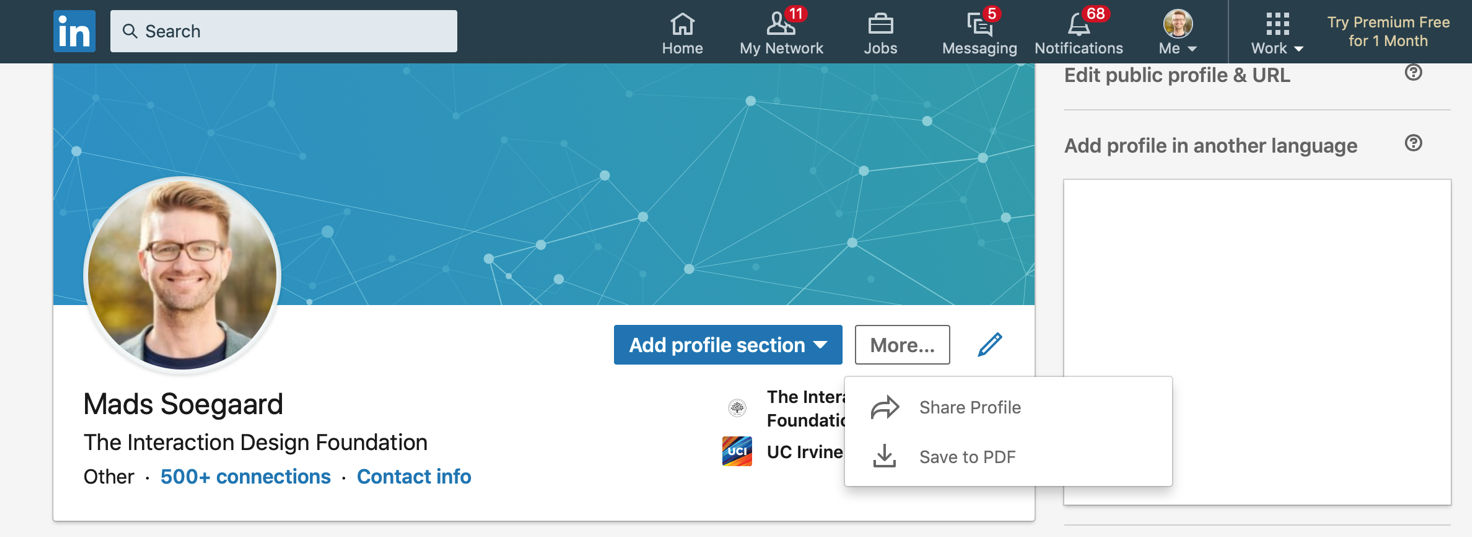
LinkedIn has a somewhat hidden feature that lets you export your profile into a PDF resume in 5 seconds! Author / copyright holder: Mads Soegaard. Copyright terms and license: Fair use.

This method is great for when you’re in a rush and need to send your UX resume to a recruiter ASAP. This is also great if you’ve got established work experience and a stellar UX portfolio—when you feel you don’t need to jazz up your UX resume to make your application stand out from the competition. But, really, are you the CEO of Uber or the lead designer at Facebook. No? Okay, then please go back and craft that amazing resume and LinkedIn profile which will thrill your recruiter. :-)
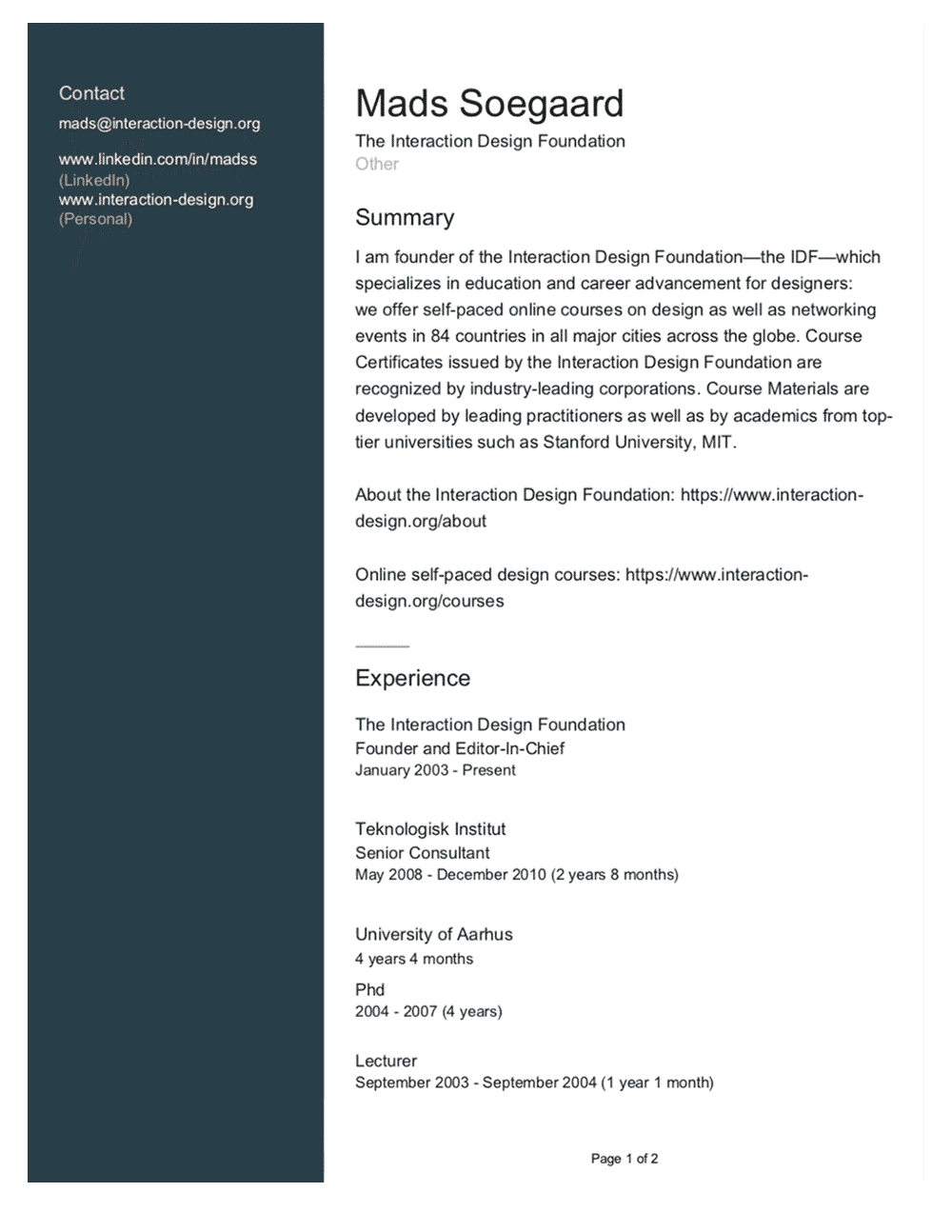
This is an example of what LinkedIn’s PDF resume looks like. Author / copyright holder: Mads Soegaard. Copyright terms and license: Fair use.

The obvious downside is that your UX resume looks generic. In view of that, we strongly recommend that you use this method only if you’re in a rush. Alternatively, you could use this method to create a rough version of your resume, which you’d then use as a reference when you create your own PDF from scratch. Remember, your resume is a wonderful opportunity to showcase your design skills.

Download Our Sample UX Resume and Cover Letter

Get a copy of our sample UX resume and cover letter as a reference:

Advance Your Career With This Free Template for “Sample UX Cover Letter and Resume”
Sample UX Cover Letter and Resume
We respect your privacy
Get 1 powerful email each week: Design a life you love!

The Take Away

Your UX resume and cover letter/information email still play a major role in your job application process. Your cover letter or email is your first chance to impress your recruiter. If you don’t craft a dedicated cover letter, it’s highly likely the recruiter won’t even open your portfolio or resume. So, make sure you explain why you’re an excellent fit for the company and how you can contribute to the team. Likewise, in your resume, build credibly when you summarize your work and educational history.

When you write your cover letter or email, keep these tips in mind:

  • Personalize your cover letter or email;

  • Be short and sweet;

  • Tell your recruiter why you’re a good fit: why you want that particular job role in that particular company. Tell how and why you can make a difference in their team;

  • Read the job posting carefully, especially to catch any screening questions or prompts (usually near the bottom); and lastly

  • Check for spelling and grammatical errors.

Your resume should contain:

  • Information about you;

  • Your work experience;

  • Your educational history;

  • An appropriate photo of you;

  • A link to your LinkedIn profile; and

  • Optional content such as a write-up, your skills and tools, as well as other things that might help create a good impression.

For a quick hack, you can export your LinkedIn profile into a PDF resume, but we don’t recommend this. Spend that extra time to craft your resume. Take the extra care to see how you look to an outsider who wants something from you. Overall, think: “From what I’ve put together, would I hire me?”

References and Where to Learn More

Chris Teso’s quote is taken from Smashing Magazine’s article, which contains more information on what makes a good cover letter.

If you need more inspiration on resumes, check out Case Study Club’s list of 21 great resumes.

Hero image: Author / Copyright holder: Teo Yu Siang and the Interaction Design Foundation. Copyright terms and license: CC BY-NC-SA 3.0.
Feel Stuck?
Want Better Job Options?

AI is replacing jobs everywhere, yet design jobs are booming with a projected 45% job growth. With design skills, you can create products and services people love. More love means more impact and greater salary potential.

At IxDF, we help you from your first course to your next job, all in one place.

See How Design Skills Turn Into Job Options
Privacy Settings
By using this site, you accept our Cookie Policy and Terms of Use.
Customize
Accept all

Be the One Who Inspires

People remember who shares great ideas.

Share on:

Academic Credibility — On Autopilot

Don't waste time googling citation formats. Just copy, paste and look legit in seconds.