We must measure what's meaningful, not what's easy.

Use More Meaningful Measurements in Design and in the World

by Laia Tremosa • 20 min read

486 Shares

What we measure and how we do it significantly impact people’s lives. Often, we measure certain things just because they’re easy to measure, and that’s how it’s always been done. But we have to ask ourselves; are the measurements meaningful or not?

We measure a country’s Gross Domestic Product (GDP) to assess its performance, but what does this number really mean? Does it give us information about how good that country’s education system is? How sustainable their industries are? UX innovator Don Norman talks about how important it is to use more meaningful measurements.

Transcript

There are many efforts worldwide to develop more meaningful measures. UX pioneer Don Norman talks about notable examples such as the United Nations’ OECD Better Life Index and the World Happiness report.

Transcript

Many alternatives to GDP take into account a broader set of factors. For example, Don talks about the The Doughnut Model of Economics, developed by the economist Kate Raworth at the University of Oxford.
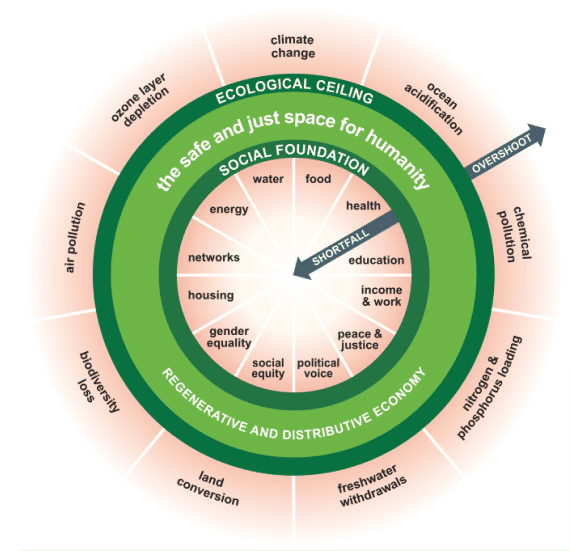
The Doughnut shows two concentric rings: a social foundation, to ensure that no one is left falling short on life’s essentials, and an ecological ceiling, to ensure that humanity does not collectively overshoot the planetary boundaries that protect Earth's life-supporting systems. Between these two sets of boundaries lies a doughnut-shaped space that is both ecologically safe and socially just: a space in which humanity can thrive.

The Doughnut of Social and Planetary Boundaries.

© Doughnut Action Lab, Fair Use

The Doughnut Model of Economics, developed by economist Kate Raworth at the University of Oxford, is a novel approach to sustainable development. This doughnut shape has two parts:

  1. Societal issues: The inner ring of the doughnut represents the minimum needs every person should have access to in order to lead a decent life. This includes things like food, shelter, healthcare, and education.

  2. Ecological issues: The outer ring of the doughnut represents the safe limits for the planet. Beyond the outer ring, the Earth's systems are in danger of being damaged. This includes air and water pollution, deforestation, and climate change.

The goal is to create a world that meets the needs of all people within the limits of what the planet can sustain—sustainable design. This economic model should ensure that no one lives in poverty and also protect the planet from harm.

Governments, organizations, and communities worldwide use the Doughnut Model to help guide and measure their decisions toward a more sustainable and equitable future.

The Doughnut Model gives a more nuanced picture of a country's sustainability. For example, it might show a country has reduced CO2 emissions but is not very good at education or health care. This is much more meaningful and important than a single number. This way of measuring makes our lives much more meaningful and understandable. 

The Doughnut Model is one guide that can help us measure in a meaningful way. However, there are several other measurements we can use that might be more appropriate for the problem we have to solve. First, understand what’s most important for your project and then choose the appropriate measurements.

The Take Away

We should measure the important things in life. We should ask questions such as; are people leading a good life? Are families supported? Do we provide clean water and housing to everyone? The ways we measure the health of a society today do not take these important factors into account.

The current widespread measurement systems originate from the physical sciences. Those models often do not account for past events and are "path independent." On the other hand, human behavior is heavily influenced by past experiences and varies significantly from person to person. This makes it "path dependent." Traditional metrics cannot accurately measure most human behaviors.

We must continue to develop new measurements that better represent complex systems—such as the Doughnut Economic Model—instead of relying on single numbers like GDP. This model aims to measure the performance of an economy by looking at several factors beyond monetary measures. Not only can designers help find new metrics, but also these metrics will allow designers to better understand the real problems, and determine if their design solutions are successful.

References and Where to Learn More

Don Norman’s book Design for a Better World: Meaningful, Sustainable, Humanity Centered covers many alternative, meaningful measures.

Additional resources from the book “Design for a Better World” are available at the Resources for DBW website.

Read more articles and essays by Don Norman on JND.org.

The Economic History Association offers a fascinating explanation of Path Dependence and illustrates the concept with examples from everyday life.

To learn more about meaningful ways to measure, read the Harvard Business Review article The Economics of Well-Being by Justin Fox.

To learn more about the Doughnut Model: An Effective Dashboard, visit the website of the Doughnut Action Lab.

Hero image: © Interaction Design Foundation, CC BY-SA 4.0

Learn More in This Course:

AI for Designers

10 days
16 % booked
View Course

What You Should Read Next

  • Read full article
    Don Norman’s Three Levels of Design - Article hero image
    Interaction Design Foundation logo

    Don Norman’s Three Levels of Design

    Don Norman is deservedly considered to be one of the greats of usability design. He is founder of the Nielsen Norman Group and he is also a former professor of Cognitive Science (among many, many, many other things). In short, he’s a guy who has spent his whole life researching what makes users tick

    Social shares
    883
    Published
    Read Article
  • Read full article
    Affordances and Design - Article hero image
    Interaction Design Foundation logo

    Affordances and Design

    'Affordance' is a term most designers will have come across at some stage of their studies and careers. Don Norman introduced this term to the design community.Despite Don Norman’s best efforts, the underlying meaning of the term is sometimes misunderstood.How to define 'Affordance'Don Norman first

    Social shares
    811
    Published
    Read Article
  • Read full article
    How Can Designers Adapt to New Technologies? The Future of Technology in Design - Article hero image
    Interaction Design Foundation logo

    How Can Designers Adapt to New Technologies? The Future of Technology in Design

    The design industry is rapidly evolving with the integration of technologies such as artificial intelligence (AI) and 3D printing. While there may be concerns about job displacement, history has demonstrated that new technologies typically create more job opportunities. Don Norman, author of The Des

    Social shares
    668
    Published
    Read Article
  • Read full article
    Human-Centered Design: How to Focus on People When You Solve Complex Global Challenges - Article hero image
    Interaction Design Foundation logo

    Human-Centered Design: How to Focus on People When You Solve Complex Global Challenges

    When we design products and services, we use human-centered design insights to help us focus on the people. But how do we focus on the people in the context of complex global challenges? What should we be aware of? What are the pitfalls? And when should we reach out to help people? In this video, Do

    Social shares
    578
    Published
    Read Article
  • Read full article
    Don Norman’s Top Tips from the Design for the 21st Century Course - Article hero image
    Interaction Design Foundation logo

    Don Norman’s Top Tips from the Design for the 21st Century Course

    The design field is evolving. It’s been proven that aside from driving business success and delivering beautiful and successful products, design can be pivotal to solving complex human issues. For instance, GE Healthcare used Design Thinking to improve the MR scanner experience for children—which is

    Social shares
    567
    Published
    Read Article
  • Read full article
    How Designers Can Help Companies Design for the Circular Economy - Article hero image
    Interaction Design Foundation logo

    How Designers Can Help Companies Design for the Circular Economy

    The circular economy sounds like a simple idea to resolve the crisis we face as a species. A circular economy generates zero waste. Once a component enters the cycle, it continues to be used for a long time. And once it is unusable, it can degrade naturally. However, as UX pioneer Don Norman explain

    Social shares
    527
    Published
    Read Article
  • Read full article
    Start Your UX Journey: Essential Insights for Success - Article hero image
    Interaction Design Foundation logo

    Start Your UX Journey: Essential Insights for Success

    One in three consumers (32%) will abandon a brand they love after a single poor experience—yes, all it takes is just one bad experience. It’s a statistic that drives home the point that designers can’t afford to gamble against user feedback. What users think is a reality that’s total for you as a de

    Social shares
    464
    Published
    Read Article
  • Read full article
    Why Do We Not Act on Climate Change? - Article hero image
    Interaction Design Foundation logo

    Why Do We Not Act on Climate Change?

    Why do we struggle to act on climate change? In this video, Father of UX design, Don Norman, sheds light on the key reasons behind our inaction. Don will explain why we humans react more effectively to immediate threats and why we often don’t understand and address longer-term, slower-moving, comple

    Social shares
    463
    Published
    Read Article
  • Read full article
    Recycling is Not Enough. Let's Design for Reuse - Article hero image
    Interaction Design Foundation logo

    Recycling is Not Enough. Let's Design for Reuse

    “We live in the age of technology and luxury, but we also live in the age of waste,” Don Norman explains. In this video, the grandfather of User Experience Design, Don Norman unpacks the world of waste we have collectively generated. He examines aspects of our daily lives that we take for granted an

    Social shares
    452
    Published
    Read Article
  • Read full article
    Sustainability Is Not Enough - Article hero image
    Interaction Design Foundation logo

    Sustainability Is Not Enough

    Sustainable design. Sustainable fashion. Sustainable living. We often hear these terms in marketing campaigns and popular media. But what does sustainability mean and why does pioneer of User Experience Design Don Norman think that sustainability shouldn’t be our goal when we design?In this video, D

    Social shares
    452
    Published
    Read Article

Top Articles

Top Topic Definitions

Feel Stuck?
Want Better Job Options?

AI is replacing jobs everywhere, yet design jobs are booming with a projected 45% job growth. With design skills, you can create products and services people love. More love means more impact and greater salary potential.

At IxDF, we help you from your first course to your next job, all in one place.

See How Design Skills Turn Into Job Options
Privacy Settings
By using this site, you accept our Cookie Policy and Terms of Use.
Customize
Accept all

Be the One Who Inspires

People remember who shares great ideas.

Share on:

Academic Credibility — On Autopilot

Don't waste time googling citation formats. Just copy, paste and look legit in seconds.

Feel Stuck? Want Freedom?

Get one powerful email each week, like 326,171 others.

Learn to design a life you love.

Next email in
6
days
18
hrs
55
mins
49
secs