The Five Languages or Dimensions of Interaction Design

by IxDF Instructor • 6 min read

789 Shares

Since the first product was designed, people have been practicing interaction design; not necessarily in name, but the activities and thought processes have remained largely the same. Interaction design is, to put things simply, the act of designing products that people will eventually interact with. As a result, there are a huge number of human considerations that guide designers, whether they refer to themselves as Interaction Designers, User Experience designers, Usability engineers, and so on.

Bill Moggridge, designer of the first laptop computer, pioneer of Interaction Design as a discipline, and author of Designing Interactions, is credited with co-coining the term interaction design with Bill Verplank, HCI-focussed designer and researcher, in the mid-1980s. Since the practices and activities of interaction design were pulled under this umbrella title, there have been slow and incremental steps to developing a vocabulary specific to this area of expertise.



Author/Copyright holder: NASA. Copyright terms and licence: Unknown


As Gillian Crampton Smith stated in Designing Interactions,

"Interaction design is still in the equivalent of the early stages of cinema. As yet, we have no fully developed language unique to interactive technology. So we are still drawing on the language of previous creative modes. It may help to categorise these languages according to their "dimensions": 1-D, 2-D, 3-D and 4-D”.

Crampton-Smith’s dimensions refer to the language we use to communicate with users, as opposed to how we communicate ideas within the design process (however, they also have their place in the sharing and dissemination of ideas in this respect).

The four dimensions of language in interaction design were outlined as follows:

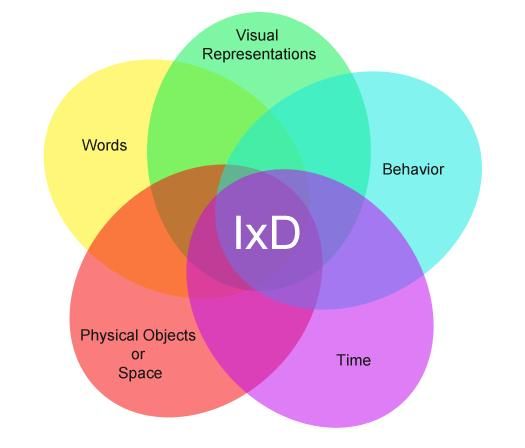
1D Words – This dimension represents the semantics, or meaning, and the nature of a user’s interactions. Words are powerful, as we are capable of processing them quickly, implicitly and yet they influence us profoundly. A single word carries considerable meaning, and words are open to interpretation. For this reason, the terminology we use must be familiar to our intended users, accurately represent the actions they denote, conveyed in a tone that is appropriate for the setting, and used consistently throughout the product.

2D Visual Representations – This dimension refers to the elements that are not words within a product, such as the typography, diagrams, icons, and other graphics. These elements are no less powerful than words, as we are capable of processing imagery just as quickly and extracting meaning within a split second. 2D visual representations are now commonplace in user interfaces, and we have already stored thousands of these elements in long-term memory, which allows us to interpret displays – when the design permits – immediately to the benefit of user experience. Four examples where 2D visual representations have been employed are: icons, foreground/background colour distinctions, borders, and the use of visual hierarchies.

3D Physical Objects or Space – The tangible means of control, such as a computer keyboard, mouse, touchscreen, joystick, games controller, and keypad. 1D words, 2D visual representations, and 3D physical objects define the user’s interactions; providing with the tools and perceptible feedback to guide their actions and enable goal-completion.

4D Time - The time in which the user interacts with and makes use of the first three dimensions, and, for example, where they are able to check the progress of these interactions. 4D Time also encompasses sound, film and animation, each representing another means of conveying information and enhancing the user experience in turn.

Kevin Silver, senior interaction designer at IDEXX Laboratories, added a fifth dimension in What Puts the Design in Interaction Design, which is:

5D Behaviour – This dimension includes “...action, or operation, and presentation, or reaction”. Silver expands on the notion of a fifth Interaction Design language dimension,

“presentation is multi-dimensional, though it is mostly visual. It can also take the form of a vibration, a tone or occur over time like music, video, or animation”.

(Read the full article for more expansion at the article name link above 5D Behaviour)

Author/Copyright holder: Samir Dash. Copyright terms and licence: All rights reserved Img source

In Summary

Products and services are how designers communicate with their users. The better the design, the easier it is to understand what the designer is trying to tell the user. If we want the user to click on the ‘sign-in’ button, we need to communicate this to them with the tools we have at our disposal, which are the five dimensions of interaction design language. When our words are poorly chosen, our images, icons, and styles easily misinterpreted, the tangible interactive devices ill-fitting for the task at hand, the user’s time cut short, or their behaviour negatively affected, user experience suffers and so does the prospect of continued use. Make sure to consider the five dimensions in your products, as they offer you the capacity to communicate, both succinctly and powerfully, with other people, not just ‘users’.

References & Where to Learn More

Header Image: Author/Copyright holder: Ana Zdravic. Copyright terms and licence: All Rights Reserved.

Course: Psychology of Interaction Design: The Ultimate Guide

Learn More in This Course:

AI for Designers

8 days
32 % booked
View Course

What You Should Read Next

  • Read full article
    Why Care about Statistical Significance? - Article hero image
    Interaction Design Foundation logo

    Why Care about Statistical Significance?

    The categorical data depicts the success and failure rate of the low-fidelity wireframe above. There is not a large enough difference between the two to determine if the designs were successful.There is an element of error involved in measuring anything. So, when we want to compare measurements, how

    Social shares
    432
    Published
    Read Article
  • Read full article
    Web Fonts: Definition and 10 Recommendations - Article hero image
    Interaction Design Foundation logo

    Web Fonts: Definition and 10 Recommendations

    Web fonts bring digital content to life. They enhance readability, set the tone, and ensure consistency across various platforms—all vital ingredients. When you understand web fonts and their impact, it can help you with effective website creation—and greatly so. We’ll provide a comprehensive overvi

    Social shares
    781
    Published
    Read Article
  • Read full article
    How to Screen Research Participants - Article hero image
    Interaction Design Foundation logo

    How to Screen Research Participants

    Finding the right participants is crucial for gathering user research. We usually need to do research with participants having a particular set of needs or experience. In this short video, you will find out about the basic need for screening and how we make sure that we have suitably qualified parti

    Social shares
    450
    Published
    Read Article
  • Read full article
    Pitfalls in Recruiting Participants for User Research - Article hero image
    Interaction Design Foundation logo

    Pitfalls in Recruiting Participants for User Research

    The level of participant engagement is an important part of the user research results. Our results are dependent on proper engagement with our participants. In this video we look at some of the issues around participant recruitment and hear practical examples that arose in a large online study.[[vid

    Social shares
    419
    Published
    Read Article
  • Read full article
    How to Fit Quantitative Research into the Project Lifecycle - Article hero image
    Interaction Design Foundation logo

    How to Fit Quantitative Research into the Project Lifecycle

    Quantitative research methods fit into the project lifecycle at different stages of the process.In this video, we see where different quantitative research methods fit into a typical project lifecycle. Bear in mind that even with an iterative process such as Agile, the short cycles still address dif

    Social shares
    510
    Published
    Read Article
  • Read full article
    How to Resolve Conflicts Between Design Thinking and Marketing - Article hero image
    Interaction Design Foundation logo

    How to Resolve Conflicts Between Design Thinking and Marketing

    In the past, designers often reported to marketing managers and were neither expected nor allowed to make business decisions. When traditionally-structured companies transition to a design-driven mindset, there can be friction between the marketing and design teams. Let’s take a closer look at this

    Social shares
    682
    Published
    Read Article
  • Read full article
    Stop the Generic Portfolio Trap! Design a Stand-Out Portfolio for Your UX/UI Niche: User Research - Article hero image
    Interaction Design Foundation logo

    Stop the Generic Portfolio Trap! Design a Stand-Out Portfolio for Your UX/UI Niche: User Research

    User research is indispensable—and without it, well... UX design is guesswork. When you’re a user researcher, you know this well—but it can be hard to communicate your work in a way that grabs the viewer and holds their attention. And that’s what a portfolio is all about—grabbing the attention of yo

    Social shares
    383
    Published
    Read Article
  • Read full article
    Top Service Blueprint Templates - Article hero image
    Interaction Design Foundation logo

    Top Service Blueprint Templates

    Service blueprint tools are vital for effective customer experience design—and for designers to make experiences that are exceptional. Here, we’ll discuss why these tools are so important. What’s more, we’ll explore templates and practical resources to create high-quality, efficient service blueprin

    Social shares
    638
    Published
    Read Article
  • Read full article
    How to Write Research Questions that Lead to Confident Design - Article hero image
    Interaction Design Foundation logo

    How to Write Research Questions that Lead to Confident Design

    Designing with Data provides an extensive background to A/B testing.As with all other research methods, we need to start with a research question. A/B testing concerns itself with changes in user behavior, meaning that our questions need to be centered on measurable goals. In many cases, these will

    Social shares
    450
    Published
    Read Article
  • Read full article
    Getting Started - Article hero image
    Interaction Design Foundation logo

    Getting Started

    We start our introduction to A/B and multivariate testing (MVT) by looking at their basic principles and their differences. Note that the video mentions Google Optimize, which has been withdrawn. Google Firebase can be used for mobile platforms. Third-party solutions are needed for A/B testing on th

    Social shares
    226
    Published
    Read Article

Top Articles

Top Topic Definitions

Feel Stuck?
Want Better Job Options?

AI is replacing jobs everywhere, yet design jobs are booming with a projected 45% job growth. With design skills, you can create products and services people love. More love means more impact and greater salary potential.

At IxDF, we help you from your first course to your next job, all in one place.

See How Design Skills Turn Into Job Options
Privacy Settings
By using this site, you accept our Cookie Policy and Terms of Use.
Customize
Accept all

Be the One Who Inspires

People remember who shares great ideas.

Share on:

Academic Credibility — On Autopilot

Don't waste time googling citation formats. Just copy, paste and look legit in seconds.

Feel stuck? Want Freedom?

Get one powerful email each week, like 325,720 others.

Learn to design a life you love.

Next email in:
5
days
5
hrs
12
mins
24
secs