Illustration of a waterfall a waterfall with arrows indicating back-and-forth between the Requirements, Design and Development phases.

Innovation vs. Incremental Improvement

by Laura Klein • 21 min read

605 Shares

Not all teams build products in highly uncertain environments or try to create cutting-edge new features. Many incrementally improve existing products and try to do so in a way that doesn’t alienate large existing user bases. Neither of these tasks is particularly easy, and they often require very different approaches to research and design. Let’s take a look at how things differ depending on a team’s goals. 

Often, product teams, regardless of how agile they are, don’t have a very good distinction between “how to do research for a brand new, innovative product” vs “how to do research for an existing, successful product with customers.” You’ll notice we said “product teams” don’t have that distinction. Typically user researchers have a very good idea of the different sorts of research required, but they’re not always the ones making the decisions, unfortunately. 

The reason that this is worse in agile environments is that many teams have largely gotten rid of the big, dedicated “discovery” phase that was used to do early research on new products or new versions of products. 
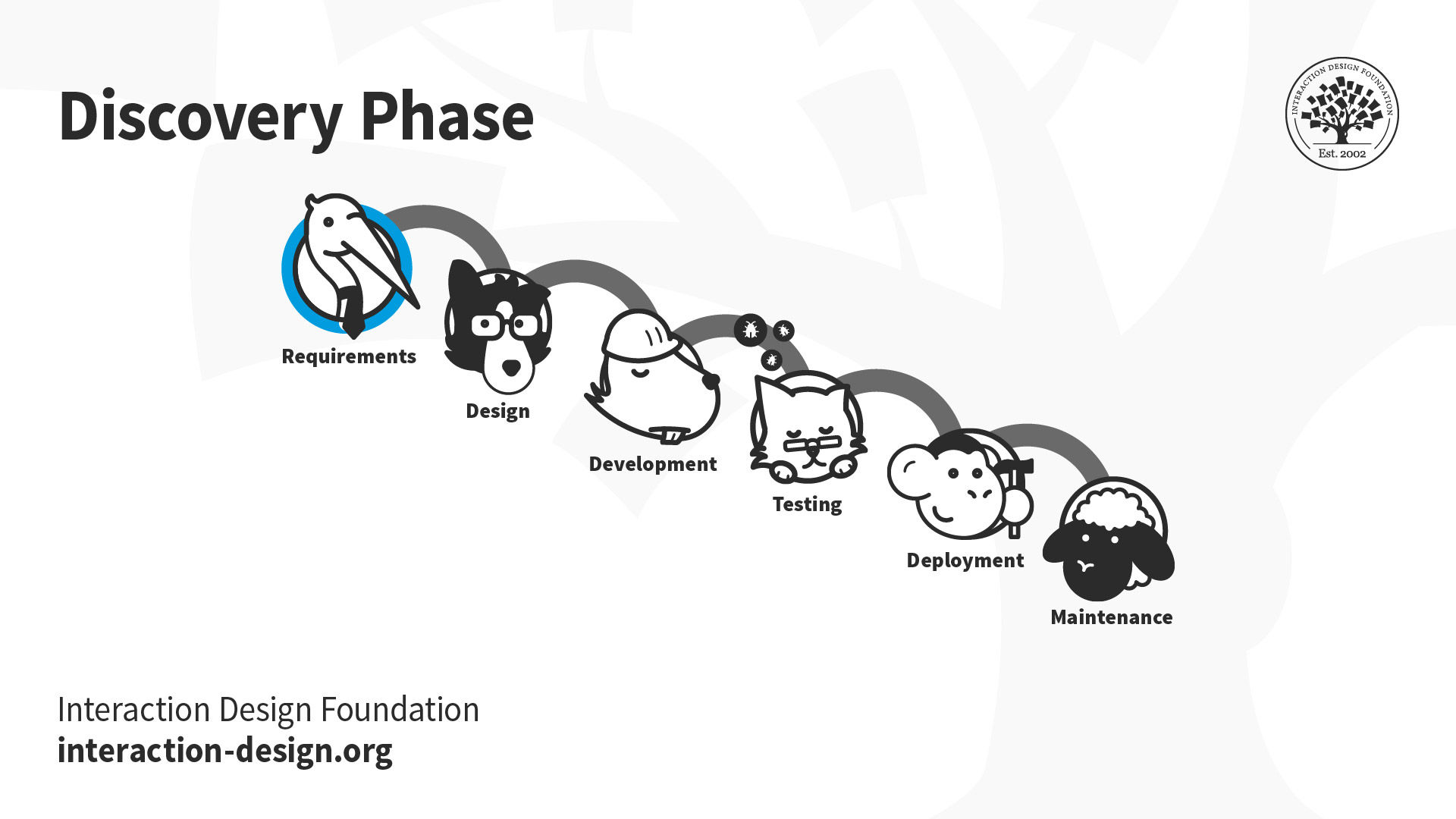
The discovery phase of a waterfall process.

© Eduardo Ferreira and Interaction Design Foundation, CC BY-SA 3.0

Since this phase happened before engineering started work on the product, and often before the product manager started writing requirements, there was generally more time to do things like contextual inquiry and deep ethnographic research. Did this always happen? No, of course not. But it was accounted for in the waterfall process, and in organizations that believed in user research, there was time built into the schedule for more in-depth research than you often see in agile environments now. 

Doing early research into user needs and problems before building a product obviously doesn’t prevent us from having to continue to do research once we’ve shipped a product—nor does it exempt us from doing usability testing on prototypes or designs. However, when we were all working in a waterfall fashion, we would ship a new version, and then start all over again with early research, often studying how people were using our product and finding all the different ways we could improve it. 
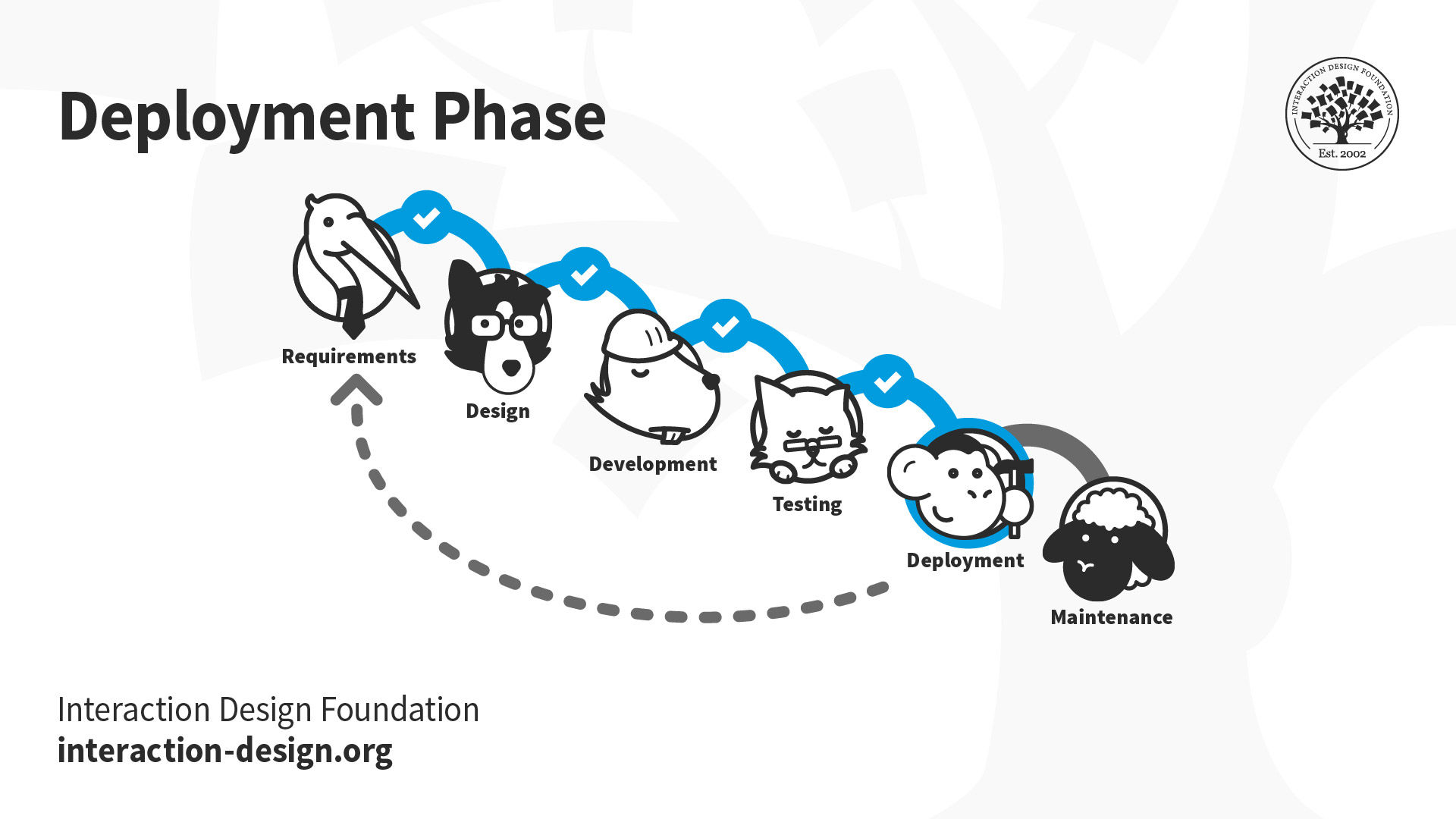
A waterfall process, with an arrow drawn from deployment to requirements.

© Eduardo Ferreira and Interaction Design Foundation, CC BY-SA 3.0

With agile teams, on the other hand, we are constantly building, constantly shipping, and constantly learning. How, then, do we distinguish between the kind of foundational research that delivers big, innovative changes and the kind that helps us identify small, incremental improvements? And are the techniques and methods we use really that different? Let’s find out from Laura Klein, UX designer and author of Build Better Products, in this video!

Transcript

Why This Matters

In companies that already have existing products or that might have longer time horizons for building new features and introducing new products, we often have to balance the time we spend on the different sorts of research. But the longer, more in-depth research studies can be a challenge in agile teams, because they don’t fit neatly into one or two sprints. 

Also, it can be very tough to do both sorts of research at the same time, especially if you only have one researcher on an agile team, which is often the case. Running a large contextual inquiry or diary study can be time-consuming, and if you’re also expected to run weekly usability test sessions or implement a Voice of the Customer program at the same time, that can be a quick recipe for researcher burn-out. 

In many ways, this is similar to any sort of split between foundational, generative research and more incremental, evaluative research. Sometimes folks call this researching the problem space vs researching the solution space. It’s also similar to discovery research vs delivery research. 

The important thing to remember, no matter what you call it, is that there is a difference in the kind of research you do depending on the kind of thing you want to learn. Some research is simply more open-ended than other types of research, and this type of early, exploratory investigation can end up being much more difficult to integrate into an agile team, especially if the team is practicing Scrum and everybody is operating in one- or two-week sprints. 

How to Fix It

Unfortunately, there’s not a single easy solution to this problem, but there are several different approaches you can take. In many instances, simply knowing the problem exists can help, because you’ll be able to talk about the different time horizons of the research with your team. If a product owner wants to work on a feature that requires some of the longer-term research, you can help them prioritize other, less research-heavy features first to give you the time you need. 

Another approach, sometimes adopted by larger organizations, is something called Dual Track Agile. In a 2005 paper, Lynn Miller, then the Director of User Interface Development at Alias, wrote about “interconnected parallel design and development tracks.” Later, in 2012, Marty Cagan and Jeff Patton named something called “dual track scrum” where the delivery track and discovery track would work in parallel, with the discovery track validating new product ideas and then feeding them into delivery. 

Of course, separating out discovery from delivery can end up looking an awful lot like a Waterfall, or possibly an AgileFall. 
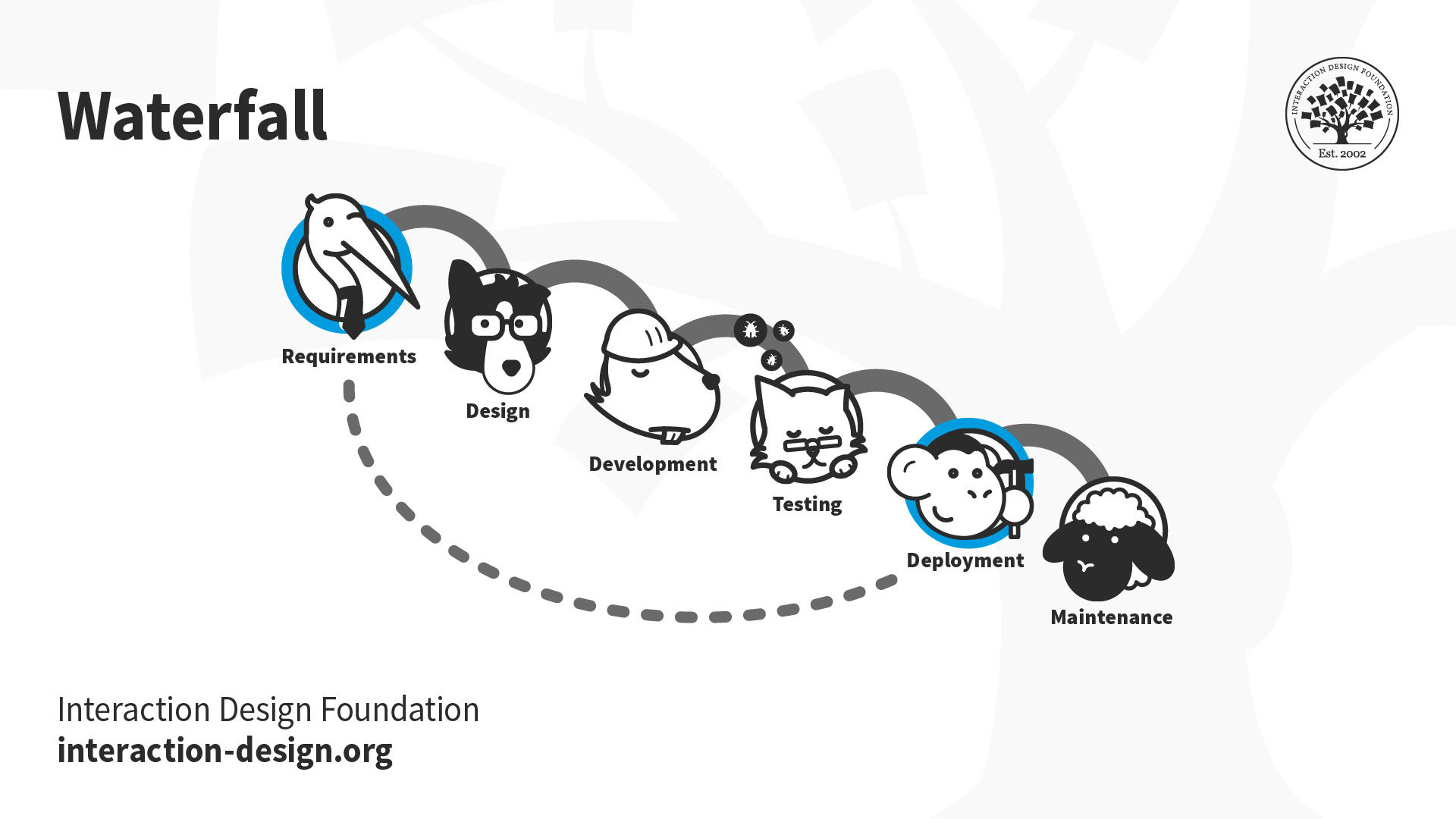
Waterfall process with an arrow drawn from deployment to requirements, with the intermediate steps (design, development and testing) skipped.

© Eduardo Ferreira and Interaction Design Foundation, CC BY-SA 3.0

That might be perfectly acceptable, or even necessary, for your team. Trying to fit everything into a sprint in pursuit of some ideal “agile” solution can lead to some extremely poor outcomes, especially if bigger, more exploratory research is being sacrificed. 

The Take Away 

Explicitly acknowledging the fact that there are different types of research with different time horizons and different logistical requirements can be the first step toward reconciling research with agile methodologies. Having separate teams responsible for the different types of research can be an important step in not burning out all the researchers on the team! 

Unfortunately, not all teams have the sorts of resources necessary to have separate teams devoted to different tracks. In that case, researchers need to learn to work at different levels and find the best research methodology suited to the questions they’re trying to answer. 

References and Where to Learn More

Learn more about Lynn Miller’s Dual Track Agile approach here.

Images

© Daniel Skrok and Interaction Design Foundation, CC BY-SA 3.0

Topics in This Article

Learn More in This Course:

AI for Designers

11 days
12 % booked
View Course

What You Should Read Next

  • Read full article
    A Simple Introduction to Lean UX - Article hero image
    Interaction Design Foundation logo

    A Simple Introduction to Lean UX

    Lean UX is an incredibly useful technique when working on projects where the Agile development method is used. Traditional UX techniques often don’t work when development is conducted in rapid bursts – there’s not enough time to deliver UX in the same way. Fundamentally Lean UX and other forms of UX

    Social shares
    1.3k
    Published
    Read Article
  • Read full article
    What Are Wicked Problems and How Might We Solve Them? - Article hero image
    Interaction Design Foundation logo

    What Are Wicked Problems and How Might We Solve Them?

    Have you ever come across a problem so complex that you struggled to know where to start? Then you might have stumbled upon a wicked problem. While wicked problems may not have a definite solution, there are certainly things you can do to mitigate any negative effects. When you learn how to tackle w

    Social shares
    1.2k
    Published
    Read Article
  • Read full article
    User Stories: As a [UX Designer] I want to [embrace Agile] so that [I can make my projects user-centered] - Article hero image
    Interaction Design Foundation logo

    User Stories: As a [UX Designer] I want to [embrace Agile] so that [I can make my projects user-centered]

    Let’s examine a tool so simple yet so powerful that once you’ve learned about it, you will apply it in all your projects. It is a great design method that enhances collaboration among all stakeholders.Users’ needs are a core part of Agile—and they're brought to life using User Stories.There are many

    Social shares
    1.1k
    Published
    Read Article
  • Read full article
    Design Thinking: New Innovative Thinking for New Problems - Article hero image
    Interaction Design Foundation logo

    Design Thinking: New Innovative Thinking for New Problems

    Einstein was certainly right — we can’t solve problems by using the same kind of thinking we used when we created them. In addition, with the rapid changes in society, the methods we have previously used to solve many of the problems we face are no longer effective. We need to develop new ways of th

    Social shares
    1.1k
    Published
    Read Article
  • Read full article
    Minimum Viable Product (MVP) and Design - Balancing Risk to Gain Reward - Article hero image
    Interaction Design Foundation logo

    Minimum Viable Product (MVP) and Design - Balancing Risk to Gain Reward

    The idea of the minimum viable product (MVP) has been around for some time. The term itself was coined by Frank Robinson but was made popular by two influential names in product design – Steve Blank, a serial-entrepreneur and academic, and Eric Ries, the pioneer of the Lean Startup movement.What is

    Social shares
    1.1k
    Published
    Read Article
  • Read full article
    Three Ideation Methods to Enhance Your Innovative Thinking - Article hero image
    Interaction Design Foundation logo

    Three Ideation Methods to Enhance Your Innovative Thinking

    “In a world where business is more interested in ‘best practice’ rather than different practice, is it any wonder that products and services, companies and organizations are all beginning to look the same?” the three authors rhetorically ask in ?What If!'s classic book on creativity and innovation,

    Social shares
    906
    Published
    Read Article
  • Read full article
    User Stories - Capturing the User’s Perspective Quickly and Simply - Article hero image
    Interaction Design Foundation logo

    User Stories - Capturing the User’s Perspective Quickly and Simply

    User stories are a simple tool for articulating the user’s perspective. They are not long, wordy stories to be told around a camp fire but rather short (often only a single sentence) descriptions of what a user will do with a part of a system. They are written in plain English or in the language of

    Social shares
    863
    Published
    Read Article
  • Read full article
    What Tech Job is Right for Me? A Comprehensive Guide to Navigating Your Career Path - Article hero image
    Interaction Design Foundation logo

    What Tech Job is Right for Me? A Comprehensive Guide to Navigating Your Career Path

    Think about which tech career is right for you and you may well find that choosing a career is about getting work that offers fulfilling employment, personal growth opportunities, and—of course—good remuneration. If you’re finding yourself contemplating a change or exploring alternative paths on you

    Social shares
    817
    Published
    Read Article
  • Read full article
    Designing the Smallest Possible Thing - Article hero image
    Interaction Design Foundation logo

    Designing the Smallest Possible Thing

    We conducted research with hundreds of people working on agile teams about their experiences in order to understand some of the biggest design problems they encounter. Designers who work in sprints of one or two weeks can be under pressure to deliver fast, skip research and cut corners, which can pr

    Social shares
    748
    Published
    Read Article
  • Read full article
    Innovate with UX: Design User-Friendly AR Experiences - Article hero image
    Interaction Design Foundation logo

    Innovate with UX: Design User-Friendly AR Experiences

    What if your favorite video game characters could come to life or your online shopping could appear right in your living room? Augmented reality (AR) transforms how we interact with digital content. Imagine creating immersive experiences where users can explore 3D models, overlay information on real

    Social shares
    608
    Published
    Read Article

Top Articles

Top Topic Definitions

Feel Stuck?
Want Better Job Options?

AI is replacing jobs everywhere, yet design jobs are booming with a projected 45% job growth. With design skills, you can create products and services people love. More love means more impact and greater salary potential.

At IxDF, we help you from your first course to your next job, all in one place.

See How Design Skills Turn Into Job Options
Privacy Settings
By using this site, you accept our Cookie Policy and Terms of Use.
Customize
Accept all

Be the One Who Inspires

People remember who shares great ideas.

Share on:

Academic Credibility — On Autopilot

Don't waste time googling citation formats. Just copy, paste and look legit in seconds.

Feel Stuck? Want Freedom?

Join 326,071+ designers who get one powerful email each week. Learn to design a life you love.

Next email in
0
days
19
hrs
5
mins
3
secs

Free forever. No spam. Unsubscribe anytime.