Information Visualization – A Brief 20th and 21st Century History

• 7 min read

608 Shares

Information visualization has a long history and there were great strides made in the field between the 17th and 19th centuries, in particular. However, the 20th century has seen the greatest progress in the development of information visualization thanks to the development of computing power. Visualizations like the redrawing of the figurative map of the Successive Losses in Men of the French Army in the Russian Campaign of 1812–1813, pictured below, could now be rendered in increasing detail and with interactive elements.
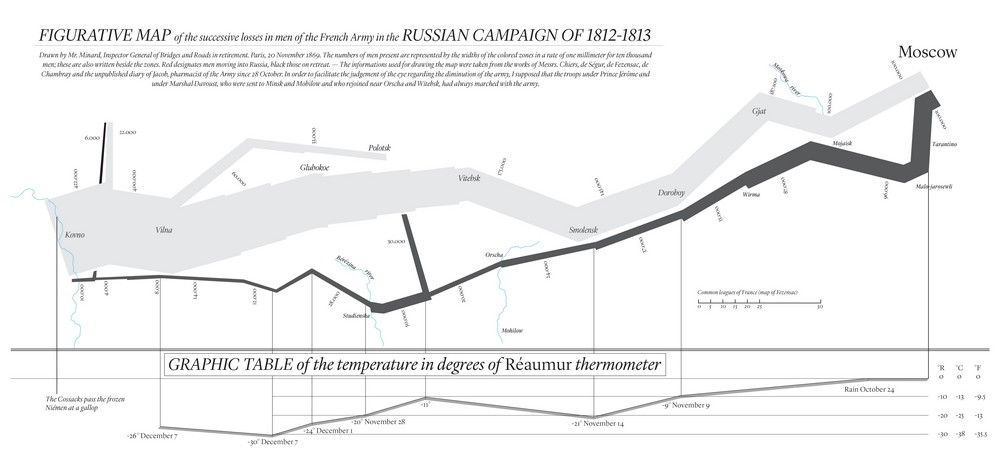

Author/Copyright holder: Iñigo Lopez. Copyright terms and licence: CC BY-SA 4.0

Information Visualization in the 20th Century

In the early 20th century the field of information visualization progressed little. Small efforts were made to refine existing models but overall – while visualizations were still being produced with regularity; the discipline seemed to fall from prominence and discoveries were few and far between.

However, the development of information technology in the latter half of the 20th century created a boom in information visualization which is still continuing to this very day.

The pace of change has been so dramatic in the 20th century that a detailed history would be next to impossible to create. No sooner had a new idea been created but it had been disseminated (thanks to the Internet and other networks) and improved upon, revised and republished.

However, Michael Friendly of the Psychology Department and Statistical Consulting Service of York University in Toronto, in his paper “A Brief History of Data Visualization” offers some of the most significant changes as follows:

1950-1975 - Data Visualization Changes

John Tukey, in 1962, published a paper “The Future of Data Analysis”. In that paper he explored the discipline of information visualization (without referring to information visualization as this term would only become common parlance after being coined at Xerox PARC in the 1980s) and in particular began to create new models that could be used for analysis such as boxplots, hanging rootograms, etc.

Tukey’s work revitalized the discipline and began to draw professionals back into the field of data analysis.

In 1967, Jaques Bertin, of France attempted to unify graphics and their presentation in his work Semiologie Graphique. It provided huge insight into the way that information could be produced visually to give greater insight in statistical analysis.

Then in the late 1950s and 1960s the adoption of the programming language, FORTRAN, which was the first “high level” language began to enable the creation of computer processed statistical data – greatly increasing the volumes of information to be processed. FORTRAN would move with the times and remain a language long after the original punch card entry systems (see below) were obsolete. In the late 1960s the process of creating information visualizations by computer was underway and the first statistical applications began to emerge in the early 1970s.
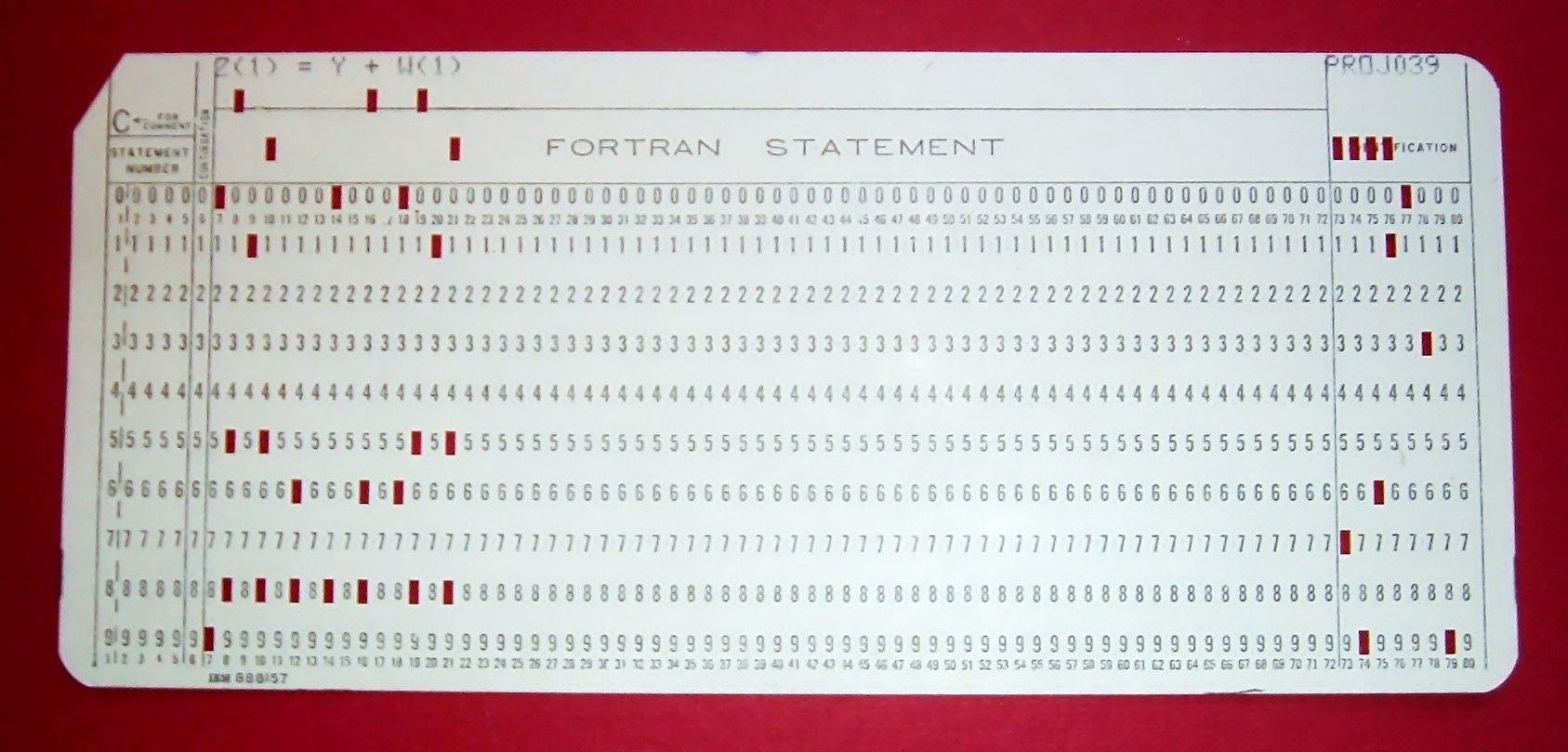

Author/Copyright holder: Arnold Reinhold. Copyright terms and licence: CC BY-SA 2.5

Many forms of statistical representation would emerge in the early 1970s too including: the Fourier function plot, Chernoff faces, start plots, clustering and representations and biplots using multi-dimensional scaling.

1975 – To The Present Day – The Emergence of Interactive and Dynamic Data Visualization

This is where it becomes more difficult to give a precise timeline to the delivery of advances in information visualization. Michael Friendly offers these key points:

  • Highly interactive statistical computing systems have been developed and are in common use. This is compared to early command-driven systems which used compiled, batch processing.

  • There are new methods for visual data analysis that have been implemented such as linking, brushing, selection, focusing, etc. that can be applied to interactive data models.

  • Data with large volumes of dimensions can be better analyzed thanks to the development of tools to do this such as the grand tour, the scatterplot matrix, parallel coordinate plots, etc.

  • There have been new techniques developed for graphing discrete, categorical data.

  • The field of information visualization has broadened to encompass many new forms of data, data structure and indeed problem solving.

  • The information visualization field has begun to implement understanding of the cognitive and perceptual aspects of displaying data in addition to delivering simple static visualizations which were aesthetically pleasing.
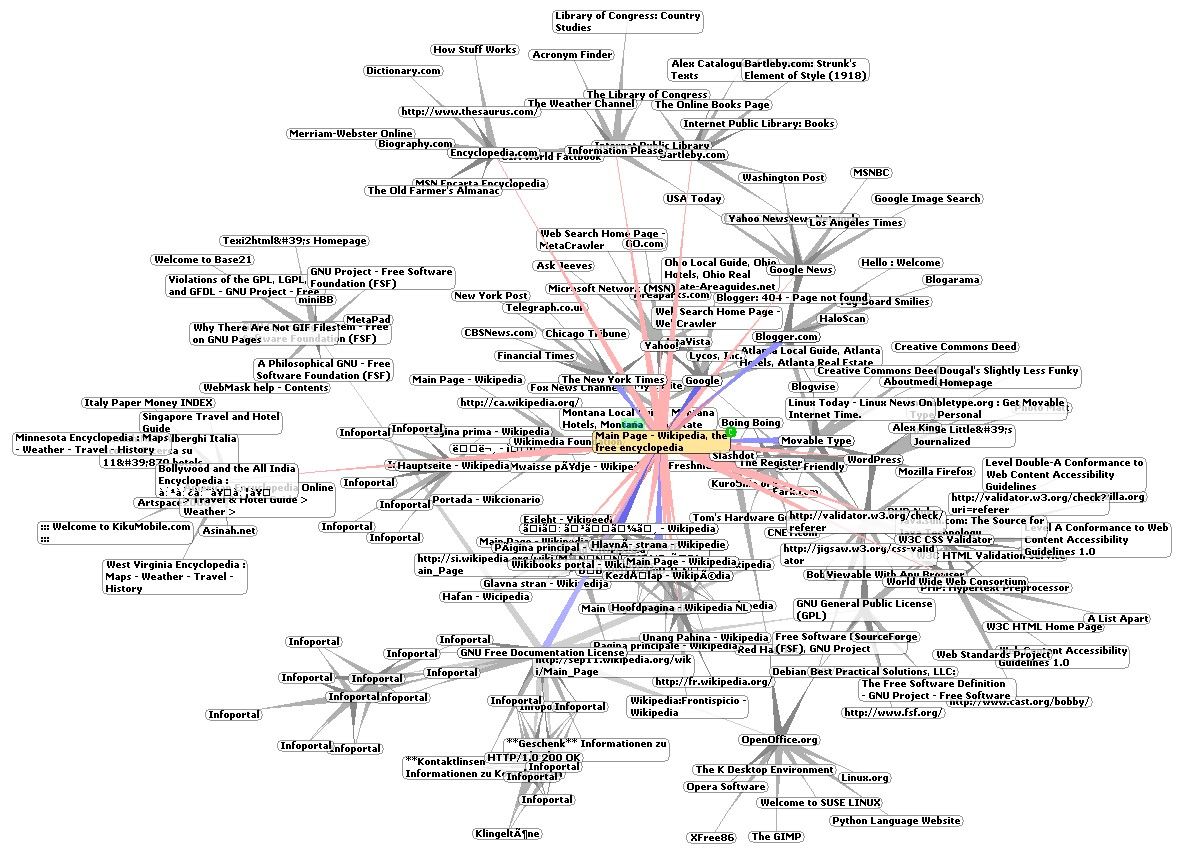

Author/Copyright holder: Chris 73. Copyright terms and licence: CC BY-SA 3.0

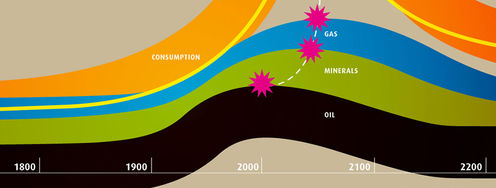
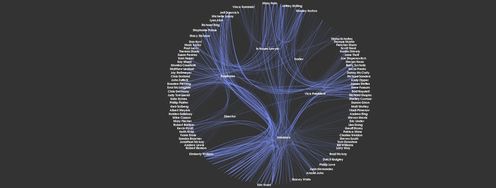
While, theoretically, images such as the one above could have been created manually – in practice they require computing power to be manageable to develop cost-effectively. A tiny mistake would render such a diagram useless if drawn by hand; on a computer a click of a button can amend the visualization.

In addition to this throughout the century – more and more powerful applications have been developed to enable information visualization. This includes the development of dynamic graphic methods which allow for fast and easy, direct manipulation of graphics and their properties by the users of the data.

The Take Away

The 20th century has been a period of remarkable advancement in information visualization thanks to the advent of computing and the dawn of “big data”. It is difficult, if not impossible, to provide a perfect chronology of events for this period thanks to the levels of rapid advancement in the field and collaborative iteration of new methods between ever more connected, thanks to the Internet, research and development teams.

References

A longer history of data visualization can be found here by Michael Friendly of York University, Toronto.

Edward Tufte’s work, which can be purchased from his website, offers the most detailed history of information visualization here.

Young, F. W., Valero-Mora, P., and Friendly, M. (2006). Visual Statistics: Seeing Data with Dynamic Interactive Graphics. New York: Wiley

Hero Image: Author/Copyright holder: Mario Klingemann. Copyright terms and licence: CC BY-NC 2.0

Learn More in This Course:

AI for Designers

12 days
13 % booked
View Course

What You Should Read Next

  • Read full article
    Data Analysis: Techniques, Tools, and Processes - Article hero image
    Interaction Design Foundation logo

    Data Analysis: Techniques, Tools, and Processes

    Data analysis is one of those terms that “is what it sounds like,” although there’s more to it than may meet the eye. In any case, it’s a valuable skill for making better decisions—a skill that you can bring to bear on both your professional and personal life, from personal budgeting to analyzing cu

    Social shares
    1.2k
    Published
    Read Article
  • Read full article
    Information Overload, Why it Matters and How to Combat It - Article hero image
    Interaction Design Foundation logo

    Information Overload, Why it Matters and How to Combat It

    Designers often need to convey information to the users of their designs. Specialists in information visualization design in particular find themselves presenting data over and over again to their users. However, it’s important when developing your designs that you don’t create “information overload

    Social shares
    1.2k
    Published
    Read Article
  • Read full article
    How to Design an Information Visualization - Article hero image
    Interaction Design Foundation logo

    How to Design an Information Visualization

    Designing information visualizations offers you endless possibilities when it comes to end products, and it would be impossible to provide step-by-step instructions for all these possibilities. However, it is fair to say that while the end products may vary dramatically – the process by which we rea

    Social shares
    984
    Published
    Read Article
  • Read full article
    Preattentive Visual Properties and How to Use Them in Information Visualization - Article hero image
    Interaction Design Foundation logo

    Preattentive Visual Properties and How to Use Them in Information Visualization

    A preattentive visual property is one which is processed in spatial memory without our conscious action. In essence it takes less than 500 milliseconds for the eye and the brain to process a preattentive property of any image. This is good news for information visualization designers and graphic des

    Social shares
    978
    Published
    Read Article
  • Read full article
    How to Visualize Your Qualitative User Research Results for Maximum Impact - Article hero image
    Interaction Design Foundation logo

    How to Visualize Your Qualitative User Research Results for Maximum Impact

    When thinking about visualization of research results, many people will automatically have an image of a graph in mind. Do you have that image, too? You would be right in thinking that many research results benefit from a graph-like visualization, showing trends and anomalies. But this is mainly tru

    Social shares
    966
    Published
    Read Article
  • Read full article
    How to Conduct Focus Groups - Article hero image
    Interaction Design Foundation logo

    How to Conduct Focus Groups

    Focus groups have long been a popular tool in market research and have become more popular in user research in the recent past too. They consist of a group of between 5 and 10 users who work with a moderator/facilitator/researcher. The moderator will pose questions from a script to the group. Their

    Social shares
    926
    Published
    Read Article
  • Read full article
    Visual Mapping – The Elements of Information Visualization - Article hero image
    Interaction Design Foundation logo

    Visual Mapping – The Elements of Information Visualization

    Information visualization requires mapping data in a visual or occasionally auditory format for the user of the visualization. This can be challenging because while some data has a spatial relationship built in (for example, temperatures in cities around a country) many data sets don’t have a tradit

    Social shares
    907
    Published
    Read Article
  • Read full article
    The Properties of Human Memory and Their Importance for Information Visualization - Article hero image
    Interaction Design Foundation logo

    The Properties of Human Memory and Their Importance for Information Visualization

    It is important to know that while neuroscience has progressed dramatically over the last decades; there is no complete understanding of how human memory works. We know, for example, that data in the brain is stored in clusters of neurons but we don’t know how, precisely, it is stored or even how it

    Social shares
    903
    Published
    Read Article
  • Read full article
    Guidelines for Good Visual Information Representations - Article hero image
    Interaction Design Foundation logo

    Guidelines for Good Visual Information Representations

    Information visualization is not as easy as it might first appear, particularly when you are examining complex data sets. How do you deliver a “good” representation of the information that you bring out of the data that you are working with?While this may be a subjective area of information visualiz

    Social shares
    900
    Published
    Read Article
  • Read full article
    Rating Scales in UX Research: The Ultimate Guide - Article hero image
    Interaction Design Foundation logo

    Rating Scales in UX Research: The Ultimate Guide

    Picture this: you’re designing a new app or website and want to know how users feel about it, but you want a good way to get actionable insights from those feelings, fast. Feedback is vital—and the sooner you get it, the better—and that’s why something as direct and visual as a rating scale comes in

    Social shares
    882
    Published
    Read Article

Top Articles

Top Topic Definitions

Feel Stuck?
Want Better Job Options?

AI is replacing jobs everywhere, yet design jobs are booming with a projected 45% job growth. With design skills, you can create products and services people love. More love means more impact and greater salary potential.

At IxDF, we help you from your first course to your next job, all in one place.

See How Design Skills Turn Into Job Options
Privacy Settings
By using this site, you accept our Cookie Policy and Terms of Use.
Customize
Accept all

Be the One Who Inspires

People remember who shares great ideas.

Share on:

Academic Credibility — On Autopilot

Don't waste time googling citation formats. Just copy, paste and look legit in seconds.

Feel Stuck? Want Freedom?

Join 326,029+ designers who get one powerful email each week. Learn to design a life you love.

Next email in
1
day
13
hrs
51
mins
53
secs

Free forever. No spam. Unsubscribe anytime.