Esteem needs encompass confidence, strength, self-belief, personal and social acceptance, and respect from others. These needs are represented as one of the key stages in achieving contentedness or self-actualization. While esteem is an internal quality, we are affected by external factors, such as validation and approval from our peers. There are now many different examples of designers tapping into our esteem needs, many of which we can find on social media sites. For this reason, you must consider how to make users feel better about themselves from both owning and using your products.
Human behavior is driven by needs, one of which is the need for a sense of personal importance, value or self-esteem. Esteem is borne out in our desire for social acceptance and status. Regardless of how big or small our group is and the nature of the groups we are affiliated with, we have a deep-rooted need for approval and validation from other members of society. This is perhaps more pronounced within the groups we identify with rather than outside, as a need for validation from everyone we come across would be exhausting and probably lead to some form of social anxiety disorder (either that or you become a comedian). Other problems may arise from an inability to achieve validation and acceptance such as low self-esteem and an inferiority complex.
The Esteem Stage of Maslow's Hierarchy
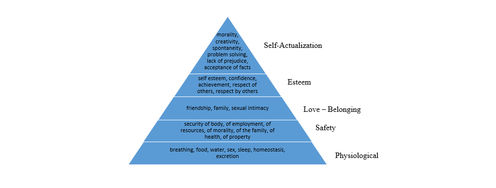
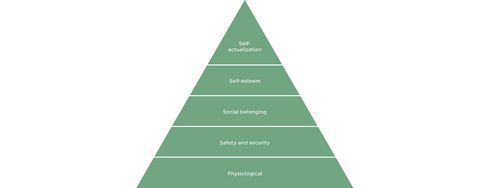
The need for esteem is addressed in Abraham Maslow's 'Hierarchy of Needs'. Esteem is the fourth layer of Maslow's five-tiered model of human motivation and is thought to be interrelated with the other levels of our needs (i.e. self-actualization, love/belonging, safety, and physiological needs). There are a number of component needs involved in achieving a sense of self-esteem, such as respect of others, an internal acceptance of who we actually are, confidence, and achievement. The need for internal acceptance is necessary for any external validation to have a significant and long-lasting effect. For example, if we behave in a certain way that is at odds with our true personality in order to fit in within a particular social group, there remains an underlying awareness that you are not really being accepted, and your approval only lasts as long as you sustain the act. That is, you tend to know for real if you are being fake.
'Higher' and 'Lower' Esteem Needs
Maslow distinguished between two different versions of esteem needs, which are the 'lower' version and 'higher' version. The former is manifested in the actions we take to gain the respect of others, while the latter is the internal need of self-respect. Higher esteem needs might include the desire for physical strength, knowledge, competence, independence and freedom. Lower esteem needs might include status, recognition, fame, celebrity, prestige and any form of attention. Our lower esteem needs are secondary or subordinate to our higher needs, as they rely on an inner strength that we develop over time and with experience. Maslow is only repeating ancient knowledge here – for example, traditional Chinese and Japanese martial arts are not competitive undertakings: they have sought primarily to develop character and inner confidence in the student, emphasizing that the only true “opponent” one has is oneself, the ultimate purpose of studying the art being that one should never actually have to use it. In society, when we are unable to satisfy one or more of these higher or lower needs, depending on their relative importance to us and the group(s) we are part of, our sense of self-esteem is likely to be affected.
Design and Esteem
While esteem is an internal quality, it is reliant on external reinforcement. We may hold certain views about ourselves and make efforts to boost our confidence, strength, and achievements, but most of us still seek validation from our social groups. Websites and applications have been engineered to satisfy our esteem needs through explicit and sometimes implicit methods. For example, in various online applications, games, and websites you might find one or more of the following:
Gamification elements – Sebastian Deterding, researcher at Hamburg University, and his colleagues (2011) define gamification as the use of game design elements in non-game contexts. Two gamification elements that are directed at esteem are these:
Leaderboards – A list of the top performers for a particular group of people, such as gamers, course takers (as you have probably seen in the weekly lesson release emails from the IxDF), and reviewers.
Achievements – Virtual rewards are often given to users when they have completed one or more tasks, such as entering profile details on a dating site or completing levels in an online game. These small, intangible rewards may seem silly to some, but they provide encouragement to continue using a product and keep going so as to achieve the next badge, moniker, percentage increase, etc.
Starred reviews – When users leave reviews for products of some sort, other users are frequently able to state whether the review was useful or not. For example, Amazon users can click 'Yes' or 'No' in response to the question 'Was this review helpful to you?'. The reviewer is then able to see how other people have responded, which can make him/her feel validated and more likely to continue reviewing (i.e. carry out an important function for the website for free).
‘Likes’ – Social media has provided us with some of the more explicit examples of approval and validation, one of which is the 'like'.
‘Retweets’ – These are another example of social approval from social media. While retweeting does not always connote approval, this Twitter feature is generally used to show the user feels positively (e.g., they agree, find the tweet funny or they want other people see the comment on their feed) about the other user's contribution.
The Take Away
Esteem needs encompass confidence, strength, self-belief, personal and social acceptance, and respect from others. These needs are represented as one of the key stages in achieving contentedness or self-actualization. While esteem is an internal quality, we are affected by external factors, such as validation and approval from our peers. There are now many different examples of designers tapping into our esteem needs, many of which can be found on social media sites. For this reason, you must consider how to make users feel better about themselves from both owning and using your products – you must design by aiming at how they like to see themselves within their social contexts.
References & Where to Learn More
Copyright: User LMFAO on Wikimedia commons, Copyright License and Terms: Public Domain
Deterding, S., Dixon, D., Khaled, R., & Nacke, L. (2011, September). “From game design elements to gamefulness: defining gamification”. In Proceedings of the 15th international academic MindTrek conference: Envisioning future media environments (pp. 9-15). ACM.