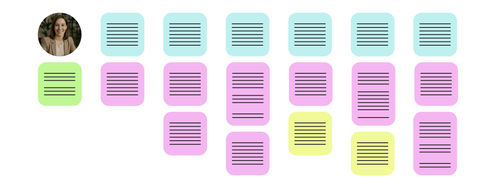
Personas for casual user Pete, business user Jennifer, and power user Brad list their different phone-use needs

UX Research Communication – Know Your Audience

• 5 min read

554 Shares
Save

Welcome to the UX Daily; if you’re not a regular visitor – we publish new UX and design related content every day of the week. This week we’re going to be looking at communication and UX research. Why? Because all the research in the world will be wasted if we can’t convey what it means to the people who approve our budgets, time, etc. and that means that our user experience will suffer too.

Know Your Audience

Among other things, I’m a professional trainer. My job, for more than a decade, has been to take concepts and present them to a wide variety of audiences. I’ve trained salespeople, boards, customer care agents, retail staff, warehouse workers, railway engineers, and a whole heck of a lot more groups of people too. The one thing that I learned early was that you cannot assume that your audience will be the same as your last audience even when they do the same thing for the same company.


Author/Copyright holder: Emerging Blue. Copyright terms and licence: All rights reserved Img source


For UX professionals there’s a wide audience to communicate with too. From the project sponsor right down to the software engineers and designers working at the virtual coalface. Each of these people needs something different from us and it’s our job to ensure that they get it.

How do you work out the way people communicate? Well for a trainer it’s actually pretty easy; you take the first 15 minutes of a training session to talk to people. You find out what they want from the day and while they talk to you – you learn their preferred communication styles and you can even throw in the occasional joke to find out about their sense of humour too. It helps to make people laugh when you’re training computer systems; it stops them from throwing themselves under a bus at lunchtime when they realize they’ve got 5 more days to go…

Now, the UX pro won’t always have the luxury of bringing their stakeholders altogether in the same room but they can still run a similar sort of process. It’s a good idea to meet your stakeholders (separately if necessary) very early on in your project. While you’re introducing yourself and what you do, etc. you can take the time to ask them what they want from you in terms of communication. That’s all it takes – asking. Ask them for copies of reports, e-mails, etc. that they’ve actually enjoyed receiving or responding to on certain issues. Ask them to define what they need in a report before you write it and you’ll find that your job is going to be much easier when you need to deliver it.


Author/Copyright holder: New Media and Marketing. Copyright terms and licence: All rights reserved Img source


Don’t just rely on what people say though; as you move forward with the project – observe the stakeholders and team; what do they really like? The more you refine your communication style for your audience the easier it will be to carry them with you.

Header Image: Author/Copyright holder: Front Digital. Copyright terms and licence: All rights reserved. Img

Learn More in This Course:

Learn Design and AI From the Best

Get one powerful email each week, like 311,224 others.

Next email in:

What You Should Read Next

  • Read full article
    Sustainability Is Not Enough - Article hero image

    Sustainability Is Not Enough

    Sustainable design. Sustainable fashion. Sustainable living. We often hear these terms in marketing campaigns and popular media. But what does sustainability mean and why does pioneer of User Experience Design Don Norman think that sustainability shouldn’t be our goal when we design?In this video, D

    Social shares
    484
    Published
    Read Article
  • Read full article
    Black Friday 2024: Invest in UX Design Education - Article hero image

    Black Friday 2024: Invest in UX Design Education

    “The best investment you can make, is an investment in yourself... The more you learn, the more you'll earn.”—Warren Buffett, Chairman and CEO of Berkshire HathawayHow many items have you added to your Black Friday shopping wishlist? This year, instead of short-term deals on products, why not take a

    Social shares
    563
    Published
    Read Article
  • Read full article
    Why Is AI so Important and How Is It Changing the World? - Article hero image

    Why Is AI so Important and How Is It Changing the World?

    You've heard about AI and all the wonderful (and sometimes scary) possibilities. But unlike sci-fi apocalyptic movies, AI isn't out to destroy humanity. Let's take a look at the challenges and opportunities we face as AI meets design.In this video, Ioana Teleanu, Founder of UX Goodies and former Lea

    Social shares
    485
    Published
    Read Article
  • Read full article
    Who, What, and How: Design Maps Show You the Way for Implementation - Article hero image

    Who, What, and How: Design Maps Show You the Way for Implementation

    For something called a “team project,” it’s amazing how often everyone’s on a different page. Design maps connect the dots. They organize your research, stories of use, and design artifacts into clear, user-centered interfaces that your team can actually build fast. No more “Wait, what did you mean

    Social shares
    401
    Published
    Read Article
  • Read full article
    How Can Designers Adapt to New Technologies? The Future of Technology in Design - Article hero image

    How Can Designers Adapt to New Technologies? The Future of Technology in Design

    The design industry is rapidly evolving with the integration of technologies such as artificial intelligence (AI) and 3D printing. While there may be concerns about job displacement, history has demonstrated that new technologies typically create more job opportunities. Don Norman, author of The Des

    Social shares
    690
    Published
    Read Article
  • Read full article
    Conceptual Models: The Hidden Structure Behind Your Next Great Interface - Article hero image

    Conceptual Models: The Hidden Structure Behind Your Next Great Interface

    Ever wondered why some interfaces feel effortless: like they already know what you’re trying to do, while others leave you guessing? The difference often lies in how well a product’s design matches the way users think. When your interface reflects their mental model, every action feels intuitive, an

    Social shares
    479
    Published
    Read Article
  • Read full article
    Get to Grips with Constraints - Article hero image

    Get to Grips with Constraints

    Got constraints? Perfect. That’s where great design begins. Just as electrical standards define how a toaster safely works without shaping what it does, your software also lives within boundaries that quietly guide its behavior. Functional requirements describe what your system does: the stories of

    Social shares
    475
    Published
    Read Article
  • Read full article
    How Persona Stories Help You Design for Real People - Article hero image

    How Persona Stories Help You Design for Real People

    User stories caught on because they were quick and simple, but speed often came at the cost of real understanding. A “user” in a story is rarely more than a guess, shaped by the assumptions of whoever wrote it. When you shift to persona stories, you ground your work in real research and real people.

    Social shares
    400
    Published
    Read Article
  • Read full article
    Use Cases: The Ideal Bridge Between Requirements and Design? - Article hero image

    Use Cases: The Ideal Bridge Between Requirements and Design?

    Imagine trying to describe everything your product needs to do, without getting lost in technical detail or endless feature lists. That’s the problem Ivar Jacobson set out to solve in the 1980s when he introduced use cases. Instead of worrying about how a system worked internally, he described it fr

    Social shares
    418
    Published
    Read Article
  • Read full article
    What is Good Design? - Article hero image

    What is Good Design?

    Design matters. It enables us to understand, communicate and improve the world around us. When done right, design has the power to improve the everyday lives of users. When done wrong, design can disrupt and frustrate users. As a designer, you have the power to improve the everyday lives of your use

    Social shares
    670
    Published
    Read Article

Top Articles

Top Topic Definitions

39% of Today's Skills Will Change by 2030

The World Economic Forum expects 39% of today's skills to be transformed or become outdated by 2030.

The good news is that jobs in UX / UI design and AI are among the fastest-growing professions globally.

Build Skills That Keep You Relevant

Privacy Settings

By using this site, you accept our Cookie Policy and Terms of Use.
Customize
Accept all

Be the One Who Inspires

People remember who shares great ideas.

Share on:

Academic Credibility — On Autopilot

Don't waste time googling citation formats. Just copy, paste and look legit in seconds.

Learn Design and AI From the Best

Get one powerful email each week, like 311,224 others.

Next email in: