Alan Dix in his presentation in 2008 to the University of Technology in Berlin defined the path of use. It simply illustrates that products do not magically become used but rather there is a definite progression between a state of not used and used. It is important to be able to consider this path when designing and marketing products in order to drive adoption and use.
Path of Use
Your constantly-updated definition of Path of Use and collection of videos and articles.
Be a conversation starter: Share this page and inspire others!
Get 1 Powerful Email Each Week
Join 313,191 subscribers.
What is Path of Use?
Learn More About Path of Use
Make learning as easy as watching Netflix: Learn more about Path of Use by taking the online IxDF Course Get Your Product Used: Adoption and Appropriation.
Why? Because design skills make you valuable. In any job. Any industry.
Earn Industry-Recognized Certificates
Industry giants trust our courses to train their teams, and prestigious universities integrate our content into their curricula. Add your certificates to your LinkedIn profile, résumé, and job applications.



All Free IxDF Articles on Path of Use

Managing the Path of Use
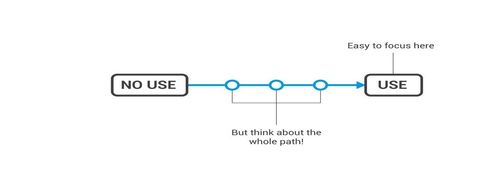
The path of use is simple and straightforward; it begins with “no use” and ends in “use”. It was first described by Alan Dix, the HCI expert and University Professor, in his 2008 presentation to the University of Technology in Berlin.The purpose of the path of use is not to state the obvious; which
- Social shares
- 463
- Published
Read Article
Managing the Path of Use
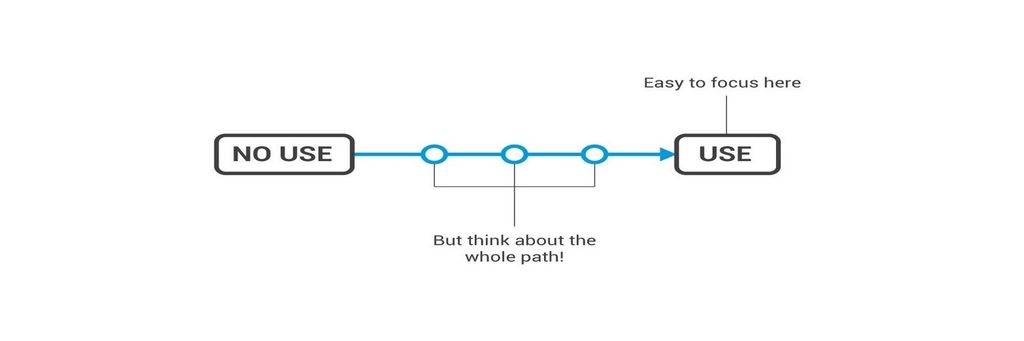
The path of use is simple and straightforward; it begins with “no use” and ends in “use”. It was first described by Alan Dix, the HCI expert and University Professor, in his 2008 presentation to the University of Technology in Berlin.
The purpose of the path of use is not to state the obvious; which if you give a couple of seconds thought to the idea of use it is. But rather to get designers to focus on the idea that “use” isn’t something that occurs by magic. Your users will not wake up one morning and think; “I need your product!” and then go out and find it.
There is a process that users follow to get from a state where they are:
Unaware that they need the product
Unaware that the product exists
Unaware that your product is best suited to their needs
To a state where they begin to use your product.
User and Market Research
 Author/Copyright holder: gdsteam. Copyright terms and licence: CC BY 2.0
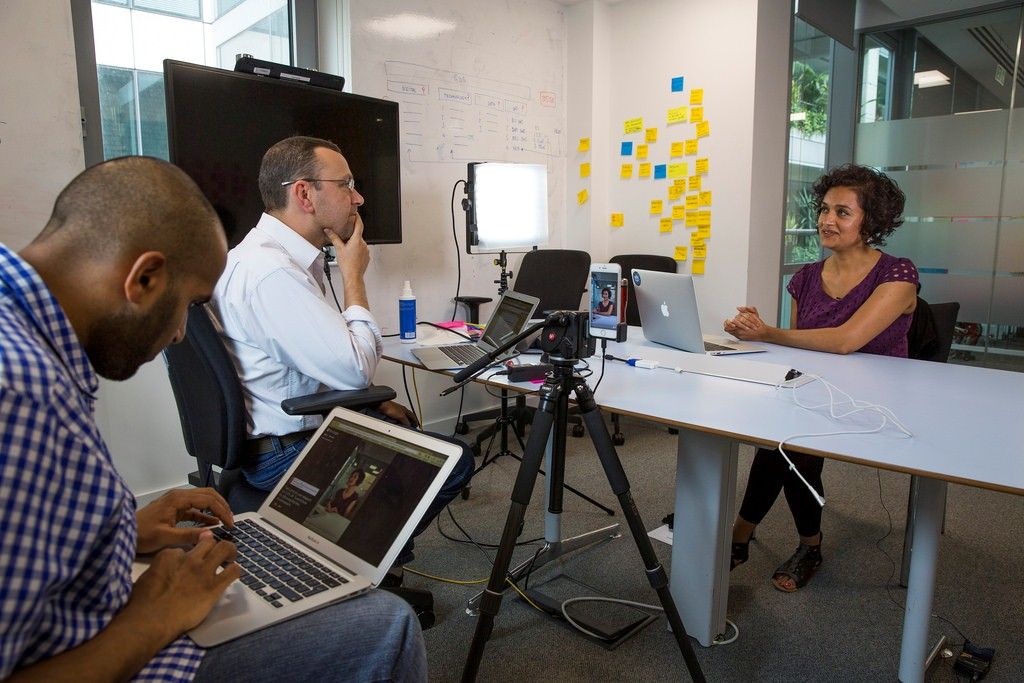
User research and market research are often separate activities within an organization. User research is focused on working out what users need from a product and testing products to see if they meet those needs. Market research is about determining customer bases and how to reach those customers.
Yet, for many organizations the terms “user” and “customer” are nearly interchangeable in the majority of instances. Someone who buys a camera, for example, is very likely to be the person who uses the camera. If someone wants to download a mobile app and pay for it; there’s a pretty good chance that they are the person who will use it too.
If you are to manage the path of use; it’s important to recognize that there is little distinction between users and customers in the majority of instances. Combining market research and user research will offer the best insight into how to manage that path.
User research will reveal:
What users want
How to deliver what they want
Whether or not that expectation has been met through design
And as Jakob Nielsen, one of the pre-eminent user researchers says; “…pay attention to what users do, not what they say.”
Market research will reveal:
Which communities of users should be involved in user research – in particular innovators and early adopters can be identified early and brought into user research
How to communicate effectively with innovators and early adopters
How best to educate users that the product exists and what benefits it will bring
How to achieve rapid adoption of successful designs
The overlap between these two spheres enables design and marketing for adoption. A product is only a success if it is being used. Moving from a potential user from a state of no awareness of a product to a user requires careful thought and action from both design and marketing.
Just Think
 Author/Copyright holder: the Skinny. Copyright terms and licence: CC BY-SA 4.0
In his talk, to the University of Technology in Berlin, Alan Dix encourages designers to “just think” when it comes to managing the path of use. He says that if you are aware of the path and that you consider it when performing the design of a product – you are more likely to design for adoption.
A conscious effort to build products which are not just useful or usable but which are aimed at being adopted by an audience is more likely to bring about the objective of adoption than a process which excludes such conscious effort.
The Power of Size
Big companies can leverage their existing power to overcome the need to manage the path of use. For example Microsoft was able to turn Internet Explorer into the world’s most popular Internet browser simply by putting it into their operating system. Apple, which doesn’t quite have the reach of Microsoft, achieved dominance on the Apple platform with the Safari browser in a very similar manner.
When Google, for example, wants to drive the adoption of a new product it can simply add it to its website and marry the functionality to an existing service or product such as Gmail.
Author/Copyright holder: Vova Serg. Copyright terms and licence: Fair Use.
When You’re Not a Business Giant
Alan Dix also offers some simple advice for managing the path of use when you cannot leverage a powerful position to force adoption of a product or service.
He says that you should; “make it easy for users to adopt the product” by removing barriers to adoption as best as possible and that you should; “understand the values of users” and meet those values with your designs.
The Take Away
Managing the path of use means marrying user research and market research so that designers can focus on the whole process from “no use” to “use”. A conscious effort to understand what it is that will drive usage can result in real improvements to adoption of products. Big companies have the opportunity to leverage assets they already have to “force” adoption such as integration with an operating system or existing web service or web site.