The task-artifact cycle (artifact can also be spelled artefact) captures the idea that tasks and artifacts coevolve (Carroll et al. 1991). The cyclical relationship between the two can be described as follows: A given task sets requirements for the design of an artifacts to help an individual perform the task. The resulting artifact, in turn, creates new or uexpected possibilities or pose new constraints on the performance of the task. These possiblities and/or constraints often suggest a revision of the original task for which the artefact was made. The new task sets new requirements for the redesign of the artifact and so on and so on (de Lëon 1999). The task-artifact cycle is in other words an iterative process of continuous, mutually dependent development between task and artifact, a process that will never reach an optimum state.
Figure 1: The task-artifact cycle.
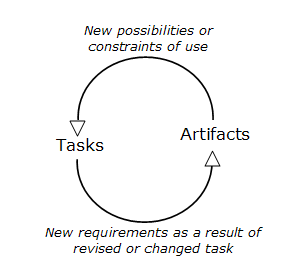
In software terms, it means an endless versioning of software, or a branching of specific sub-programs (e.g. the web components of Adobe Photoshop became ImageReady). This happens because requirements never stabilize and because the act of introducing the software into the work process changes the nature of the work. Also, software is always "appropriated" and will consequently never be used as intended by the designer.
29.0.1 Further perspectives of the task-artifact cycle
Not only does the artifact itself, as suggested by the task-artifact cycle, change the task it was designed to address, but it also has to adapt to other changes in the context of use. Human organisations are continually evolving in the face of changing circumstances and wherever humans are involved, there is a constant negotiation and re-negogation of meaning, work processes, identities, etc. This poses a problem to information systems as computers and software can only respond to pre-defined situations or problems in a finite problem space (Harris and Henderson 1999). Information systems therefore have an inherent disadvantage when trying to keep up with the constant change of the unpredictable humans. Pre-defined, rule-based behaviour is not sufficient, and therefore it is only natural that people continually find their artifacts insufficient for their evolving work practices.
The canonical reference for the term task-artifact cycle is Carroll et al. 1991, but the idea that the term describes was by no means 'discovered' by these researchers.