Your UX design portfolio is the key that gets you a job interview, and it is therefore vital that you include everything necessary in it. After all, a recruiter spends only a few minutes to form an opinion of you through your portfolio. If you’re new to UX, however, you might not know what exactly needs to go inside a UX portfolio. Fret not—we’ll examine the anatomy of a UX design portfolio to tell you what you should communicate through it and what you should include in it.
What Should Your UX Design Portfolio Communicate?
Before we talk about the contents of your UX design portfolio, let’s zoom out to get an overview of what your UX portfolio is about. This will show you what you need to include in it.
Your UX design portfolio is a tool you use to land a job interview. As such, it should communicate a specific message to its users—that is, recruiters.
It Should Explain What You’ve Been Working on and How You Work
Make sure your UX design portfolio communicates the “what” and “how”: what you’ve been working on and how you work. That’s the key advice from Stephen Gay, Design Lead at Google Adwords Display and Apps.
Stephen explains more about the “what” and “how”:
Stephen Gay explains that he looks for a balance of the “what” and “how” in a UX design portfolio: what you’ve been working on and how you work. Both elements must be equally present in your portfolio. Author/copyright holder: Stephen Gay and the Interaction Design Foundation. Copyright terms and license: CC BY-NC-SA 3.0.
This means, for example, that it’s not enough if you just include UX case studies that explain what you’ve designed. Through the case studies and throughout your UX design portfolio, you should let recruiters know about your approach to work, too. Highlight your ability to work in teams and showcase your passion in what you do.
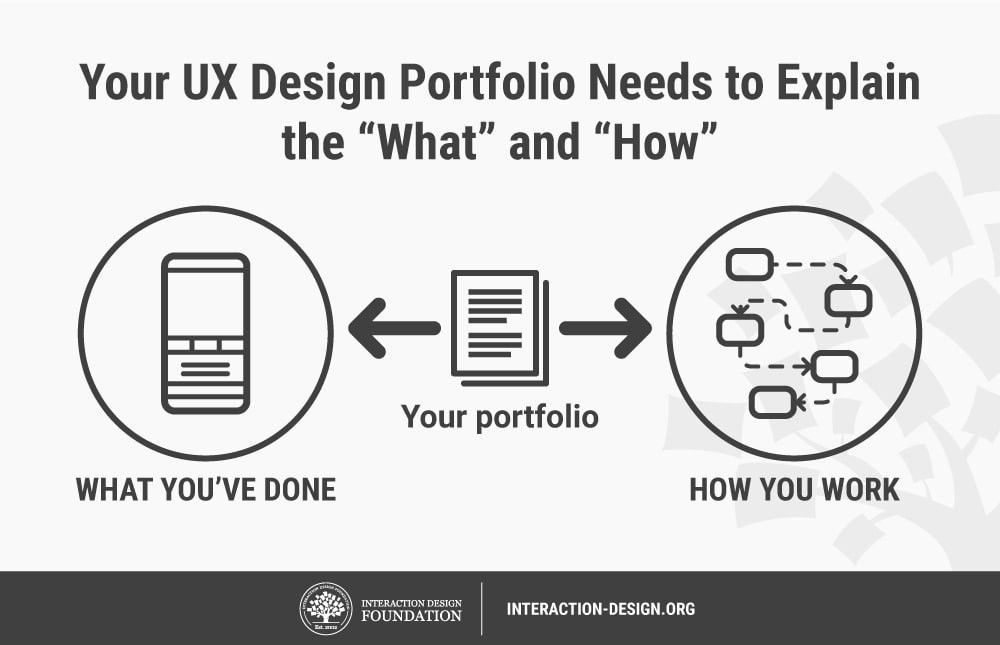
Remember to not only show what you’ve done but also communicate how you work through your UX design portfolio. Author / copyright holder: Teo Yu Siang and the Interaction Design Foundation. Copyright license and terms: CC BY-NC-SA 3.0
It Should Express Your Proficiency in Design
Recruiters expect to see a level of craft in your UX portfolio. In fact, many recruiters evaluate your portfolio based not only on the contents of your UX case studies but also on the quality of your portfolio’s design!
Everything in your UX design portfolio should reflect your proficiency in design. After all, your portfolio is a designed product itself. Even if your role is non-visual, you need to make sure your portfolio is easy and pleasant to use.
Daniel Rosenberg is an author and professor, and for 18 years he led Oracle and SAP’s global UX design efforts across all product lines. He advises:
“Any sloppiness in the design of the [UX design portfolio], independent of the design of the artifacts that you’ve produced, tells the hiring manager a lot about you.”
—Daniel Rosenberg, global UX executive
So, What Should Your UX Design Portfolio Contain?
Now that we know the meta-level messages that your UX design portfolio should communicate, we can focus on the concrete-level details of what you should include in it.
In summary, your UX design portfolio should contain 3–4 UX case studies and some information about yourself. Let’s go into more detail.
Include 3 to 4 Relevant UX Case Studies
Your UX design portfolio should contain 3–4 relevant UX case studies to sufficiently demonstrate your abilities. If you’re new to UX, recruiters might accept UX design portfolios that contain 1–2 UX case studies.
Your UX case studies have to be relevant to the job role for which you want to apply. For instance, if you want to be a UX designer, your UX case studies should demonstrate your ability to work on an end-to-end design project, from the initial stage of empathizing with users right to the final stage of creating a prototype. Conversely, if you want to be a user researcher, your UX case studies should highlight your research skills.
It’s better to remove irrelevant UX case studies and end up with a UX design portfolio with less content than to include case studies irrelevant to your UX role. That’s because if your UX design portfolio contains a messy mix of case studies, you’re telling your recruiter that you don’t really know what you want to be. Going back to Stephen Gay’s advice, you’ll muddle the “what you’ve been doing” message that your UX design portfolio sends.
If possible, show a variety of UX case studies. This way, you’ll showcase a wider range of skills. For example, to demonstrate your skills as a UX designer, you could show 2 case studies that involve mobile apps and 1 case study that involves usability testing. This lets recruiters know, for instance, that you can do more than design mobile apps.
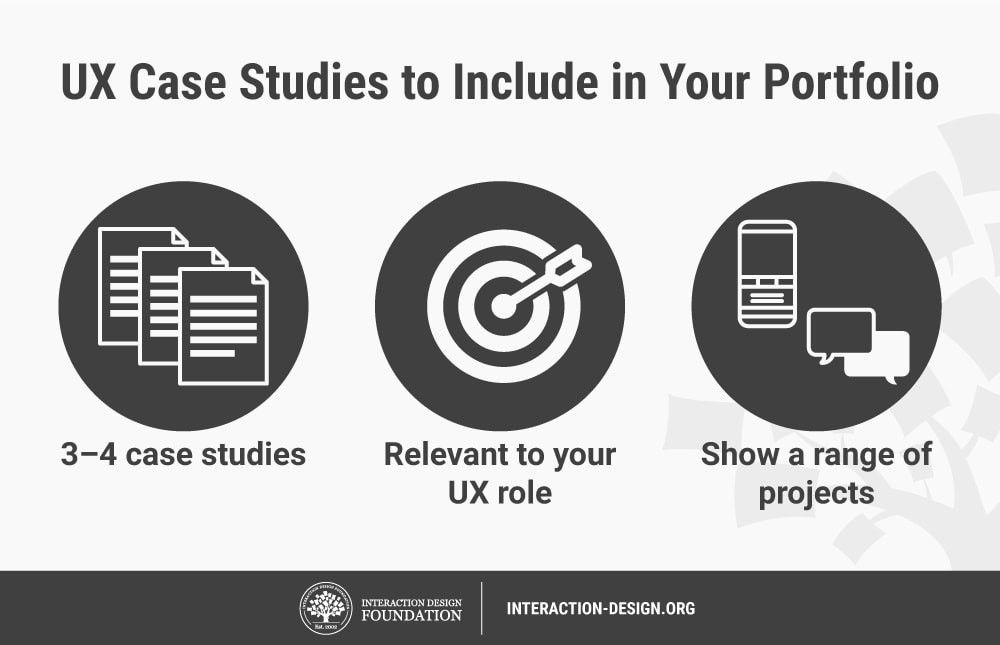
You should include 3–4 UX case studies that are relevant to your UX role in your portfolio. Ideally, the case studies should showcase a range of projects so you can demonstrate your versatility. Author / copyright holder: Teo Yu Siang and the Interaction Design Foundation. Copyright license and terms: CC BY-NC-SA 3.0
Include Some Information About Yourself
Your UX design portfolio’s goal is to let a recruiter know about you and your skills, so it goes without saying that it should contain some information about yourself.
Let recruiters know your educational background. You don’t have to show your entire schooling history, but it would be great to highlight your college and any design-related coursework. For example, you can show the courses you’ve completed at the Interaction Design Foundation to prove your design skills. You should also include the industry-recognized course certificate you get for each course you complete―and the unique link you get so recruiters can verify it. Interaction Design Foundation Course Certificates are trusted by industry leaders such as Adobe, Accenture, Philips and IBM who’ve taken up company memberships with the IxDF. When you showcase your Course Certificate you emphasize the skills that you possess as a UX designer―and you show that you take courses in the company of the very best design companies.
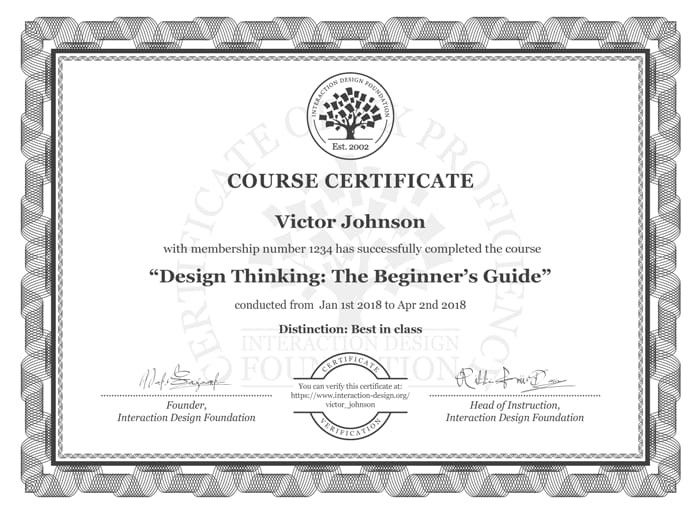
Include the industry-recognized course certificate you get for each Interaction Design Foundation course you complete―and remember to insert the individual link you get so recruiters can verify the authenticity.
Include your work history briefly. Focus on relevant or major roles you’ve taken on, rather than list all the jobs you’ve done. Recruiters who want to hire a UX designer won’t care if you’ve worked part-time as a shop assistant! In your resume, you should elaborate some more and describe all relevant positions. It’s a great idea to link to your resume in your portfolio, so the recruiter can easily check out your work history in more detail.
What about personal information and social media links? According to Michael Hawley, Chief Design Officer of design agency Mad*Pow, it’s more important to demonstrate your passion in UX than it is to share personal information about yourself:
“Personal stuff, whether you’re married or have kids, is not important. The best UXers live it. It’s best to demonstrate your passion. Did you participate in a hack-a-thon? Do you volunteer your time at industry events? Do you have relevant blog posts?”
—Michael Hawley, Chief Design Officer of Mad*Pow
Along the same lines, you should carefully choose which social media links to include in your UX design portfolio. Portfolio sites such as Behance and Dribbble and professional networking sites (e.g., LinkedIn) are appropriate, but you should make sure they’re regularly updated. Exercise caution before you share your personal social media links, such as those of your Facebook and Twitter profiles. You don’t want a recruiter to discover a year-old post in which you complained about work!
The Take Away
Your UX design portfolio is your ticket to a job interview. To start with, your portfolio should say what you’ve been doing as well as how you work, so you give recruiters a holistic idea of your value as a team-mate. Furthermore, your portfolio should be well-designed and reflect your level of design expertise.
When it comes to the concrete things you should include in your UX design portfolio, ensure that it features 3–4 UX case studies as well as some information about you. Your UX case studies should be relevant to your job role and showcase a range of topics to fully sell you as a viable candidate. When it comes to information about you, focus on your education (such as IxDF courses) and work history, as well as a carefully curated list of social media and portfolio links.
References and Where to Learn More
Read more about Michael Hawley’s and others’ tips on UX portfolios: What Do Recruiters and Hiring Managers Look for in a UX Portfolio?
Hero image: Author / Copyright holder: Teo Yu Siang and the Interaction Design Foundation. Copyright terms and license: CC BY-NC-SA 3.0.