Recruiting the right participants is crucial if your user research is to get your design anywhere. Your research participants must be able to represent your target group or end users; otherwise, your results will not translate into something you can use. The level of difficulty you will face when recruiting participants depends on your criteria. If your criteria are general, such as age group and location, recruiting participants is an easy matter. If your criteria are more specific, things can get more involved and time-consuming. Here, we will go through the considerations you should make when deciding what type of research participants you want and give you pointers on how you can recruit the participants you need to make your project matter far, far more to the real users later.
Recruiting a Sample of Users
If you want to do effective user research, you'll need to recruit participants who represent your (potential) users. These participants should possess characteristics found in your eventual customers — the people in your target group. Many products and services have various user types or groups, so you need to recruit a range of research participants to tap into these variations. Ideally, time and budget permitting, when dealing with a product with multiple user groups, you should research with each group separately.
Companies sometimes outsource the job of recruiting research participants to a specialist firm or group. Such specialist firms will also need to take demographics and other qualities and characteristics into consideration when selecting potential participants on behalf of their clients. The firm requires knowledge of the target users and the context under investigation, so the recruitment team will need to gather this information before recruitment begins.
Whom Should You Recruit?

© dotshock, Envato Elements, Commercial License
When people are short on time, they may frequently use their colleagues as test participants. Still, it would be best if you were careful about using your colleagues because of the potential for bias.
If the employees feel they must say positive things because they know you or if they know too much about the product, the research sessions will probably fail to yield the desired results.
Another risk is déformation professionnelle — a phenomenon that arises when so many testers from one profession come into contact with an item they must judge. While this may not have to matter if you do manage to latch your project with the perfect niche — for example, you get a bunch of employees from a games manufacturer to test your game — the risk is significant if too many are from one industry. Not having aligned your design solution with your target audience's needs, they'll analyze the design based on their industry know-how. That will cause a slanted view of your work's functionality and its ability to please.
In some projects, recruitment is a straightforward process, as there will be a ready supply of people willing and able to take part. However, when a product has a particular target group, recruitment must identify the best possible candidates from the available pool. For example, when testing a new mobile app for checking which supermarket offers the lowest prices on specific products, recruitment should be relatively straightforward. The target users would be the general public — although you might have a few additional requirements such as a particular age group or income bracket. Recruiters could then ask people outside supermarkets if they would like to participate in the study.
In contrast, if you are developing a new and complicated system for a specific group of workers in a company, you would need either to take a sample of these eventual users or to identify the skills and responsibilities necessary for this role and try to find an equivalent group from another source. In that case, recruitment can take a while because the pool of potential participants is smaller.
Recruitment Criteria

© Wavebreakmedia, Envato Elements, Commercial License.
Before you recruit participants, you must consider what criteria you need to apply when recruiting so that your participants can provide relevant insights for your project. In some cases, your criteria may be very general, such as age, location, and experience with a particular type of widely used product (e.g., laptop computers).
In other cases, you need people who can provide more specific insights into the project you are working on — e.g., someone who has experience using online click-and-collect services or someone who has been through one particular type of treatment at a hospital. Deciding on the right number and type of criteria for research participants is a balancing act. You don't want so few requirements that your participants don't represent your end users. For instance, if you have a design for an app that “almost anyone can use” (such as a low-intensity physical activity monitor), that might be all well and good in the long run, but you'll need to tighten your scope to identify likely customers embodied in your research participants.
On the other hand, you don't want to add criteria that might make it difficult to recruit participants, at least not unless you have to. The more specific the requirements you have, the more effort you must put into recruiting, so you should carefully consider the necessity of each criterion. Often, you need to recruit participants who represent your primary target group, and you don't have to cover every corner case you can think of. Your actual users are likely to end up involving more than just a few unexpected types of users, anyway.
If you have a broad target group, you can use design consultancy IDEO's method of recruiting both “Extremes” and “Mainstreams”. By including extreme users, you can be more confident that your research covers the entire spectrum of your target group. You can, for example, include participants who have minimal computer experience in your test of a new software tool because if they can figure out how to use your software, most other users probably will be able to, too. If you use the extremes and mainstreams methods, just remember to include the mainstream users as well — after all, they are the ones who represent the majority of your target group.
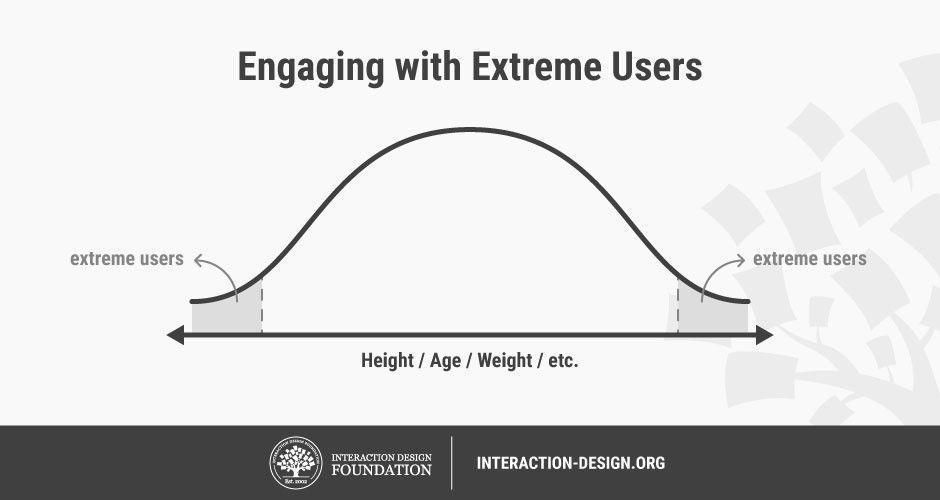
© Teo Yu Siang and Interaction Design Foundation, CC BY-NC-SA 3.0
In most projects, at the minimum, you need to consider the age group of your participants, their geographical location, as well as if there is any specific type of experience they should or should not have. For example, suppose you want to do a usability test of an Android app. In that case, you probably need participants who have experience using Android phones because your end users will also own Android phones and thus have experience with that operating system.
Once you have decided on your criteria, you need to write a screener — a script for screening participants — that you or someone else can use for recruiting by asking questions that will determine whether a potential participant fits into your criteria.
How to Recruit

© Prostock-studio, Envato Elements, Commercial License.
There are different ways to go about recruiting participants. Using a recruitment agency is usually an efficient way to recruit participants, but it is also costly. If you don't have the funds to use a recruitment agency, you must recruit participants yourself. The best way to recruit participants depends on your project. Using your network or posting on social media can be efficient if your participants are people not too far from your social circle. How closely related your participants can be to you again depends on your project, but you have less risk of bias if your participants don't know you personally. If you need to recruit user groups that are hard to reach, you can use interest groups or internet forums where you think people from your target group might be active. Sometimes, recruiting this way requires you to get permission from or go through a moderator who will decide if your request is appropriate for the users in question.
You can make recruiting easier by ensuring that you make the time and location of your sessions as convenient as possible for your potential participants and offer some form of reward or incentive. It's always a good idea to recruit a few more participants than you need; that way, you are sure to have the participants you need in case of no-shows or cancelations. Remember, these participants, just like the users they are standing in for, live in a real world of broken-down cars, sickness, forgetfulness, and all the other “what ifs” that make us human.
The Costs of Recruitment
The chosen research participants will usually receive some form of “reward” or financial compensation for their involvement in the research sessions. Compensation will vary according to the amount of time the research takes and, sometimes, the complexity of the tasks. If the participants are recruited from a specific group of skilled professionals, the rewards may be higher to compensate them appropriately for their time. Rewards can include payment (you can Google what is appropriate), gifts (e.g., vouchers and products), and expenses (e.g., travel, food, and hotel costs). Sometimes, you might find it easier (and overall cheaper) to entice participation by offering a chance to win a prize, rather than offering direct compensation (e.g., "Take part in our study for a chance to win a 50-inch TV."). How much you should pay depends on your geographic region. Usually, you'll find it easy to find out how much is appropriate in your area through a simple Google search. If you do offer compensation, you should keep documentation for your accounting and/or personnel/HR department to show the costs of the process.
If the company or business uses a recruitment firm, the cost of compensating participants will be eclipsed by their expenses. Recruitment groups or individual recruitment agents are typically paid a fee for every research participant who fulfills all of your criteria (i.e., fits the specified demographic and completes the research session).
The recruitment process should be a relatively painless procedure, but it is essential to provide the recruiter(s) with sufficient information to choose the right people for your project. On a final note, remember that your recruited testers will indeed be representing your users, and hopefully in ways that reflect how the real users will engage with your design. Here's a little piece of inspiration to help keep things in perspective:
“When you design a solution, what pops into your head? Here is my answer: that we considered and explored. That we peered ahead into the stress test of the real world, when some harried young woman minding her own business encounters our work. She's not thinking of us, she's thinking of what she has to do that night, an email to write to her professor, a midterm to cram for, laundry to do in preparation for that party on Saturday. And we were prepared for her. We left no detail unexamined.
— Julie Zhuo, Former-Product Design VP at Facebook
Screener Surveys
You can use a screener survey to help you identify research participants. Once you identify the criteria for your research participants, you can draft a questionnaire to “test” potential participants. Questions in the screener are typically in the multiple-choice format that can either eliminate users from taking part in your study or give them access to it.
Screeners may seem easy, but it’s often quite challenging to craft screeners properly. If a user misunderstands the questions, you could end up with test participants who don’t match your criteria.
You can use the qualifying participants’ screener survey responses as a great opening prompt. For example:
“I noticed in your survey responses that you indicated you are currently shopping for a new car. I’m curious to know what kind of car you are looking for.”
The Take Away
Recruiting the right participants is crucial for getting valuable results from your user research. Your participants have to be able to represent your end users. That means that you must consider what criteria you have for your research participants before you can start recruiting. When your criteria are general — such as age and location — recruiting participants is relatively easy, but when you have more specific requirements concerning who you need to participate in your study, it can be more difficult and time-consuming. By involving extreme and mainstream users in the research stage, however, you can improve your chances for latching with your true target users later, as the former two will consist of a blanket of experience (and lack thereof!) that will show you where your design truly stands. As ever, keep accessibility issues and users with disabilities in mind.
References & Where to Learn More
Course: Conducting Usability Testing
For more on how to recruit participants, read this guide about
Recruiting Usability Test Participants
Here’s a handy primer on how to find great participants for your user study
Read more about IDEO’s Extremes and Mainstreams method.
Here is a good repository of templates that you can use in your work, including how to write your screener.
Images
Hero Image: © Dave, CC BY-NC-ND 2.0