Legal and ethical issues confront entrepreneurs and freelancers on a regular basis; learning how to handle them is vital to business success. The legal issues can always be explored with a legal representative, but the ethical issues add more nuances to working life, and making ethical decisions is not always easy. Yet, the ethical business – in the long run – is the one that most people would prefer to work with.
Freelance businesses and business-to-business (B2B) start-ups need to have a handle on the legal and ethical issues that may affect them, their clients or their suppliers. If you want your business to have a good reputation, you need to be able to stay not just within the confines of the law but to apply an ethical approach in all that you do.
Legal vs. Ethical
What’s the difference between legal and ethical? Legal is simply a matter of complying with the laws of your country and—often—with the laws of the client’s country, too.
Ethical is concerned with more than just the law. It’s concerned with the basic principles and common sense of “right and wrong”. For example, you visit a fellow freelancer’s office to discuss potential partnership work. As you’re sitting down, the person you are meeting is called away for a few minutes. You glance at her desk and see a complete list of her clients... wow—that was careless of her.
Quick... Do you make a copy of that list by taking a picture of it with your phone? It may be legal to do this (in fact, it almost certainly is legal to do this in most places)—but it’s not ethical, is it? Breaching someone’s trust like that is wrong, no matter how much we might want to try painting it over to look and feel right.
Common Legal Issues Every Freelancer and B2B Start-up Should Face Actively
Legions of possible legal issues face freelance and business-to-business start-ups. It would be impossible to list all of those for every country; however, here are some common issues you’ll likely face:
Data protection – How will you collect, store and dispose of information relating to clients?
Privacy – How will you ensure that details provided to you are not shared with others? What about when sharing details is necessary (because you’re working on a project with other freelancers, for example)?
Intellectual property – How are copyright, trademarks and patents to be handled?
Contracts – How will you ensure that your contracts are watertight?
Safety law – Are you compliant with health and safety legislation?
Liability issues –What happens if something goes wrong and a client is hurt (or perceive/s himself/herself/themselves to be hurt and sues you)?
The best thing to do to prevent legal issues is to use your common sense, research an issue if in doubt, or seek the services of a legal practitioner in your environment, if necessary: someone who knows the ins and outs of local law and can help you navigate it properly.
 Author/Copyright holder: BusinessSarah. Copyright terms and licence: CC BY 2.0
Intellectual property is an area which is very likely to come up in your working life. You need to know when to assert your rights and how to avoid infringing other people’s rights, too.
You should also consider insurance in the event that you are sued by a client or someone else affected by your business. It can cost a lot of money to go to court.
If you can’t afford legal advice, you may be able to get advice from a business support service provided locally to you or even your local Chamber of Commerce. Some countries even offer completely free legal services for start-ups.
Common Ethical Issues Every Freelancer and B2B Start-up Should Consider
Ethical choices may be less obvious and less clear-cut than getting the legal compliance correct in your business. A freelancer may face a wide range of ethical dilemmas, but some of the most common include:
Conflict of interest – How do you handle a potential client when they are seeking the same results as an existing client, but you can only deliver those results to one client – will you prevent the other from attaining them? (Think, for example, SEO on a website – if you achieve top ranking for one dentist in your neighbourhood, you can’t repeat that for another.) A sea of potential conflicts of interest can be found in freelance life.
Dodgy clients – How do you deal with a potential client who promotes smoking in the developing world? What about one who sells guns? A lot depends on where you feel your own ethical responsibilities lie.
Setting out to fail – What will you do if a client instructs you to do something that will cause the final outcome to fail? Is it ethical to take a client’s money if he/she/they won’t listen to reason? You can see that the road ahead suddenly ends at a cliff edge. You can already imagine someone moaning, “Oh, why didn’t you say something?!”
When the client sucks – If you don’t get paid, how will you respond? You can always leave the client a bad review, but is airing your dirty laundry in public a good idea? How will it impact on your own business? Might you appear petty? Worse, might lashing out make them leave you nasty feedback?
Handling the competition – What do you do if you’re asked for your opinion on a competitor? Is it ever OK to badmouth another freelancer?
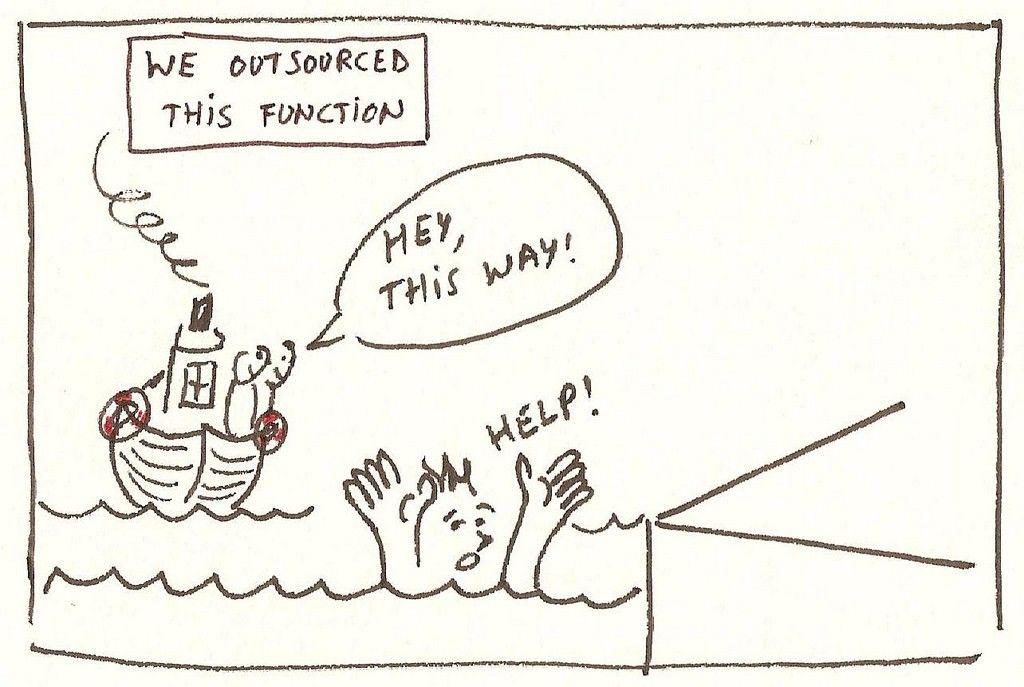
Outsourcing conundrums – A client asks you to work on a big project; in fact, it’s too big for you to handle. You know you can outsource some of the work and get the job done easily enough. Should you tell the client about the act of outsourcing or claim all the work as your own? When should you tell the client—before the work is done or afterwards?
 Author/Copyright holder: Luc Galoppin. Copyright terms and licence: CC BY 2.0
Outsourcing part of your business or project can leave you in real trouble if you don’t approach it very carefully indeed.
Every freelancer and entrepreneur has different opinions on these (and almost every other) ethical dilemmas. How would we handle them?
Conflict of interest – Speak to the existing client, without compromising the identity of the potential client, and ask if they’re OK with us taking on the business. If not, we won’t. If so, however, we would agree a small rate rise based on exclusivity at that time.
Dodgy clients – We wouldn’t represent pro-smoking companies (and we smoke) or a host of other industries that we don’t consider to be ethical (including gun vendors). This is a very personal call, and what’s right for us may quite possibly not be right for you—and vice versa.
Setting out to fail – We would talk to the client and explain why we think they’re going wrong. Then, if they insist that their way is right, we would put our objections in writing and do the job, anyway. Ethically, we feel it’s important to let the client know what we think, but in the long run, it’s their money, and they can spend it how they like... even if it all sinks.
When the client sucks – We think it depends on the level of harm a client does to you. If it’s a small dispute, let it go. If—on The other hand—it’s for $50,000… we think we’d pursue it publicly. If they’re going to hurt our business that badly, they’d probably be willing to hurt yours like that, too. The ethical responsibility at that point is to other freelancers, so we would try to stop such a dangerous menace from wrecking more decent businesses and soiling the freelance realm.
Handling the competition – Never badmouth the competition; it’s unprofessional. Sell your strengths and value; don’t waste time attacking competitors. Even if a client volunteers bad reviews of a competitor, try to steer the conversation back to your value-adding skills and the work under consideration, without joining in the attack. You’ll look and feel better.
Outsourcing conundrums – We’d tell the client that we would need to outsource the moment that became clear. We’d share the details of the outsourcer, too. We wouldn’t be comfortable passing other people’s work off as our own.
Author/Copyright holder: Michael Powerhouse. Copyright terms and licence: CC BY-SA 4.0
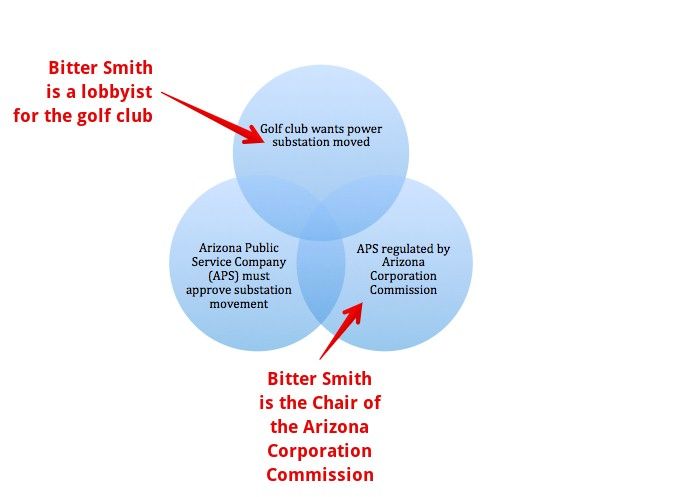
Conflicts of interest can arise in an obvious manner such as here—or in rather less obvious circumstances with several removes and factors. It’s something you’ll need to keep a careful eye on.
If you don’t know how to handle an ethical issue—talk it through with someone. Examine both sides and as many aspects of the issue as you can see, and then decide how to proceed. Remember that your ethical decisions will, in the long term, shape how others view your business. You only have one reputation—don’t squander it.
It’s also worth noting that many professional bodies have a code of ethics. You might want to check out your professional body’s code and sign up to that. This can save a lot of effort when you encounter awkward ethical situations.
The truth is—you will always know the right thing to do. The hard part is doing it. It’s worth remembering this when you face an ethical dilemma and all the gut reactions, long-drawn-out analysing and worrying about the “what ifs” it may involve.
The Take Away
Staying inside the law is the only sensible approach to running a business; if you get caught breaking the law—your professional reputation may be permanently harmed and you might get fined and/or jailed.
Ethics are a little trickier. We all have our own ethical systems—still, as long as you are consistent with yours, you should be fine. Don’t be afraid to ask for help if you can’t find exactly what you should do ethically in any given situation.
References & Where to Learn More
Hero Image: Author/Copyright holder: Kent Bye. Copyright terms and licence: CC BY 2.0
Case studies in handling ethical issues in business: 7 Business Leaders Share How They Solved The Biggest Moral Dilemmas Of Their Careers