How to Succeed in an In-House UX Role

• 8 min read

435 Shares

If you’re a UX designer there’s a good chance that sooner or later; you’re going to find yourself working in-house for a client. This can be a wonderful chance to develop the soft and hard skills of consulting but without careful attention to your approach; it can leave you alone and frustrated too.

So with that in mind, we’ve got some tips to increase the chances of succeeding in that in-house role:

UX Evangelism is Necessary

You need to be able to promote the value in the work you do. Many in-house consultants don’t have a sales and marketing team to call on to do this; so they have to do it themselves. This really boils down to making people aware that there’s a UX service in the building and helping them understand how this can be of benefit to them. You don’t need to turn into the salesperson from hell but you do need to devote some time to evangelism to get it right.

Develop Strong Relationships

You’re not going to achieve very much by yourself. You need allies for UX work and that means developing relationships within the organization. This should be as an ass kissing suck up but rather by determining what it is people need from UX and their own priorities and then helping them deliver their objectives through your work. Talking to people is a good step to developing relationships.


Keep Developing Your UX Skills

You’ll find that most in-house roles require a greater degree of generalism than project specific roles and that means broadening your own horizons. You’ll need to be able to a bit of IA, usability testing, interaction design, research, etc. and that means pursuing a UX education as you work. Whether you do this through book learning, online learning (such as our own programs), classroom learning or take a blended approach isn’t important – what is important is that you do it.

Take UX to a Wider Audience

In-house roles tend to be tied to smaller development teams which means that you have a big burst of activity and then… you’re waiting for the next project to start. You can increase the reach of UX by learning to contribute to other projects. There’s no reason that you can’t bring UX skills to bear on internal processes, for example, and improve the user experience of being an employee. Reach out to other parts of the organization and see where you can add value.

Network

While working alone can be a wonderful thing; it does limit your exposure to new ideas. It’s important to find a UX network (on or offline). They can provide support when things aren’t going well and new ideas too. You can contribute in a similar manner. Most importantly it will give you a sounding board of experienced people who can constructively criticize and enhance your overall skillset. Check out our local groups as a starting off point for this.



Recognize Your Own Limits

The solo practitioner cannot deliver the kind of service that a large UX team can. You need to be aware of this when you propose research and ideas. You are only human and working 100 hours a week will very quickly destroy the love you have for UX. Make certain that your proposals are reasonable and based on your own capacities and capabilities. There’s no point in setting yourself up to fail. If the best solution requires more resources – then you need to ask for those resources or scale down to the second (or third or fourth) best option if you can’t get them.

You Need to Focus on the End Result

It might seem obvious but UX design is all about delivering a great end user experience. Big UX teams often split their focus between the end result and all the stages in between. They create large lists of deliverable items and make beautiful, detailed documentation for their clients. The trouble is that the solo UX designer can’t deliver as many detailed documents and produce the end-result. If you have to cut corners, it should be on mid-project documentation and not on the design for the end user.

Consider Building Internal UX Capacity

Just because you have no budget for other UX team members it doesn’t mean that you can’t rope in other people in the organization to get involved unofficially with UX. You can bring people together to talk about UX. You can invite them to get involved in UX projects and show where there’s a benefit to their own work. You could share training materials with them. You can create a mailing list about UX ideas and share your thoughts with that list. You may even be able to get people to dedicate some of their time to attending UX networking events with you too.

Build a Library of UX Resources

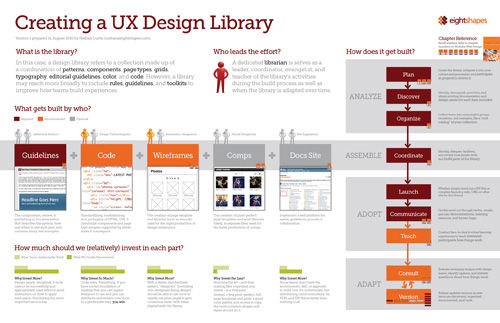
See if you can get a budget for UX books, templates, etc. Then create some useful UX tool templates yourself and bring them together in a single repository where everyone can access them. This can be really helpful not just to your peers but also to you – you never know when something you’ve done in the past can be recycled to help a new project. A library of UX resources can be incredibly helpful to you as well as other folks in the business.


Learn to Be Patient

In-house resources often have to battle to get the importance of UX work understood within the organization and to have the outputs accepted by the wider project team. Nobody said that you would be blessed with instant success and total acceptance. There’s a need for patience in in-house roles. You will, if you stick at it, eventually convince others of the importance of UX – but it may take some time. Patience is the key to long-term happiness in an in-house UX role.

Imgs:

http://matthewtyas.com/wp-content/uploads/2013/01/prototyping2.jpg

http://www.neon.org.nz/images/Exceptional_workplaces2.jpg

/images/ux-daily/54ec78af0ccaaaef6ef1b22a1d73bc4fc721efb732de1.jpg

http://www.uie.com/articles/images/design_library/CreatingAUXDesignLibrary.500.jpg

 

Learn More in This Course:

AI for Designers

8 days
19 % booked
View Course

What You Should Read Next

  • Read full article
    Why Care about Statistical Significance? - Article hero image
    Interaction Design Foundation logo

    Why Care about Statistical Significance?

    The categorical data depicts the success and failure rate of the low-fidelity wireframe above. There is not a large enough difference between the two to determine if the designs were successful.There is an element of error involved in measuring anything. So, when we want to compare measurements, how

    Social shares
    432
    Published
    Read Article
  • Read full article
    Web Fonts: Definition and 10 Recommendations - Article hero image
    Interaction Design Foundation logo

    Web Fonts: Definition and 10 Recommendations

    Web fonts bring digital content to life. They enhance readability, set the tone, and ensure consistency across various platforms—all vital ingredients. When you understand web fonts and their impact, it can help you with effective website creation—and greatly so. We’ll provide a comprehensive overvi

    Social shares
    781
    Published
    Read Article
  • Read full article
    How to Screen Research Participants - Article hero image
    Interaction Design Foundation logo

    How to Screen Research Participants

    Finding the right participants is crucial for gathering user research. We usually need to do research with participants having a particular set of needs or experience. In this short video, you will find out about the basic need for screening and how we make sure that we have suitably qualified parti

    Social shares
    450
    Published
    Read Article
  • Read full article
    Pitfalls in Recruiting Participants for User Research - Article hero image
    Interaction Design Foundation logo

    Pitfalls in Recruiting Participants for User Research

    The level of participant engagement is an important part of the user research results. Our results are dependent on proper engagement with our participants. In this video we look at some of the issues around participant recruitment and hear practical examples that arose in a large online study.[[vid

    Social shares
    419
    Published
    Read Article
  • Read full article
    How to Fit Quantitative Research into the Project Lifecycle - Article hero image
    Interaction Design Foundation logo

    How to Fit Quantitative Research into the Project Lifecycle

    Quantitative research methods fit into the project lifecycle at different stages of the process.In this video, we see where different quantitative research methods fit into a typical project lifecycle. Bear in mind that even with an iterative process such as Agile, the short cycles still address dif

    Social shares
    510
    Published
    Read Article
  • Read full article
    How to Resolve Conflicts Between Design Thinking and Marketing - Article hero image
    Interaction Design Foundation logo

    How to Resolve Conflicts Between Design Thinking and Marketing

    In the past, designers often reported to marketing managers and were neither expected nor allowed to make business decisions. When traditionally-structured companies transition to a design-driven mindset, there can be friction between the marketing and design teams. Let’s take a closer look at this

    Social shares
    682
    Published
    Read Article
  • Read full article
    Stop the Generic Portfolio Trap! Design a Stand-Out Portfolio for Your UX/UI Niche: User Research - Article hero image
    Interaction Design Foundation logo

    Stop the Generic Portfolio Trap! Design a Stand-Out Portfolio for Your UX/UI Niche: User Research

    User research is indispensable—and without it, well... UX design is guesswork. When you’re a user researcher, you know this well—but it can be hard to communicate your work in a way that grabs the viewer and holds their attention. And that’s what a portfolio is all about—grabbing the attention of yo

    Social shares
    383
    Published
    Read Article
  • Read full article
    Top Service Blueprint Templates - Article hero image
    Interaction Design Foundation logo

    Top Service Blueprint Templates

    Service blueprint tools are vital for effective customer experience design—and for designers to make experiences that are exceptional. Here, we’ll discuss why these tools are so important. What’s more, we’ll explore templates and practical resources to create high-quality, efficient service blueprin

    Social shares
    638
    Published
    Read Article
  • Read full article
    How to Write Research Questions that Lead to Confident Design - Article hero image
    Interaction Design Foundation logo

    How to Write Research Questions that Lead to Confident Design

    Designing with Data provides an extensive background to A/B testing.As with all other research methods, we need to start with a research question. A/B testing concerns itself with changes in user behavior, meaning that our questions need to be centered on measurable goals. In many cases, these will

    Social shares
    450
    Published
    Read Article
  • Read full article
    Getting Started - Article hero image
    Interaction Design Foundation logo

    Getting Started

    We start our introduction to A/B and multivariate testing (MVT) by looking at their basic principles and their differences. Note that the video mentions Google Optimize, which has been withdrawn. Google Firebase can be used for mobile platforms. Third-party solutions are needed for A/B testing on th

    Social shares
    225
    Published
    Read Article

Top Articles

Top Topic Definitions

Feel Stuck?
Want Better Job Options?

AI is replacing jobs everywhere, yet design jobs are booming with a projected 45% job growth. With design skills, you can create products and services people love. More love means more impact and greater salary potential.

At IxDF, we help you from your first course to your next job, all in one place.

See How Design Skills Turn Into Job Options
Privacy Settings
By using this site, you accept our Cookie Policy and Terms of Use.
Customize
Accept all

Be the One Who Inspires

People remember who shares great ideas.

Share on:

Academic Credibility — On Autopilot

Don't waste time googling citation formats. Just copy, paste and look legit in seconds.

Feel stuck? Want Freedom?

Get one powerful email each week, like 325,742 others.

Learn to design a life you love.

Next email in:
5
days
11
hrs
50
mins
8
secs