whiteboard with strategy illustrations

Understanding Your Business To Get Your UX Strategy Right

• 7 min read

611 Shares

In order to get your UX strategy right, you need to dig a little deeper than just into your user’s wants, needs, dreams and desires. One of the key elements, for getting your UX strategy just right, is understanding the business itself.

You must deliver on the overall business strategy to succeed. You cannot be a “user champion” without being a “corporate champion” too. It’s easy to get carried away with the former and neglect the latter – so how do we better understand the business we work for in order to develop our UX strategy holistically.

A Question or Two

What does your company do to earn profits?

  • You make/design products and services and sell them, right?

  • Then why is it that so many UX designers struggle with this next question?

  • What do you need to do to beat your competitors and how can User Experience deliver real impact on this?

The Core of User Experience Strategy

Yet, the answer to that question is what defines the core of your UX strategy. If you don’t know which buttons to push or levers to pull within the organization to achieve external results; you’re shooting in the dark. You can’t control the way your competitors behave, of course, but you can control the way you approach your market and position for advantage.

Much of the knowledge that you need to do this is already available to you. Your colleagues, team members, stakeholders, management, etc. have access to the information you want. You just have to ask for it.

You need to ask questions like:

  • How are our offerings currently positioned in the market?

  • What are the operating and ongoing costs of the business?

  • How does the pricing model work? Why was it chosen over the alternatives?

  • What are the key factors that influence our overall margin?

  • What might make a competitor more or less successful in any given year than we are?

  • What do you think our potential customers prefer in the current competitive offerings?

  • What are the company’s plans for strategic growth this year, next year and in the longer future?

  • What categories of product are key to that growth?

It is answers to questions like these that allow you to start asking UX questions that support the answers provided.

For example; if you’re told that category X is the key strategic category for the business. You can then examine how you can draw attention to that category via your app or website without relying on the time tested “giant banner ad”.

Or you might want to examine how you can improve profitability through the user experience by increasing “add on” sales to the same volumes sold in retail stores, thus supplementing a low margin leader product with higher margin support.

The link between the core user experience and the business needs is a vital part of UX becoming a serious contributor to business objectives.
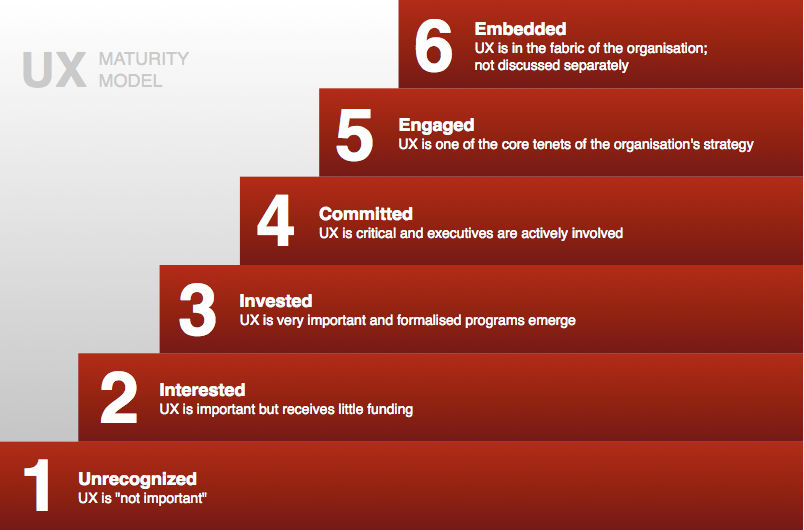

Johnny Holland's UX Maturity Model ranks organisations into 6 categories based on how well UX is integrated in the business. From the bottom up, the ranks are: 1. Unrecognised: UX is 'not important'. 2. Interested: UX is important but receives little funding. 3. Invested: UX is very important and formalised programs emerge. 4. Committed: UX is critical and executives are actively involved. 5. Engaged: UX is one of the core tenets of the organisation;s strategy. 6. Embedded: UX is in the fabric of organisation; not discussed separately.

© Johnny Holland, All rights reserved.

Exploring Business Strategy

Businesses have a tendency to produce a fair number of documents that elucidate the strategic direction the business is taking. The smart UX pro will do a fair amount of running around to lay hands upon this documentation and use it wisely to develop their understanding of business strategy to tune the UX strategy to complement and support it.

Look for marketing plans, competitive analysis reports, the operating plan, the 5 year plan (don’t take this too seriously but do look at the near future), supply-chain management plans, industry reports, etc.

You may need a little help working through some of these reports. There’s probably nothing drier and more difficult to tackle at first glance than a company’s annual reports. However, in our experience – there’s always someone in finance just dying to explain these to the layman. In particular, they can point out financial pain points and help you make sense of the headline objectives for the next year.

If you have a dedicated strategy unit in house – go and talk to them too. You may find that there’s somebody there who has been waiting a long time for a UX team member to come and see how they can join minds and come up with valuable strategic output that works in tandem rather than at loggerheads.

Check The Company Vision Too

Vision statements are often taken as marketing BS and treated with a certain amount of sniggering behind the hands when they’re brought out in the light. Yet, the company’s vision provides an excellent means of “sense checking” your UX strategy. If your company has a strategic vision, it’s likely that the senior management team (at a minimum) spent quite a bit of time and effort creating that vision.

Microsoft’s “A PC on every Desktop and in every home” was a classic and easy statement to use. Unfortunately, that vision has been remodelled along with Microsoft’s strategy and it’s a less easy to remember; “to create a family of devices and services for individuals and businesses that empower people around the globe at home, at work and on the go, for the activities they value most.”

However, while the statement may not be as punchy as before – it’s still pretty easy to work out whether your UX strategy aligns with such a vision.

Highlighting where the business strategy and the UX strategy are in harmony and support the company vision will make it much easier for you to promote your work within your company.

During the process, you’ll start to communicate in the language of the business rather than just in the language of UX. This linguistic transformation will also aid your quest to raise the profile of UX – when the executive team fully understands how your work benefits their objectives; they’re much more likely to see the value in that work.
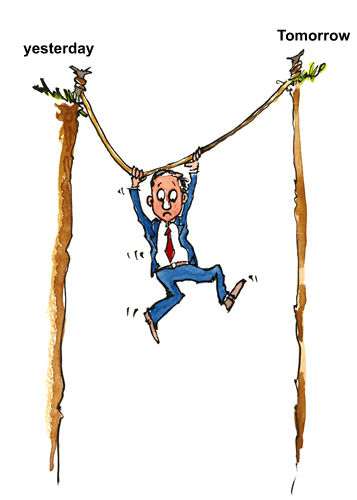
A cartoon of a man crossing a gorge on a rope. One side of the gorge is labeled 'yesterday', the other, 'tomorrow'. The man crossing the gorge is nervously hanging on to the rope at the middle, looking down at the empty space between the two sides of the gorge.
© Frits Ahlefeldt-Laurvig, CC BY-ND 2.0

Summary

Aligning the UX strategy with the Business Strategy is an essential part of getting UX to the forefront and winning support for the work you do. It’s not too complicated to achieve either.

Header Image: © Sebastiaan ter Burg, CC BY 2.0


Learn More in This Course:

AI for Designers

12 days
13 % booked
View Course

What You Should Read Next

  • Read full article
    Why Care about Statistical Significance? - Article hero image
    Interaction Design Foundation logo

    Why Care about Statistical Significance?

    The categorical data depicts the success and failure rate of the low-fidelity wireframe above. There is not a large enough difference between the two to determine if the designs were successful.There is an element of error involved in measuring anything. So, when we want to compare measurements, how

    Social shares
    430
    Published
    Read Article
  • Read full article
    Web Fonts: Definition and 10 Recommendations - Article hero image
    Interaction Design Foundation logo

    Web Fonts: Definition and 10 Recommendations

    Web fonts bring digital content to life. They enhance readability, set the tone, and ensure consistency across various platforms—all vital ingredients. When you understand web fonts and their impact, it can help you with effective website creation—and greatly so. We’ll provide a comprehensive overvi

    Social shares
    778
    Published
    Read Article
  • Read full article
    How to Screen Research Participants - Article hero image
    Interaction Design Foundation logo

    How to Screen Research Participants

    Finding the right participants is crucial for gathering user research. We usually need to do research with participants having a particular set of needs or experience. In this short video, you will find out about the basic need for screening and how we make sure that we have suitably qualified parti

    Social shares
    449
    Published
    Read Article
  • Read full article
    Pitfalls in Recruiting Participants for User Research - Article hero image
    Interaction Design Foundation logo

    Pitfalls in Recruiting Participants for User Research

    The level of participant engagement is an important part of the user research results. Our results are dependent on proper engagement with our participants. In this video we look at some of the issues around participant recruitment and hear practical examples that arose in a large online study.[[vid

    Social shares
    417
    Published
    Read Article
  • Read full article
    How to Fit Quantitative Research into the Project Lifecycle - Article hero image
    Interaction Design Foundation logo

    How to Fit Quantitative Research into the Project Lifecycle

    Quantitative research methods fit into the project lifecycle at different stages of the process.In this video, we see where different quantitative research methods fit into a typical project lifecycle. Bear in mind that even with an iterative process such as Agile, the short cycles still address dif

    Social shares
    509
    Published
    Read Article
  • Read full article
    How to Resolve Conflicts Between Design Thinking and Marketing - Article hero image
    Interaction Design Foundation logo

    How to Resolve Conflicts Between Design Thinking and Marketing

    In the past, designers often reported to marketing managers and were neither expected nor allowed to make business decisions. When traditionally-structured companies transition to a design-driven mindset, there can be friction between the marketing and design teams. Let’s take a closer look at this

    Social shares
    682
    Published
    Read Article
  • Read full article
    Stop the Generic Portfolio Trap! Design a Stand-Out Portfolio for Your UX/UI Niche: User Research - Article hero image
    Interaction Design Foundation logo

    Stop the Generic Portfolio Trap! Design a Stand-Out Portfolio for Your UX/UI Niche: User Research

    User research is indispensable—and without it, well... UX design is guesswork. When you’re a user researcher, you know this well—but it can be hard to communicate your work in a way that grabs the viewer and holds their attention. And that’s what a portfolio is all about—grabbing the attention of yo

    Social shares
    380
    Published
    Read Article
  • Read full article
    Top Service Blueprint Templates - Article hero image
    Interaction Design Foundation logo

    Top Service Blueprint Templates

    Service blueprint tools are vital for effective customer experience design—and for designers to make experiences that are exceptional. Here, we’ll discuss why these tools are so important. What’s more, we’ll explore templates and practical resources to create high-quality, efficient service blueprin

    Social shares
    636
    Published
    Read Article
  • Read full article
    How to Write Research Questions that Lead to Confident Design - Article hero image
    Interaction Design Foundation logo

    How to Write Research Questions that Lead to Confident Design

    Designing with Data provides an extensive background to A/B testing.As with all other research methods, we need to start with a research question. A/B testing concerns itself with changes in user behavior, meaning that our questions need to be centered on measurable goals. In many cases, these will

    Social shares
    448
    Published
    Read Article
  • Read full article
    Getting Started - Article hero image
    Interaction Design Foundation logo

    Getting Started

    We start our introduction to A/B and multivariate testing (MVT) by looking at their basic principles and their differences. Note that the video mentions Google Optimize, which has been withdrawn. Google Firebase can be used for mobile platforms. Third-party solutions are needed for A/B testing on th

    Social shares
    217
    Published
    Read Article

Top Articles

Top Topic Definitions

Feel Stuck?
Want Better Job Options?

AI is replacing jobs everywhere, yet design jobs are booming with a projected 45% job growth. With design skills, you can create products and services people love. More love means more impact and greater salary potential.

At IxDF, we help you from your first course to your next job, all in one place.

See How Design Skills Turn Into Job Options
Privacy Settings
By using this site, you accept our Cookie Policy and Terms of Use.
Customize
Accept all

Be the One Who Inspires

People remember who shares great ideas.

Share on:

Academic Credibility — On Autopilot

Don't waste time googling citation formats. Just copy, paste and look legit in seconds.

Feel Stuck? Want Freedom?

Join 326,020+ designers who get one powerful email each week. Learn to design a life you love.

Next email in
1
day
15
hrs
38
mins
15
secs

Free forever. No spam. Unsubscribe anytime.