Persuasive UX Techniques that You Might Not Have Heard Of

• 8 min read

464 Shares

If you’re involved in the user experience of selling or persuading and let’s be fair, most UX designers are, then you want to be able to use as many tools as possible to drive decisions in your direction. Of course, you could head for the dark side and cheat, extort and mislead your users but the problem is that this doesn’t generate lasting relationships and real UX professionals want to keep their users not just empty their pockets as fast as possible.

Of course, you already know about the idea that scarcity (letting people know that something will soon no longer be available), exclusivity (hey – if your name’s not down, you’re not coming in) and social proof (doesn’t everyone want to keep up with the Joneses?) can work but we’ve found some other techniques that you might not have heard of yet too:

The Easier Instructions are To Read – The Easier they Are to Carry Out

If you put two identical sets of instructions in front of someone; the first in a standard and easy to read font and the second in say… Comic Sans; people will tell you that they expect that the ones in an easy to read font will be easier to carry out that the ones in Comic Sans. Easy to read text isn’t just an issue that affects “usability”, it actually encourages people to do what you ask them to because they perceive it to be easier to do.



Author/Copyright holder: Ken-ichi Ueda. Copyright terms and licence: CC BY-NC 2.0

Progress Leads to Perseverance

If you’ve ever got stuck into binge watching a TV series, you’ll understand this. The closer you get to bedtime, the easier it is to watch; “just one more episode” which inevitably leads to another because “there’s not much left to go”.

It turns out that people are more motivated to finish things when they think they’re closer to finishing them than they are at the start of the process. Binge watching is a self-fulfilling prophecy as is staying up late to read just one more chapter of a book… we can see our progress towards the end.

You can tap into this by providing a countdown to completion in a process rather than counting up all the prior steps… show how close someone is to the end of the process. It will motivate them to finish.

We Really Do Eat an Elephant One Bite at a Time

It’s more likely that someone will finish a big project if they can see it as a series of easily completed steps. Marathon runners do this by focusing on the next mile marker rather than the whole 27 miles. Project workers do this every day at work – focusing on milestones rather than the final output. And so on… we’re actually OK with eating elephants if we just take that single bite and focus on finishing it rather than the whole darn thing.

This is useful in complex checkout processes and the like. If you need someone to do a lot of things for you… present it in a series of small, easy to complete steps and ideally, combine it with the previous idea of a countdown to the end to get people to the finish line.
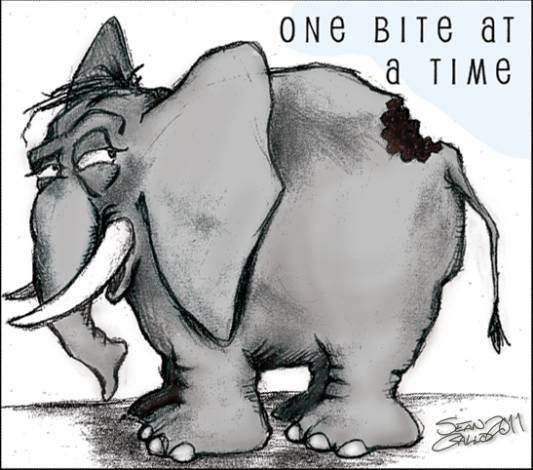


Author/Copyright holder: Sean Gallo. Copyright terms and licence: All rights reserved Img source

The Fewer the Digits in a Price Tag – The Less it Costs in Your Head

Everyone’s familiar with the $X.99 rule which says that consumers see $9.99 as less than $10.00 even though the difference is so miniscule that it barely matters to their bank manager. It’s such a staple of the retail environment that we encounter pricing like this every time we step out of the front door.

However, many folks aren’t aware that there’s a corollary to this idea. The fewer digits used to display a price… the less the item is perceived to cost – even when the prices are the same.

So $7,500.00 is seen to be more than $7,500 which is seen to be more than $7.5K. Strange but true and easy to incorporate into the way you display prices to your users.

People’s Innate Laziness Can Be Your Ally

We are all lazy about things that aren’t much fun. We will avoid filling in a form to the last minute if we can. We’ll sit down and watch a film rather than a book. If you can give people an easy option and a hard option; it’s human nature for people to take the path of least resistance.

So, for example, you want to sell your users something and you want them to create an account so you can sell them more stuff next time round. Break it down, make the sales process effortless and simple… then require them to sign up for the account. Making the first task pain-free makes it much more likely that you’ll get them all the way through your process.

People Want to Obey Authority Figures

Conformity experiments show that people will do just about anything if a man in a white coat tells them to. In fact, in one famous experiment, researchers showed that a very high percentage of people would be willing to apply a fatal electric shock to another person if a man in a white coat told them to. (Note: This also applies to women in white coats – we’re not sexist about authority figures).

If you want to take advantage of this, you can use an image of someone in authority (think toothpaste commercials for an example) and deliver a message of “take action” based on that authority.
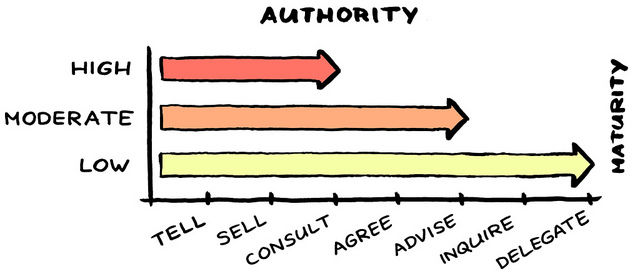


Author/Copyright holder: Jurgen Appelo. Copyright terms and licence: CC BY 2.0

If In Doubt Go For B

If you’ve ever been in a multiple choice quiz and you haven’t got a clue which option to go for – you’ll go for one in the middle most of the time. There’s some feeling of safety in this. The same is true for pricing options. If you offer a choice of a.) Cheapest (and no frills), b.) Mid-Price (some frills) and c.) High Price (all the frills) - most people will take the middle option.

Summary

All of these persuasive UX techniques are ethical alternatives to Dark UX and they’ve all been observed to work well. So why not try one today?

Header Image: Author/Copyright holder: Unknown. Copyright terms and licence: Unknown. Img


Learn More in This Course:

AI for Designers

7 days
32 % booked
View Course

What You Should Read Next

  • Read full article
    Why Care about Statistical Significance? - Article hero image
    Interaction Design Foundation logo

    Why Care about Statistical Significance?

    The categorical data depicts the success and failure rate of the low-fidelity wireframe above. There is not a large enough difference between the two to determine if the designs were successful.There is an element of error involved in measuring anything. So, when we want to compare measurements, how

    Social shares
    433
    Published
    Read Article
  • Read full article
    Web Fonts: Definition and 10 Recommendations - Article hero image
    Interaction Design Foundation logo

    Web Fonts: Definition and 10 Recommendations

    Web fonts bring digital content to life. They enhance readability, set the tone, and ensure consistency across various platforms—all vital ingredients. When you understand web fonts and their impact, it can help you with effective website creation—and greatly so. We’ll provide a comprehensive overvi

    Social shares
    782
    Published
    Read Article
  • Read full article
    How to Screen Research Participants - Article hero image
    Interaction Design Foundation logo

    How to Screen Research Participants

    Finding the right participants is crucial for gathering user research. We usually need to do research with participants having a particular set of needs or experience. In this short video, you will find out about the basic need for screening and how we make sure that we have suitably qualified parti

    Social shares
    451
    Published
    Read Article
  • Read full article
    Pitfalls in Recruiting Participants for User Research - Article hero image
    Interaction Design Foundation logo

    Pitfalls in Recruiting Participants for User Research

    The level of participant engagement is an important part of the user research results. Our results are dependent on proper engagement with our participants. In this video we look at some of the issues around participant recruitment and hear practical examples that arose in a large online study.[[vid

    Social shares
    420
    Published
    Read Article
  • Read full article
    How to Fit Quantitative Research into the Project Lifecycle - Article hero image
    Interaction Design Foundation logo

    How to Fit Quantitative Research into the Project Lifecycle

    Quantitative research methods fit into the project lifecycle at different stages of the process.In this video, we see where different quantitative research methods fit into a typical project lifecycle. Bear in mind that even with an iterative process such as Agile, the short cycles still address dif

    Social shares
    510
    Published
    Read Article
  • Read full article
    How to Resolve Conflicts Between Design Thinking and Marketing - Article hero image
    Interaction Design Foundation logo

    How to Resolve Conflicts Between Design Thinking and Marketing

    In the past, designers often reported to marketing managers and were neither expected nor allowed to make business decisions. When traditionally-structured companies transition to a design-driven mindset, there can be friction between the marketing and design teams. Let’s take a closer look at this

    Social shares
    682
    Published
    Read Article
  • Read full article
    Stop the Generic Portfolio Trap! Design a Stand-Out Portfolio for Your UX/UI Niche: User Research - Article hero image
    Interaction Design Foundation logo

    Stop the Generic Portfolio Trap! Design a Stand-Out Portfolio for Your UX/UI Niche: User Research

    User research is indispensable—and without it, well... UX design is guesswork. When you’re a user researcher, you know this well—but it can be hard to communicate your work in a way that grabs the viewer and holds their attention. And that’s what a portfolio is all about—grabbing the attention of yo

    Social shares
    383
    Published
    Read Article
  • Read full article
    Top Service Blueprint Templates - Article hero image
    Interaction Design Foundation logo

    Top Service Blueprint Templates

    Service blueprint tools are vital for effective customer experience design—and for designers to make experiences that are exceptional. Here, we’ll discuss why these tools are so important. What’s more, we’ll explore templates and practical resources to create high-quality, efficient service blueprin

    Social shares
    638
    Published
    Read Article
  • Read full article
    How to Write Research Questions that Lead to Confident Design - Article hero image
    Interaction Design Foundation logo

    How to Write Research Questions that Lead to Confident Design

    Designing with Data provides an extensive background to A/B testing.As with all other research methods, we need to start with a research question. A/B testing concerns itself with changes in user behavior, meaning that our questions need to be centered on measurable goals. In many cases, these will

    Social shares
    450
    Published
    Read Article
  • Read full article
    Getting Started - Article hero image
    Interaction Design Foundation logo

    Getting Started

    We start our introduction to A/B and multivariate testing (MVT) by looking at their basic principles and their differences. Note that the video mentions Google Optimize, which has been withdrawn. Google Firebase can be used for mobile platforms. Third-party solutions are needed for A/B testing on th

    Social shares
    227
    Published
    Read Article

Top Articles

Top Topic Definitions

Feel Stuck?
Want Better Job Options?

AI is replacing jobs everywhere, yet design jobs are booming with a projected 45% job growth. With design skills, you can create products and services people love. More love means more impact and greater salary potential.

At IxDF, we help you from your first course to your next job, all in one place.

See How Design Skills Turn Into Job Options
Privacy Settings
By using this site, you accept our Cookie Policy and Terms of Use.
Customize
Accept all

Be the One Who Inspires

People remember who shares great ideas.

Share on:

Academic Credibility — On Autopilot

Don't waste time googling citation formats. Just copy, paste and look legit in seconds.

Feel stuck? Want Freedom?

Get one powerful email each week, like 325,661 others.

Learn to design a life you love.

Next email in:
4
days
9
hrs
14
mins
59
secs