Needs Before Wants in User Experiences – Maslow and the Hierarchy of Needs

• 7 min read

968 Shares

It has been established that users are more likely to choose products that meet their needs than ones that meet their wants. Abraham Maslow developed a deep understanding of human needs and how they could be met. You can use Maslow’s Hierarchy of Needs in a design context to deliver more powerful user experiences that meet user needs rather than user wants.

If you want your users to accept your products they need to be motivated to do so. Abraham Maslow’s, the American psychologist, most famous research examined human motivation. In 1943 he published his paper; “A Theory of Human Motivation.” In this paper he revealed his understanding of human needs and proposed that they formed a hierarchy from the most basic to the most complex.

He suggested that in order for a human being to be satisfied they must take of all their needs. However, the most basic needs must be fulfilled before higher level needs can be met satisfactorily.

From the Bottom Up – The Hierarchy of Needs
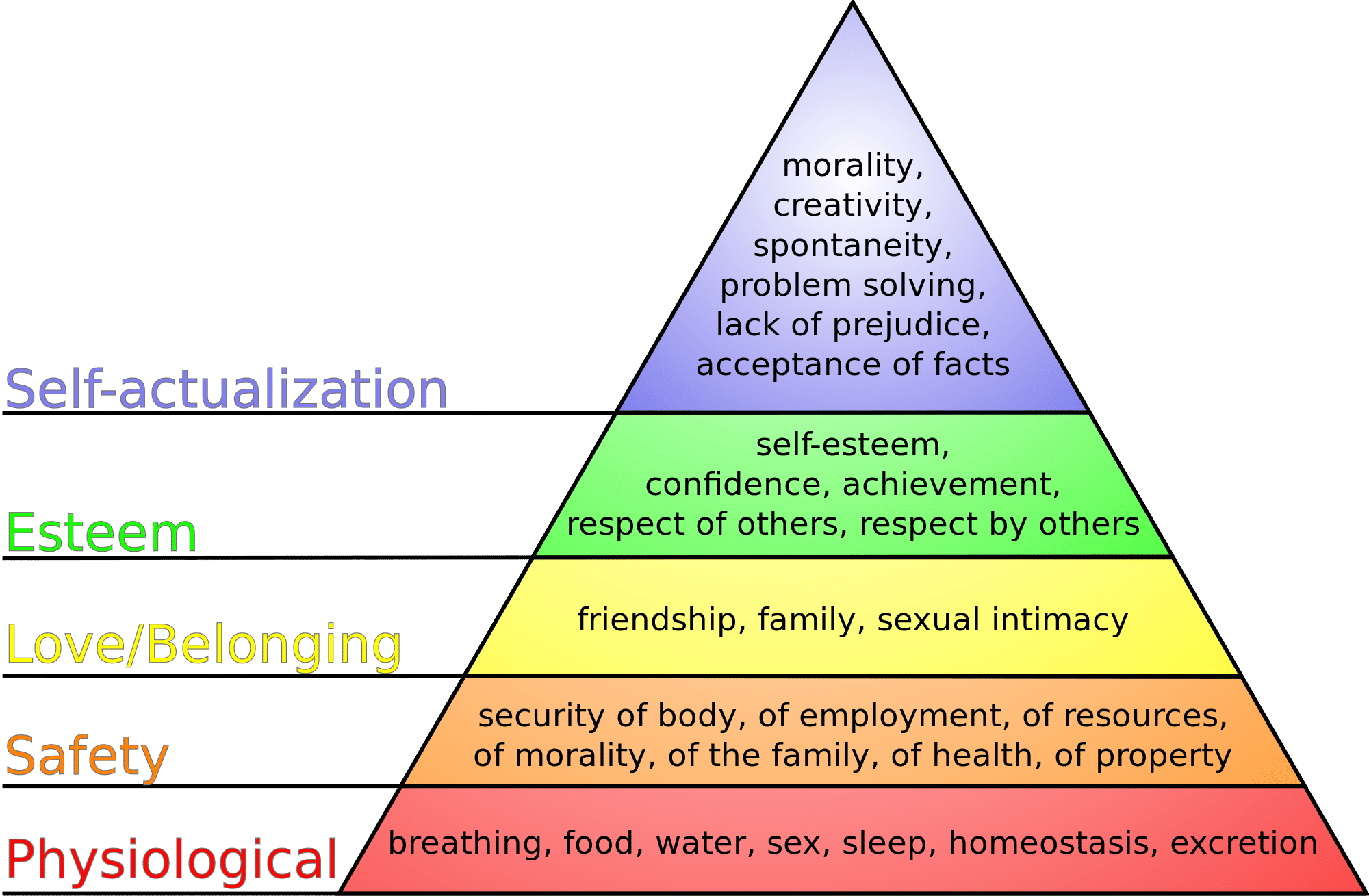

Author/Copyright holder: J. Finkelstein . Copyright terms and licence: CC BY-SA 3.0

  • Physiological Needs – The most basic needs of all are those that are needed to sustain us as individuals and as a species. They include food, drink, shelter, breathing, sex, comfort and sleep.

  • Safety Needs – The next level of needs to be met are those that offer us some guarantee of being able to satisfy our physiological needs in the long-term. These include fiscal and personal security, health, protection from the elements, etc.

  • Social (or Love and Belonging) Needs – The human animal is a social one and there is a deep-seated requirement for company in life. Social needs include friends, lovers, intimacy, families, communities, relationships and a sense of belonging.

  • Esteem Needs – Basic social needs become more complex for people and there is a need for our efforts to be recognized by others. Esteem needs may be fulfilled by social status, achievements, mastery, prestige, etc.

  • Self-Actualized Needs – The final, top layer of the hierarchy, is associated with our ability to grow as an individual. These needs include peace, contentment, self-growth, maximum experiences, etc.

When a lower level of need fulfilment is not in place; it is technically possible to be fulfilled at a higher level. However, this is seen by Maslow as an unstable fulfilment. If you’re starving it doesn’t matter if you’re seen as the world’s leading physicist, for example, eventually your hunger is going to overwhelm any satisfaction you get from your professional status.

We naturally seek to stabilize the lowest level of the hierarchy that is uncertain before we try to retain higher levels.

But Is Maslow Right?

It’s difficult to say that Maslow is 100% correct. There are many criticisms of the hierarchy of needs. In particular; he completely ignored spiritual needs in the pyramid (though many would argue that spiritual fulfilment is a manufacture need rather than an intrinsic human need).

It also fails to account for acts of altruism where a person puts another’s needs ahead of their own. These acts may be “selfish” acts (such as a parent’s sacrifice for a child) which can be explained logically or completely “unselfish” (such as when an individual sacrifices themselves for a stranger) which are harder to explain. However, it would seem pretty clear that these actions are driven by needs outside of the pyramid.

Finally, it’s also worth noting that Maslow’s hierarchy lacks social context. In Western societies it is common for individual needs to be prioritized over the needs of a society as a whole. In many Asian cultures, for example, this is completely reversed. “Face” as a concept comes from a need to serve society before the individual.

The Hierarchy of Needs in Design Terms
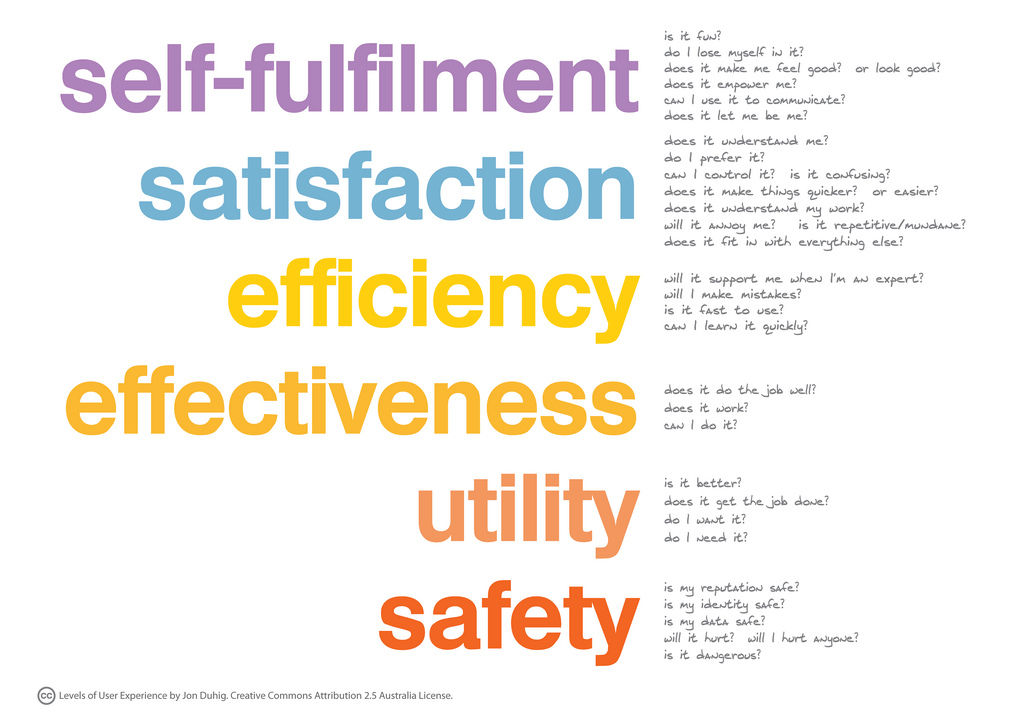
Author/Copyright holder: Jon and Barb . Copyright terms and licence:CC BY 2.0

Stephen Bradley, writing for Smashing Magazine, proposes that Maslow can be used as a template for design needs too. He abandons Maslow’s hierarchy and replaces it with a new one

The Design Hierarchy from Bottom to Top

As with Maslow’s hierarchy it is essential for a design to meet the lowest need on the pyramid before progressing to meet further needs.

  • Functionality – for a design to meet any need it must work and it must meet the basic needs of the user. However, if this is all it does; it may well be seen as having little value if any to the user in the short to long-term.

  • Reliability – the next step is for your design to function in a reliable manner and present a consistent experience. This may increase the user’s perception of the value of your product from a purely functional one but it does not add large amounts of value either.

  • Usability – then a design should be simple to use and relatively forgiving of user error. When you meet this need the product is likely to be considered of middling value by the user.

  • Proficiency – a design which helps a user to do more or achieve more is one which is likely to be desired as a high-level of value and fulfil user needs more effectively.

  • Creativity – the final step in the design pyramid is to create products which fulfil all other needs and are beautiful not just in form but also in interaction and function. This is where the highest user value is placed (think Apple products for an example in real life).

The Take Away

Maslow’s original hierarchy of needs may not be directly related to design. However, as Stephen Bradley demonstrates it may be amended to give a very useful guide to developing products which deliver high-levels of value to the user. Keeping the design hierarchy of needs in mind during your own design projects will result in better user experiences.

References & Where to Learn More

Course: “User Experience: The Beginner's Guide”

Stephen Bradley’s original piece for Smashing Magazine may be found here.

You can read Maslow’s original paper “A Theory of Human Motivation” online here.

Hero Image: Author/Copyright holder: Rosenfeld Media. Copyright terms and licence: CC BY 2.0

Learn More in This Course:

AI for Designers

11 days
13 % booked
View Course

What You Should Read Next

  • Read full article
    Bad Design vs. Good Design: 5 Examples We Can Learn From - Article hero image
    Interaction Design Foundation logo

    Bad Design vs. Good Design: 5 Examples We Can Learn From

    Looking at examples of bad design alongside counter-examples of good design is not only fun but also draws important lessons for designers. They highlight pitfalls for designers to avoid and let us understand how to translate design theories into solutions that work in the real world. Jared Spool, t

    Social shares
    1.5k
    Published
    Read Article
  • Read full article
    What is Interaction Design? - Article hero image
    Interaction Design Foundation logo

    What is Interaction Design?

    Interaction design is an important component within the giant umbrella of user experience (UX) design. In this article, we’ll explain what interaction design is, some useful models of interaction design, as well as briefly describe what an interaction designer usually does.A simple and useful unders

    Social shares
    1.5k
    Published
    Read Article
  • Read full article
    Apple’s Product Development Process – Inside the World’s Greatest Design Organization - Article hero image
    Interaction Design Foundation logo

    Apple’s Product Development Process – Inside the World’s Greatest Design Organization

    Apple’s Product Development Process may be one of the most successful design processes ever implemented. With a valuation that exceeds $2 trillion, there’s a lot that designers can learn from Apple and introduce into their own design environments.Apple is a notoriously secretive business. In Steve J

    Social shares
    1.4k
    Published
    Read Article
  • Read full article
    10 Great Sites for UI Design Patterns - Article hero image
    Interaction Design Foundation logo

    10 Great Sites for UI Design Patterns

    You don’t want to spend your whole life redesigning the wheel, do you? No, neither do we. If you are looking for a design that solves a problem that has been solved with a different application before, then the template for your wheel is probably already out there. This lets you save time and make a

    Social shares
    1.4k
    Published
    Read Article
  • Read full article
    Shneiderman’s Eight Golden Rules Will Help You Design Better Interfaces - Article hero image
    Interaction Design Foundation logo

    Shneiderman’s Eight Golden Rules Will Help You Design Better Interfaces

    Follow Ben Shneiderman’s 'Eight Golden Rules of Interface Design' if you want to design great, productive and frustration-free user interfaces. Apple, Google and Microsoft are among some of the highly successful companies whose well-designed products reflect Shneiderman’s rules. The characteristics

    Social shares
    1.4k
    Published
    Read Article
  • Read full article
    User Interface Design Guidelines: 10 Rules of Thumb - Article hero image
    Interaction Design Foundation logo

    User Interface Design Guidelines: 10 Rules of Thumb

    Learn to design with your user’s needs and expectations in mind by applying Jakob Nielsen and Rolf Molich’s Ten User Interface Guidelines. These heuristics have been reflected in many of the products designed by some of the most successful companies in the world such as Apple, Google, and Adobe. Fur

    Social shares
    1.4k
    Published
    Read Article
  • Read full article
    How to Change Your Career from Graphic Design to UX Design - Article hero image
    Interaction Design Foundation logo

    How to Change Your Career from Graphic Design to UX Design

    If there’s an occupation that is 100% linked with the public’s idea of what design is all about, it’s graphic design. From the familiar golden arches of the McDonald’s brand to the typography and colors of movie posters, graphic designers create some of the most iconic and ubiquitous designs around

    Social shares
    1.4k
    Published
    Read Article
  • Read full article
    Repetition, Pattern, and Rhythm - Article hero image
    Interaction Design Foundation logo

    Repetition, Pattern, and Rhythm

    Let’s look at three subjects that, at first glance, may strike you as being incredibly basic and self-explanatory. However, although they may seem like they should need no introduction, we should study them. By understanding these concepts, you’ll be able to apply them more effectively to captivate

    Social shares
    1.4k
    Published
    Read Article
  • Read full article
    The Grid System: Building a Solid Design Layout - Article hero image
    Interaction Design Foundation logo

    The Grid System: Building a Solid Design Layout

    Now that we’ve seen some grids at work in the Rule of Thirds article, let’s examine them a little more deeply. As a concept that deals so fundamentally with the fabric and background of our work as designers, it’s easy to overlook the power of grids and think more about the elements we want to creat

    Social shares
    1.4k
    Published
    Read Article
  • Read full article
    The Principles of Service Design Thinking - Building Better Services - Article hero image
    Interaction Design Foundation logo

    The Principles of Service Design Thinking - Building Better Services

    Service design is all about taking a service and making it meet the user’s and customer’s needs for that service. It can be used to improve an existing service or to create a new service from scratch. In order to adapt to service design, a UX designer will need to understand the basic principles of

    Social shares
    1.4k
    Published
    Read Article

Top Articles

Top Topic Definitions

Feel Stuck?
Want Better Job Options?

AI is replacing jobs everywhere, yet design jobs are booming with a projected 45% job growth. With design skills, you can create products and services people love. More love means more impact and greater salary potential.

At IxDF, we help you from your first course to your next job, all in one place.

See How Design Skills Turn Into Job Options
Privacy Settings
By using this site, you accept our Cookie Policy and Terms of Use.
Customize
Accept all

Be the One Who Inspires

People remember who shares great ideas.

Share on:

Academic Credibility — On Autopilot

Don't waste time googling citation formats. Just copy, paste and look legit in seconds.

Feel Stuck? Want Freedom?

Join 326,033+ designers who get one powerful email each week. Learn to design a life you love.

Next email in
1
day
10
hrs
54
mins
14
secs

Free forever. No spam. Unsubscribe anytime.