Customer service skills are vital for business owners who want to leave the right lasting impression on their customers. It’s surprising how many CEOs and freelancers never seem to get to grips with this basic skill that brings repeat business and cements customer loyalty. If you want to keep your sales and marketing to a minimum—you have to learn to deliver great customer service. Customer service simply means providing services that make your customers happy. That’s it. If you want to provide good customer service—ask your customers what they want and deliver it.
Many freelancers and entrepreneurs have never managed the customer relationship until they start their own business. Fortunately, it’s easy to get a grip on the skills that make for good customer service. Much of it is common sense applied in a structured and ordered way.
Sam Walton, the founder of Walmart, said: “The goal as a company is to have customer service that is not just the best but legendary.”
The Easiest Form of Customer Service
If you set your business up so that your objective is to add value for your clients and so that you try to under-promise and over-deliver, you will find that you won’t need to spend too much time dealing with customer service issues.
That means ensuring that you have a clear contract with your clients, that you meet your deadlines and always produce the best work you can do. It also means treating your clients with professionalism throughout the process; this is true even if your client is a good friend. Separate work and play, and always conduct your work life to the highest personal standards—and you won’t go far wrong.
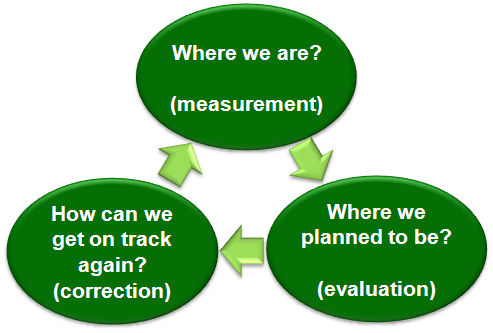
Author/Copyright holder: Alphamu57. Copyright terms and licence: CC BY-SA 4.0
Staying on track can be difficult – if you find yourself falling behind, use this simple project management tool to examine how to get there. Don’t get bogged down in blaming yourself for things going wrong – that won’t make them right again.
How to Handle Customer Feedback
When we own our own business, our work becomes personal. The work we create is a reflection of ourselves. Taking on board client feedback can be challenging. If we can’t separate ourselves from our work—any criticism from a client can feel as though it is criticism of us as individuals, rather than a critique of the works we have delivered.
The Process for Handling Feedback is Straightforward:
Shut up and listen. When someone gives us feedback, it’s very important to listen to the feedback and fully understand it. You can’t do that if you’re interrupting your client, and you can’t do it if you are becoming defensive. So, close your mouth, and give your client your full attention – make notes if the feedback is complex.
Ensure that you have properly understood the feedback. Once the client has finished delivering the feedback, ensure that you have understood his/her position. Summarise what he/she has said, and check that your understanding of what he/she has said is correct. This allows you to demonstrate that you have listened and to correct any misinterpretations of the feedback.
If the feedback is reasonable (e.g., you agree with it or it’s within the scope of work for the client to provide such feedback), you then need to act on it. Agree a timeline to incorporate the feedback and any updates on progress to be provided as necessary.
If the feedback is reasonable, but it falls outside of the scope of work – e.g., it means another revision and the client has used up their contractual revisions – then you may need to agree that acting on the feedback will be chargeable. If it’s something small, we would tend to remind the client that their revisions are over, but—in the interests of a good relationship—we would make the change but also make clear that all future revisions will be chargeable. If it’s something big… then you may have to agree to charge for it. Note: If the feedback is based on an error that you made—you should offer to fix this free of charge no matter the scope of work.
 Author/Copyright holder: Kai Chan Vong. Copyright terms and licence: CC BY 2.0
Taking on board negative client feedback can be challenging. You should simply let your guard down and listen. Don’t interrupt. Don’t be defensive. Give your client your full attention.
Is the Customer Always Right?
What do we do when we don’t agree with the feedback? Should we just get on and deliver something that we don’t feel is an optimal product/service? Is the customer always right?
If we disagree with the client’s feedback but the changes asked for are minor or irrelevant to the final output—we should probably just suck it up and act on their feedback. If a client comes back to us and wants to change the wording in a sentence – as long as the change won’t be misleading or disingenuous – we will make it; our pride in our work is irrelevant. It’s the client’s product, and they’re entitled to have it the way they want it.
However, sometimes clients ask for changes that are not as clear cut. They may want to change something so that your work will be ineffective (for example, insisting that the font on their website must be Comic Sans), or that your work becomes misleading to others, etc.
Handling this kind of feedback can be a little more challenging. It can be even more challenging if the feedback makes you frustrated or angry. You don’t want to have arguments with your clients. It’s not productive, and even if you “win” an argument, you’ll lose the client.
So, if you’re angry or frustrated—the best thing to do is give yourself time to cool down. Thank the client for the feedback.
Tell them you need some time to think about how to handle the feedback best, and arrange a meeting in an hour or a day (or however long it takes you to cool down) to come back to them with a plan to move forward. In that cool-off time, examine whether your first instincts are correct or whether the feedback is actually reasonable. If it’s reasonable (and often it is with difficult feedback), you can go back to the client and agree to deliver the changes.
When you have the conversation regarding feedback that you truly disagree with, the important thing is to be calm, factual and have data to support what you’re saying. If, for example, the client wants that Comic Sans look – saying “I don’t agree” is daft. Providing the client with references to show that people really don’t like Comic Sans is a much better way to move forward.
Be calm, clear and polite. Explain why you think that acting on the feedback is a bad idea, and explain what you think might work instead.
Clients employ freelancers and business-to-business entrepreneurs for their expertise. Your know-how and experience are an asset to them. In most cases, if you can demonstrate effectively and politely why something is a bad idea—they will listen. Your specialist judgement may be the only thing saving them from a potential disaster.
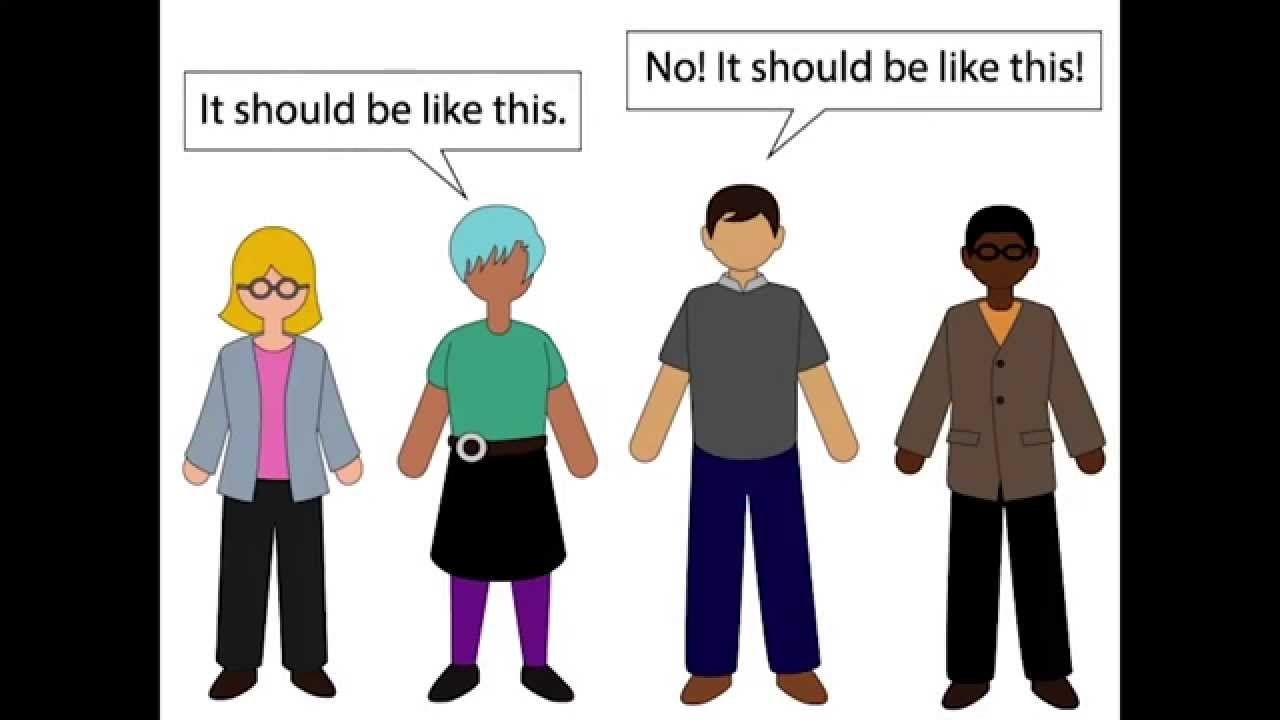 Author/Copyright holder: University of Portland. Copyright terms and licence: Fair Use.
There is a right way and a wrong way to give feedback. This is definitely the wrong way. Nobody likes to be told “you’re wrong”, and your clients won’t like it either.
What Happens If Your Client Won’t Listen to Your Expertise?
It’s the client’s project. It’s their money and their work. You can either accept their feedback and agree to move forward (but document your own objections to the client – so that if things go wrong, as you predict, they won’t be able to blame you for that), or you can withdraw from the project (which may cost you money and time).
Be aware that withdrawing from a project is bad form and will almost certainly result in losing the client. Having said that, we know of freelancers who have withdrawn from projects because they felt that an ethical issue was involved and the client has come back to them when they’ve realised the problem and asked them to re-engage with the project.
 Author/Copyright holder: Eric McGregorz. Copyright terms and licence: CC BY 2.0
A smile goes a long way when it comes to managing relationships – you can even hear a smile over the phone.
General Customer Service Tips
There are also some general tips for dealing with clients over the phone and in person; these will help your relationships grow over time:
Smile. Even over the phone—Your attitude comes through even when the client can’t see you, and a smile is a good place to start with the right attitude.
Communicate. If something is going to be late, or you’re struggling with a deliverable, etc. talk to the client as soon as you know there’s a problem. Don’t leave it until deadline day.
Be honest. If something falls outside of your expertise—tell the client. If you don’t know something, tell the client and offer to get back to them. Nobody, ever in the history of the world, has been omniscient. You do not have to pretend you know things that you don’t.
Keep your promises. If you said you would deliver on a Monday morning, deliver on a Monday morning.
Thank your clients. Seriously, thank them at the end of a project for the opportunity to work with them. Thank them for their calls. Gratitude (although don’t go so far that it descends into obeisance) is a good thing; people like to be appreciated.
Don’t focus on blame. Always focus on how to move forward. What’s the issue? How can it be solved? Blame is pointless and wasteful and, worse, it’s toxic.
Apologise if necessary. If you’ve screwed up, apologise. If a client is unhappy, even if it’s not your fault, you can apologise for the way that he/she feels (this doesn’t involve accepting any blame – it just acknowledges that you can understand the client’s position). There are some dreadful customer care guides out there that assert you should never apologise – they’re wrong—an apology is a great way to defuse a tense situation, and it’s often the morally correct thing to do, too.
The customer is not always right. In fact, they’re all too often completely wrong. It’s OK to understand this, but the ideal situation for customer care is to enable customers to change their minds without making them feel like they are wrong (even when they are wrong).
Always keep your cool. You can’t “win” against your customers. If you become angry or aggressive, they’d be quite right never to deal with you again. No matter, how you feel it’s a good idea to keep a firm lid on your temper. Sometimes, you may need to request that you pick up a conversation again at a later moment in order to recompose yourself.
 Author/Copyright holder: Pixabay. Copyright terms and licence: CC0
If you’re a graphical designer—you may find that drawing keeps you calm. Whatever helps you stay calm, you need to do it when dealing with your customers.
The Take Away
Customer care is really a matter of common sense. How do you like to be dealt with as a customer? Think about it, and put yourself in your client’s shoes.
That doesn’t mean you have to become a doormat for your clients, but it does mean that you should always behave professionally and personably. Focus on issues and not on individuals – concentrate on “how can we move forward from here”, and you’ll find that most customer care issues are easy to resolve and can improve your long-term relationship with your clients.
References & Where to Learn More
Hero Image: Author/Copyright holder: Sylvain Kalache. Copyright terms and licence: CC BY 2.0
More customer service tips: 20 Expert Customer Service Tips to Try Right Now
And here: 21 Tips for Better Customer Service