Fun is the key to how games work, and it’s the key to making gamification work, too. Without fun, gamification is simply another feature of a system or product – with fun, your product or system becomes much more enjoyable to use.
There are several criteria which need to be met in order for a game to be considered fun. Namely, it must have goals (so the player has something to achieve) and rules (so that the player has a means to achieve those goals); it must also provide feedback (so that the players can examine their progress or lack of it), and it must involve voluntary play (because being forced to have fun isn’t fun). Last but not least, there must be obstacles to provide a challenge.
Here, we’ll be looking at how the computer game classic, Tetris, meets these criteria for fun.
Tetris
Tetris is a surprising game. On paper, at least, it seems unlikely that something so basic should have done so well beyond the year 1975. Nevertheless, it’s been a consistently popular video game for decades. It was invented in Russia, and it was never expected to be as popular as it became. Yet, the reason it is so popular is that it meets the key criteria for fun in a game. That is, it has goals, rules, feedback, participation is voluntary, and there are unnecessary obstacles that keep the game challenging.
Goals
The aim in Tetris is simple; you bring down blocks from the top of the screen. You can move the blocks around, either left to right and/or you can rotate them. The blocks fall at a certain rate, but you can make them fall faster if you’re sure of your positioning. Your objective is to get all the blocks to fill all the empty space in a line at the bottom of the screen; whenever you do this, you’ll find that the blocks vanish and you get awarded some points.
A goal gives us a reason to play the game. Tetris offers an incredibly simple reason to play—pitting your wits against the computerized block dropper in order to last as long as you can.
Rules
Tetris has very simple rules: you can only move the pieces in specific ways; your game is over if your pieces reach the top of the screen; and you can only remove pieces from the screen by filling all the blank space in a line.
Rules give much needed structure to our play. A completely random environment offers no clue as to how to play and would be incredibly frustrating. How fortunate it is, then, that Tetris’s three rules are what shape it into such an award-winning game.
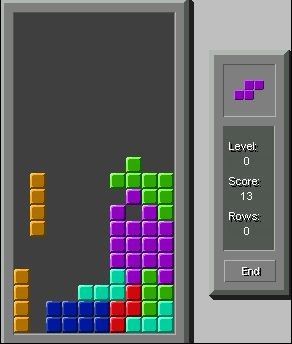
You have probably seen Tetris (or even played it), but, just in case—this is what Tetris looks like.
© @joefoodie, CC BY 2.0
Feedback
Each time you clear a line in Tetris, you are awarded more points. Each time your pieces reach the top of the screen, your game is over. That means, if you’re not particularly attentive, your game can be over very quickly.
Feedback in Tetris is instant and incontrovertible. You always know how well you are performing as you play the game. We like feedback, and this enables us to feel satisfied/dissatisfied with our performance. It’s a measure of the fun we’re having, and it constantly challenges us to do better. Also, the increasing speeds involved in playing the game generate a fair deal of endorphins and dopamine. If you’re thinking that a good indicator of a game’s worth is how hard you go “Argh!” when you eventually lose, then you’re on the right track here.
Voluntary Play
We’ve yet to find anyone who has been coerced into playing Tetris. If we could play Tetris all day rather than work… we probably would for a few weeks. Yet, sadly, we’ve never found anyone willing to pay us to play Tetris. Presumably, in the beginning, a lucky select few were paid to play it for testing purposes. Still, it’s not work; it’s fun, and we choose to play Tetris (or to do something else).
Obstacles
Tetris has a cunning means of adding challenge. It becomes faster the better you do. This means you have to make the same decisions but under a higher level of pressure. There’s no end in Tetris if you could think and move your fingers fast enough – you could literally play forever. However, this is the real genius of Tetris – we play it because it keeps us in a state of “flow”; that is, it balances our skills with the challenge in hand. We’ll never “finish” the game, but we are constantly compelled to come back again and try to do a little bit better. Take the highest level you’ve reached and remember the fast, furious gameplay involved. Yes, we’re talking endorphins again… and going “Grr” when a piece lands badly… and perhaps shouting at anyone who dares to distract us in these tension-laced-but-addictively-fun moments.
When the author used to play Tetris a lot, his friends and he would compare high scores on a near-daily basis to see who was “the best”. It didn’t matter who was in the lead, at least, not really… but somehow it did at the same time. All that came from arranging falling blocks—coloured, simple, almost childish-looking structures made up of little squares—at speed on a screen the size of your palm.
Tetris meets all of the four criteria for having fun and the obstacles offer that fun longevity—far greater longevity than Tetris’ Russian inventor ever anticipated.
Of course, Tetris has left plenty of folks frustrated over the years, too:
“If Tetris has taught me anything, it’s that errors pile up and accomplishments disappear.”
— Damana Madden, Web application builder and gamer
Interestingly, Dr. Tom Stafford, of the Department of Psychology at the University of Sheffield, pointed out that the game taps into the mind’s simple pleasure of tidying up things by feeding it with a “world of uncompleted tasks”. Then, we have the Tetris Effect, a scientifically recognised phenomenon that relates to how people find themselves thinking about how shapes in the real world can fit together. Not for nothing has Tetris made so deep an impression in the popular psyche: all this from a—for lack of a better term—somewhat backward-looking game devised in the Soviet Union of the 1980s.
The Take Away
Tetris meets all of the rules required to have fun. It provides an objective (make as many rows as possible), rules (you can only rotate blocks into certain positions, lines disappear only when fully complete, and, should any block fall to make it high enough to touch the top of the screen—the game is over), feedback (a constantly updated score), and play is purely voluntary.
We would do a disservice to the analysis if we failed to mention that the last magical ingredient—increasingly hard obstacles, which, in the case of this game, manifest in the ever-increasingly frenetic speeds at which blocks fall. If you are looking for a guide as to what makes a game fun – you can do a lot worse than examine Tetris.
References & Where to Learn More
Find more about The History of Tetris.
Janaki Mythily Kumar and Mario Herger, Gamification at Work: Designing Engaging Business Software, The Interaction Design Foundation, 2014
A fascinating article about the enduring appeal of and winning formula involved in Tetris.
Hero Image: © Damian Yerrick and Ondrejk, CC BY-SA 3.0