Your constantly-updated definition of Product Thinking and collection of videos and articles. Be a conversation starter: Share this page and inspire others!
Product thinking, like design thinking, is a set of cognitive processes and possibly design methods that a designer has when addressing and solving a problem.
Effective product thinking begins by identifying an audience’s problem. Then, a strategy is established and objectives are outlined by the designer or design team.
Product thinking aims to solve real problems by building meaningful solutions. Designers who employ product thinking on a regular basis create resonating solutions that add value for customers.
Learn More About Product Thinking
Make learning as easy as watching Netflix: Learn more about Product Thinking by taking the
online IxDF Course User Experience: The Beginner's Guide.
Why? Because design skills make you valuable. In any job. Any industry.
In This Course, You'll
Get excited to become a UX designer, one of the most in-demand roles in tech, and the person responsible for whether people love a product or abandon it. In this course, you'll learn from industry leaders like Don Norman, who coined the very term "User Experience." You'll build a solid UX foundation, from the core principles that shape how people experience products to the hands-on methods and deliverables that define UX work. Along the way, you'll build on your existing skills, like empathy and creativity, master the entire design process, from user research to testing and prototyping, and finish with the skills, vocabulary, and a portfolio that proves you can do the job.
Make yourself invaluable when you learn the frameworks, methods, and tools at the core of professional UX practice. You'll use Jesse James Garrett's five elements of user experience and Peter Morville's seven factors (usefulness, usability, findability, credibility, desirability, accessibility, and value) as the foundation for every design decision you'll make. These frameworks apply across the full design process (empathize, define, ideate, prototype, test). At every stage, you'll complete optional hands-on activities that build toward your complete portfolio deliverable.
Gain confidence and credibility when you know how UX design functions inside organizations. You'll learn how waterfall and Agile development frameworks operate, how to prevent design handoffs between designers and developers from breaking down, and how to advocate for UX to stakeholders and clients. And because the UX process at a startup looks very different from UX at an enterprise company, you'll be able to adapt your design process to different team structures, product stages, and organizational constraints.
Craft your personal portfolio through an optional hands-on project that runs the full length of the course. Each activity builds on the last, from your first user interview through to your tested prototype. By the end, you'll have a complete case study with a competitive analysis, personas, journey maps, sketches, prototypes, and usability findings that shows employers your process, your judgment, and your ability to move from idea to validated design. You'll also give and receive feedback within a global community of your peers, which will sharpen your ability to critique work constructively and articulate design decisions clearly. You might be exploring UX for the first time, be ready to make a career switch into design, or be a designer who wants to fill in your gaps. Wherever you're starting from, this comprehensive course gives you the skills, the practice, and the portfolio to land your first UX role and create better results in your daily design work.
Learn From Industry Leaders
Master complex skills with proven best practices and toolkits directly from industry leaders. Meet your experts for this course:
Don Norman: Father of User Experience (UX) design, author of the legendary book “The Design of Everyday Things,” and co-founder of the Nielsen Norman Group.
Rikke Friis Dam and Mads Soegaard: Co-Founders and Co-CEOs of IxDF.
Mike Rohde: Experience and Interface Designer, author of the bestselling “The Sketchnote Handbook.”
Stephen Gay: User Experience leader with 20+ years of experience in digital innovation and coaching teams across five continents.
Alan Dix: Author of the bestselling book “Human-Computer Interaction” and Director of the Computational Foundry at Swansea University.
Ann Blandford: Professor of Human-Computer Interaction at University College London.
Cory Lebson: Principal User Experience Researcher with 20+ years of experience and author of “The UX Careers Handbook.”
Earn Industry-Recognized Certificates
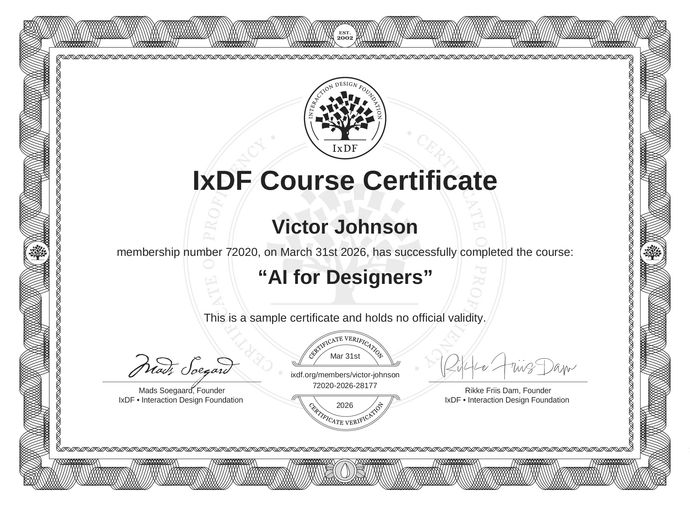
Industry giants trust our courses to train their teams, and prestigious universities integrate our content into their curricula. Add your certificates to your LinkedIn profile, résumé, and job applications.
It can be easy to get bogged down in developing features when we get into user experience design. It’s not that features aren’t important but that they are often secondary to the reason a customer or user buys our product. That reason is simple; the user buys the product to solve a real world proble
How to Become a Product Manager: Best Career Advice
Pick any product and you’ll find that product management is vital to how successful it is—and product managers are who make sure that a product’s life cycle runs smoothly, and it means they know how to align strategy, vision, and user needs. Product managers split into multiple roles that have got u
Social shares
598
Published
Read Article
Product Thinking is Problem Solving
It can be easy to get bogged down in developing features when we get into user experience design. It’s not that features aren’t important but that they are often secondary to the reason a customer or user buys our product. That reason is simple; the user buys the product to solve a real world problem for themselves.
In practice that means we have to see the product first. A feature may (or may not) be a useful part of a product but without the product the feature is a waste of space. A smartphone may be able to run apps for example but the primary use of a phone is communication. Apps may enhance the communication experience but without the ability to make calls, send texts, etc. apps would be of little value by themselves.
Therefore, designers should think in products first and features second.
Nikkel Blasse, the product and interaction designer at Xing, calls this product thinking.
What’s the Problem?
The first step of product thinking is to determine the problem that your users are looking to solve. That’s the reason that they will buy your product (as long as it actually solves the problem in a meaningful and valuable way).
If the problem you choose doesn’t actually exist or the solution you propose doesn’t actually solve the problem – your products are going to be worthless to users. Products without users end up at the scrap heap (often with the jobs of the people who created them).
Sure, there’s the possibility that if you get the solution wrong – you can fix it but if you solve a problem that doesn’t exist; there’s little you can do about that in the post-launch analysis.
Finding real problems is difficult sometimes. Even when you do a bunch of research – it’s possible that you will identify a problem that doesn’t exist. However, the right place to start is always by talking to would-be users.
Don’t forget that users may not be able to articulate their problems very well (it’s not their job as Steve Jobs would have said) so you may need to dig deep and do some real life observations as well as just talking to your users.
The audience that you’re going to solve the problem for
Then you look at the job to be done:
Why are you doing this (what’s the vision behind it)?
Strategy – the how will we do this?
Finally you reach your outputs:
What goals are we setting? What exactly will we achieve?
What features will this manifest as? What will we do to reach our goals?
Solve the Problem First
It’s vital that your process delivers a solution that solves the problem. Features that enhance this solution are welcome but if you don’t solve the problem – the whole product is fluff nothing more. It’s important to remember that while Interaction Design and Visual Design can build something beautiful – it’s wasted without the product being useful.
Don’t Forget to Define the Product from a UX Perspective
This product is for: (Your Audience)
It will help them solve this problem: (The Problem)
We will do this by: (The Strategy)
We expect a working product to: (The Objective)
Once you’ve done this definition – you can move on to deciding on the features.
What Does Product Thinking Do for the Design Process?
It allows you to create features that matter for the users of your products. It lets you see the product in context and not as a combination of features and design efforts. It makes sure that you’re tackling meaningful problems. It reduces the risks of creating product failures (though nothing can eliminate these risks entirely).
It should also help shape the questions that a designer asks to develop products. It should give designers the confidence to say “no” when asked to introduce a feature that doesn’t support the solution. It should lead to leaner more effective products.
The Take Away
Product thinking enables designers to build better products. It’s a way of examining every design decision in context with the problem the user wants to solve. It should also extend the relationship between UX and product management.
However, for some product thinking is just a new buzzword that does not necessarily bring anything new compared, for example, to design thinking. Whether it is a new approach or not, you can use the concept product thinking as an advocacy tool. Maybe this term is easier to grasp for your manager, client, team, etc. So, analyse your internal audience and see what word makes more sense to accomplish your aims and convey your ideas!