Minimum Viable Products (MVP)

Your constantly-updated definition of Minimum Viable Products (MVP) and collection of videos and articles.
Be a conversation starter: Share this page and inspire others!

295 Shares

What are Minimum Viable Products (MVP)?

Designers who work in startup environments will need to become familiar with the concept of the minimum viable product (MVP). It's the ideal state for a product to reach launch which tries to minimize risks for investors whilst still providing a product that will succeed on the open market. The idea is simple – release a product with the smallest number of features and ship as quickly as possible.

Transcript

Learn More About Minimum Viable Products (MVP)

Make learning as easy as watching Netflix: Learn more about Minimum Viable Products (MVP) by taking the online IxDF Course Agile Methods for UX Design.

Why? Because design skills make you valuable. In any job. Any industry.

In This Course, You'll

  • Get excited when you discover that agile isn't just about speed; it's about clarity, confidence, and doing work that delivers better results faster. As AI reshapes how teams work, you stay in demand when you can use timeless human-centered design skills to bring clarity and direction to fast decisions and keep projects focused on real human needs. Agile skills help you stay competitive in any job and across all industries. Today, 95% of organizations use Agile development methods to quickly adapt and avoid delays, bottlenecks, and costly failures in the design and development process.

  • Make yourself invaluable with the high-demand skills that companies are looking for. Agile methodologies often top job requirement lists because they help teams deliver more value in less time. Agile empowers you to feel in control, make faster, smarter decisions, and do meaningful work without burning out. Whether you're in User Experience (UX) Design, marketing, or management, this course will give you the skills you need to find solutions in less time and drive business success with higher-quality deliverables. You'll improve communication with developers, product managers, and other stakeholders, breaking down silos for a more collaborative team dynamic. You'll learn the secret to navigating different Agile environments with ease and experience the satisfaction of real progress.

  • Gain confidence and credibility as you get hands-on with proven techniques like continuous discovery, Minimum Viable Products (MVPs), and design slicing. It's easier than you think! No matter your background, you can easily learn to master Agile Methods for UX Design. You'll get comfortable with Agile patterns and anti-patterns and learn how to tailor your design and research to different teams. With step-by-step guidance and downloadable resources like the glossary of Agile terms and the product roadmap, you'll have everything you need to excel in any Agile environment

It's Easy to Fast-Track Your Career with the World's Best Experts

Master complex skills effortlessly with proven best practices and toolkits directly from the world's top design experts. Meet your experts for this course:

  • Laura Klein: Product Management Expert, Principal at Users Know, and author of “Build Better Products” and “UX for Lean Startups.”

  • Teresa Torres: Product Discovery Coach at Product Talk, speaker, and author of “Continuous Discovery Habits.”

  • Adam Thomas: Product Management Expert who has worked with top companies like Google, BP, and SmartRecruiters.

Get an Industry-Recognized IxDF Course Certificate

Increase your credibility, salary potential and job opportunities by showing credible evidence of your skills.

IxDF Course Certificates set the industry gold standard. Add them to your LinkedIn profile, resumé, and job applications.

Course Certificate Example

Be in distinguished company, alongside industry leaders who train their teams with the IxDF and trust IxDF Course Certificates.

Our clients: IBM, HP, Adobe, GE, Accenture, Allianz, Phillips, Deezer, Capgemin, Mcafee, SAP, Telenor, Cigna, British Parliament, State of New York

All Free IxDF Articles on Minimum Viable Products (MVP)

Read full article
A Simple Introduction to Lean UX - Article hero image
Interaction Design Foundation logo

A Simple Introduction to Lean UX

Lean UX is an incredibly useful technique when working on projects where the Agile development method is used. Traditional UX techniques often don’t work when development is conducted in rapid bursts – there’s not enough time to deliver UX in the same way. Fundamentally Lean UX and other forms of UX

Social shares
1.3k
Published
Read Article
Read full article
Minimum Viable Product (MVP) and Design - Balancing Risk to Gain Reward - Article hero image
Interaction Design Foundation logo

Minimum Viable Product (MVP) and Design - Balancing Risk to Gain Reward

The idea of the minimum viable product (MVP) has been around for some time. The term itself was coined by Frank Robinson but was made popular by two influential names in product design – Steve Blank, a serial-entrepreneur and academic, and Eric Ries, the pioneer of the Lean Startup movement.What is

Social shares
1.1k
Published
Read Article
Read full article
How to Become a Product Manager: Best Career Advice - Article hero image
Interaction Design Foundation logo

How to Become a Product Manager: Best Career Advice

Pick any product and you’ll find that product management is vital to how successful it is—and product managers are who make sure that a product’s life cycle runs smoothly, and it means they know how to align strategy, vision, and user needs. Product managers split into multiple roles that have got u

Social shares
559
Published
Read Article

Minimum Viable Product (MVP) and Design - Balancing Risk to Gain Reward

Minimum Viable Product (MVP) and Design - Balancing Risk to Gain Reward

The idea of the minimum viable product (MVP) has been around for some time. The term itself was coined by Frank Robinson but was made popular by two influential names in product design – Steve Blank, a serial-entrepreneur and academic, and Eric Ries, the pioneer of the Lean Startup movement.

What is an MVP?

The simplest definition is that an MVP must be the simplest core feature set of any product that allows it to be deployed and absolutely nothing more. However, the most popular definition is; “The smallest thing that you can build that delivers customer value (and as a bonus captures some of the value back).”
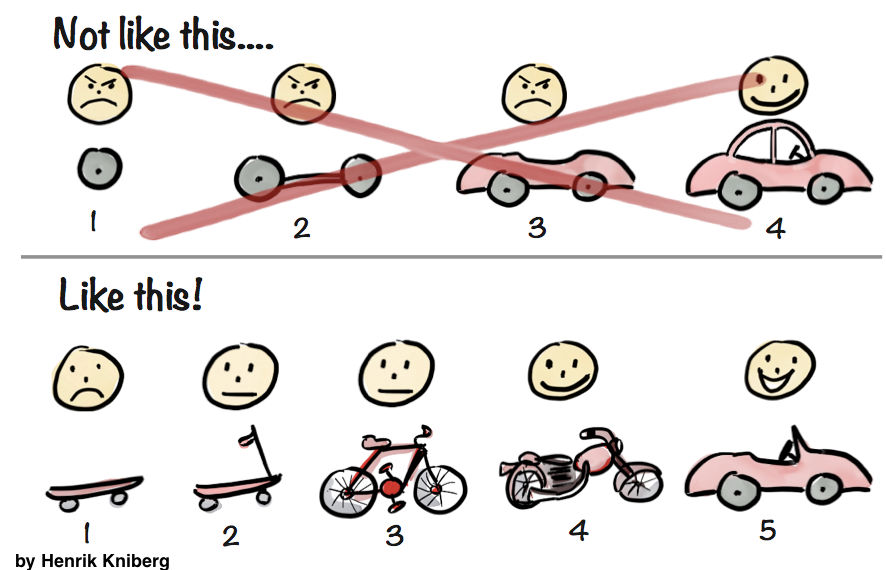

Author/Copyright holder: Henrik Kniberg. Copyright terms and licence: All rights reserved

The concept of value is vital to the MVP strategy – a wheel has no value to a user but a skateboard does. It’s all about transport not concepts to the user.

In general practice it’s also important for the team to define what the customer group will be. This will often be a highly-selective group with potential to become early adopters and thus more forgiving of a product’s short comings than those who attach themselves to more established technology. This group will be used to obtain feedback on the MVP and determine the strategic direction of further product development.

The MVP is thus a short-hand expression for a process that is dedicated to making new products that will be sold to customers. It assumes that the product will undergo a process of rapid iteration after it has entered the market to reach a more desirable state or that the product development will be abandoned if the market deems the product unusable or undesirable.

Eric Ries said; “As you consider building your own minimum viable product, let this simple rule suffice: remove any feature, process, or effort that does not contribute directly to the learning you seek.”
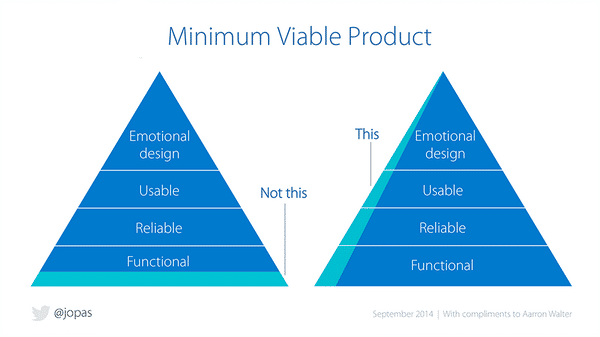

Author/Copyright holder: Jussi Pasanen. With acknowledgements to Aarron Walter, Ben Tollady, Ben Rowe, Lexi Thorn and Senthil Kugalur. Copyright terms and license: All rights reserved

Minimum Viable Product: Build a slice across, instead of one layer at a time

What are the Benefits of Using an MVP process for design?

There are several key benefits of using an MVP process; these apply not just to the design team but also to the company at large and any investors (if they are present):

  • You can test your understanding of whether the product is needed without having to use a huge amount of resources to develop the full product.

  • You can accelerate the team’s learning regarding what the customer actually wants/needs whilst using rapid iteration to deliver that.

  • You can minimize the number of wasted hours spent by your development team by focusing on a minimal number of features for launch.

  • You can go to market faster and thus, theoretically, start to raise sales revenues faster than if you develop the fully featured final product for launch.

  • You can gain a competitive advantage if other companies are contemplating entering the market you are focusing on.

The simplest mantra to follow to gain the benefits of an MVP is that you are looking to build the simplest product that you can test to see if the product should have been built in the first place. The objective of testing is to determine whether or not development should move forward or be abandoned.
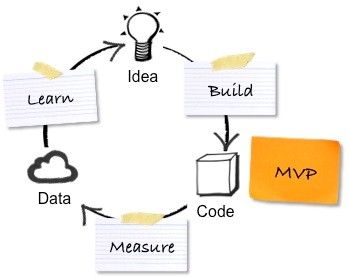

Author/Copyright holder: Roman Pichler. Copyright terms and licence: All rights reserved. Img Src

Minimum Viable Product design can still be iterative. It doesn’t mean you have to get everything right on the first attempt.

Minimum Viable Product – Testing Approaches

Websites and Applications

One of the simplest methods to test demand for a product is to create a website for it and then buy traffic to that website. The website is not fully-featured but rather a mockup explaining what will be available and inviting customers to click for more information. The number of clicks is compared to visitor numbers to determine the amount of interest in the product.

Services

If you are going to sell a service the easiest way to test it is not to build the service delivery product but rather to perform the service for someone and try and measure how much they would be willing to pay for that service. This can be done multiple times in order to gain an accurate measure of this willingness.

New Features

Before developing new features for an existing product – it might be sensible to advertise the feature on an existing website and provide a link for more information. The link explains that the feature is currently under development. Again a measure of clicks to visitors will deliver a reasonable understanding of the need for such a feature before development commences.

How Does This Differ from “Release Early, Release Often”?

The MVP strategy can be compared to the open source movement’s strategy of “release early, release often” - the difference being that while both approaches are designed to take onboard client feedback and iterate the MVP strategy has a clear objective prior to engaging with customers and seeks reassurance on that strategy – the open source strategy relies on customers to set the objectives as it evolves. Both are good means of developing products but the MVP offers a clearer and faster journey to a fully featured product.
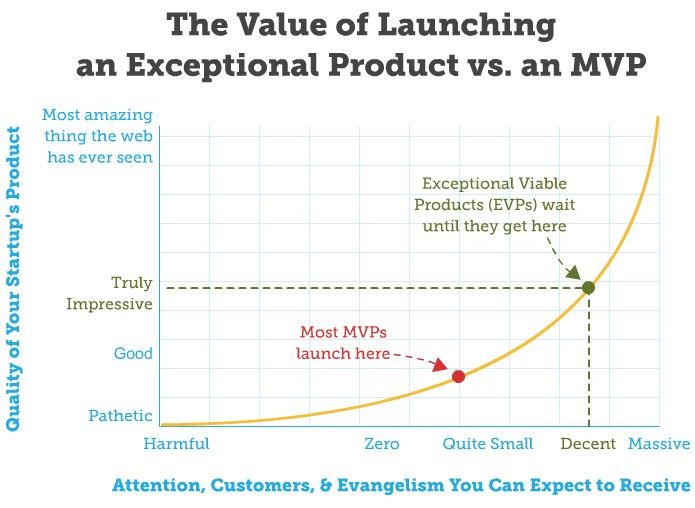

Author/Copyright holder: Unknown. Copyright terms and licence: Unknown

Minimum viable products do not have to be unexceptional. As you can see from this graph – there is value in delivering a quality product not just something that provides a tiny advantage to the user.

The Take Away

The MVP strategy is an ideal design approach for startup enterprises though it is also often employed within established corporations on designs that may be considered high-risk from investment or capital standpoints. It is designed to get a simple basic product to market in as short a time as possible and then to examine the feasibility of the product and to determine which features should be added in the next iteration. It is a user-focused design approach which gathers valuable feedback constantly to provide an improved product at each iteration.

References

Defining the minimum viable product is tricky. Gain practical tips on how to scope out the MVP in the course, “Agile Methods for UX Design.

Find out more about the Lean Startup Approach and the work done by Erik Reis here.

Worried you’re not getting your MVP strategy right? Check out these warning signs here.

Hero Image: Author/Copyright holder: visualpun.ch. Copyright terms and licence: CC BY-SA 2.0

Feel Stuck?
Want Better Job Options?

AI is replacing jobs everywhere, yet design jobs are booming with a projected 45% job growth. With design skills, you can create products and services people love. More love means more impact and greater salary potential.

At IxDF, we help you from your first course to your next job, all in one place.

See How Design Skills Turn Into Job Options
Privacy Settings
By using this site, you accept our Cookie Policy and Terms of Use.
Customize
Accept all

Be the One Who Inspires

People remember who shares great ideas.

Share on:

Academic Credibility — On Autopilot

Don't waste time googling citation formats. Just copy, paste and look legit in seconds.