Voxels, the Future of Computer Game Design?

• 5 min read

451 Shares

Computer games are all about the user experience. If they suck, they’re dead in the water and with hundreds of millions now required to product a big-budget production; that’s no small loss to weather. However, one of the commonest complaints regarding games may be easier to fix than it has been in the past. The issue of not enough realistic content looks to be coming to a close.

Procedural Development

In most games the way you interact with a world is fixed. If you play a first person shooter you can normally shoot something, stand on it, jump on it or simply not interact with it any way at all. This makes programming easier. If you define every relationship in a world then it should be simple to ensure that actions meet the rules. Sadly, it also makes for a dull game. Why? Because in real life we can do pretty much anything we feel like with an object not just pick it up, trash it or blow it up.
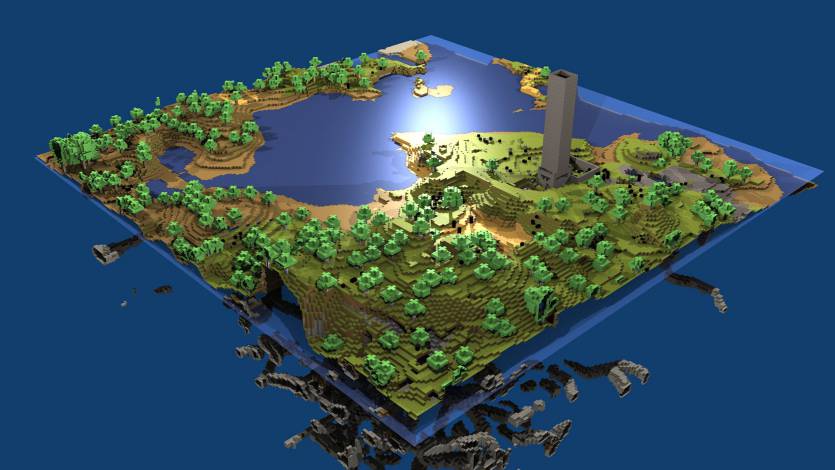


Procedural development is the development of games using rule sets. Now there’s enough computing power on hand for games to begin generating their own rule sets as and when the need them. This is going to require a change in approach when it comes to coding to enable a very basic kind of “artificial intelligence” to operate within the confines of the game environment.

OK But Voxels?

Voxels are a combination of the word volume and pixel. They were the original concept for 3D modelling on computers. Unfortunately, they were too clever an idea for the early computers. They were too processor heavy to calculate. So game designers used a different trick to create 3D environments – polygons. This is fine in most instances but… polygons are only surface deep. Voxels on the other hand give the entirety of a body form.
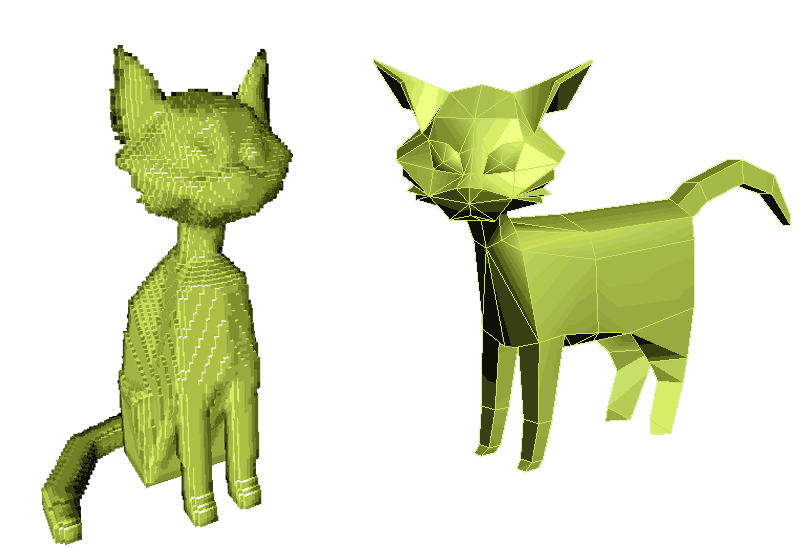


Thus you can finally model for interiors of objects and not just exteriors. And when every object has real physical properties; you can start to create laws about how those properties interact with each other. The world becomes realer if you like.

So What Does this Mean for Computer Game Designers?

It means that in the future design for games is going to be about more than just the way things look. It’s also going to be about the way things behave. The behaviour of elements in the game is going to require some understanding of engineering concepts and principles. If you want to be able to pick anything up, throw it at something else and see them both react correctly; it takes a little more than an expectation of gravity to do its thing.



On the bright side; designers who can adapt are looking at better careers options than ever before. The joy of voxels and procedural development is that they should reduce the cost of making games and that means more jobs and more companies ready to create games than ever before.

Header Image: Author/Copyright holder: Unknown. Copyright terms and licence: Unknown. Img

Images: Header, Minecraft, Polygon, Portal

Learn More in This Course:

AI for Designers

5 days
57 % booked
View Course

What You Should Read Next

  • Read full article
    8 Talks by Women to Inspire UX Designers - Article hero image
    Interaction Design Foundation logo

    8 Talks by Women to Inspire UX Designers

    User Experience design, like so many other disciplines, has a lower representation of women as compared to men. Things are changing now, though. Slowly, but surely. From strategy to tactics and from ideas to actionable tips, here is a curated playlist of talks by, and stories of just some of the mos

    Social shares
    655
    Published
    Read Article
  • Read full article
    UX Storyboards: Ultimate Guide - Article hero image
    Interaction Design Foundation logo

    UX Storyboards: Ultimate Guide

    In user experience design, we use techniques like workshops and interviews to understand users. We turn our research into user stories and process flows. We use personas and wireframes to share our ideas with our teams.But it’s important to remember the real people we design for. We need to know wha

    Social shares
    777
    Published
    Read Article
  • Read full article
    Stop the Generic Portfolio Trap! Design a Stand-Out Portfolio for Your UX/UI Niche: UX Writing - Article hero image
    Interaction Design Foundation logo

    Stop the Generic Portfolio Trap! Design a Stand-Out Portfolio for Your UX/UI Niche: UX Writing

    A picture may be worth a thousand words, but in UX design the right words are priceless. UX writing guides users, simplifies complex concepts, encourages desired actions, and creates a sense of delight. But how do you demonstrate you can do all of these things? How do you get noticed by hiring manag

    Social shares
    415
    Published
    Read Article
  • Read full article
    Mobile Breadcrumbs: 8 Best Practices in UX - Article hero image
    Interaction Design Foundation logo

    Mobile Breadcrumbs: 8 Best Practices in UX

    Breadcrumbs act as navigation aids—ones that simplify user journeys on websites. They highlight the path taken within a site to boost user experience, especially on mobile devices with limited screen space. Explore more about mobile breadcrumbs and understand the common design mistakes and best prac

    Social shares
    806
    Published
    Read Article
  • Read full article
    TAPT: Teasing Apart, Piecing Together - Article hero image
    Interaction Design Foundation logo

    TAPT: Teasing Apart, Piecing Together

    [[video:96]]Many experiences share the same core elements but differ in context. Photo sharing on Facebook has similar experience elements to sharing physical photos, but the actions involved and the context of the two experiences differ vastly. In creative processes, it’s valuable to analyze relate

    Social shares
    419
    Published
    Read Article
  • Read full article
    Why Care about Statistical Significance? - Article hero image
    Interaction Design Foundation logo

    Why Care about Statistical Significance?

    The categorical data depicts the success and failure rate of the low-fidelity wireframe above. There is not a large enough difference between the two to determine if the designs were successful.There is an element of error involved in measuring anything. So, when we want to compare measurements, how

    Social shares
    434
    Published
    Read Article
  • Read full article
    Web Fonts: Definition and 10 Recommendations - Article hero image
    Interaction Design Foundation logo

    Web Fonts: Definition and 10 Recommendations

    Web fonts bring digital content to life. They enhance readability, set the tone, and ensure consistency across various platforms—all vital ingredients. When you understand web fonts and their impact, it can help you with effective website creation—and greatly so. We’ll provide a comprehensive overvi

    Social shares
    782
    Published
    Read Article
  • Read full article
    How to Screen Research Participants - Article hero image
    Interaction Design Foundation logo

    How to Screen Research Participants

    Finding the right participants is crucial for gathering user research. We usually need to do research with participants having a particular set of needs or experience. In this short video, you will find out about the basic need for screening and how we make sure that we have suitably qualified parti

    Social shares
    452
    Published
    Read Article
  • Read full article
    Pitfalls in Recruiting Participants for User Research - Article hero image
    Interaction Design Foundation logo

    Pitfalls in Recruiting Participants for User Research

    The level of participant engagement is an important part of the user research results. Our results are dependent on proper engagement with our participants. In this video we look at some of the issues around participant recruitment and hear practical examples that arose in a large online study.[[vid

    Social shares
    421
    Published
    Read Article
  • Read full article
    How to Fit Quantitative Research into the Project Lifecycle - Article hero image
    Interaction Design Foundation logo

    How to Fit Quantitative Research into the Project Lifecycle

    Quantitative research methods fit into the project lifecycle at different stages of the process.In this video, we see where different quantitative research methods fit into a typical project lifecycle. Bear in mind that even with an iterative process such as Agile, the short cycles still address dif

    Social shares
    511
    Published
    Read Article

Top Articles

Top Topic Definitions

Feel Stuck?
Want Better Job Options?

AI is replacing jobs everywhere, yet design jobs are booming with a projected 45% job growth. With design skills, you can create products and services people love. More love means more impact and greater salary potential.

At IxDF, we help you from your first course to your next job, all in one place.

See How Design Skills Turn Into Job Options
Privacy Settings
By using this site, you accept our Cookie Policy and Terms of Use.
Customize
Accept all

Be the One Who Inspires

People remember who shares great ideas.

Share on:

Academic Credibility — On Autopilot

Don't waste time googling citation formats. Just copy, paste and look legit in seconds.

Feel stuck? Want Freedom?

Get one powerful email each week, like 325,448 others.

Learn to design a life you love.

Next email in:
1
day
15
hrs
56
mins
22
secs