The ROI of UX – Customer Conversions

• 6 min read

529 Shares

Welcome back to our series on the ROI of UX. If you missed the first part you can find it under the UX Daily tab on our website. Today, we’re going to look at a specific metric and how it might help you in your quest to show value in your work to the top brass:


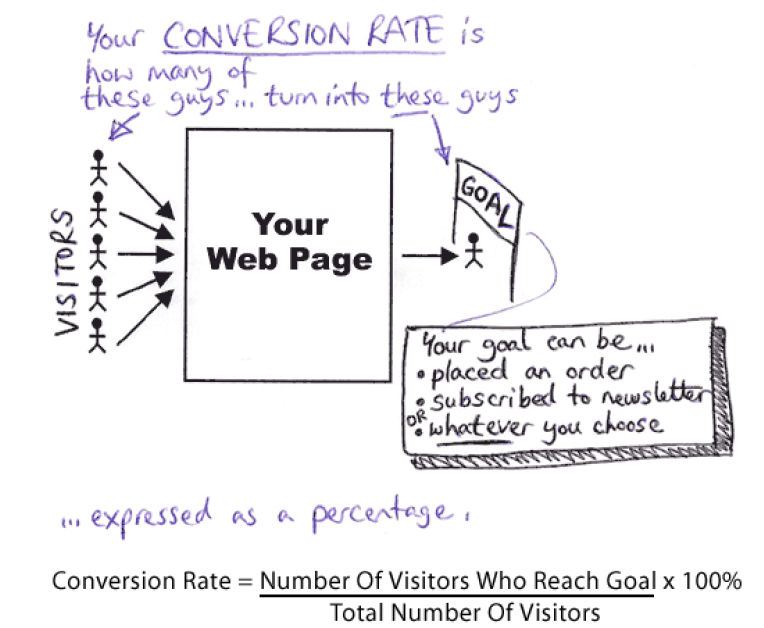
It’s a digital world and as the high street slowly evaporates in parts of the West; retail online has become the most important part of many company’s sales strategies. The user experience of the web presences these companies use will determine whether people where people arrive on the site, how many arrive and most importantly how many people who came to the site bought something. A conversion rate is simply the ratio of visitors to purchasers.

e.g. Total Purchasers/Total Visitors x 100 = Conversion Percentage


Author/Copyright holder: Stefson. Copyright terms and licence: CC BY-NC-ND 2.0


Before You Begin the Project

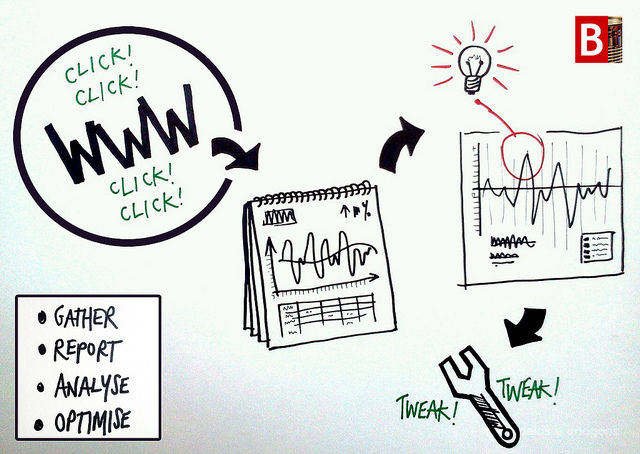
If your project is designed to increase conversion rates. It’s a good idea to know what those rates are now. You should be able to work out this number based on analytics from the customer’s site.

Author/Copyright holder: James Royal-Lawson. Copyright terms and licence: CC BY-SA 2.0


You might also want to know the average profit or average spend per customer. Why? Because if you double the conversion rate but halve the profitability of each customer – you haven’t actually improved anything, the client still makes the same money. In fact, it may even be worse, in that the client now has to do twice the work (in shipping, storage, etc.) to make the same money.

If you know your baseline; you can then see if you’ve made a meaningful difference. Without that baseline you simply can’t demonstrate value in your UX work.

During the Project

You need to know how much the work on the project costs. It might be tempting to take just the UX costs and use them for ROI but in reality; that’s not the way it works. A profit on the UX work but a loss on the project as a whole is not very valuable to a business. So you need to take the total investment as your figure to base ROI (or not) upon.

After Implementation

You might want to give it a few days (or even weeks) before you take your next sample; this enables your changes to have taken effect and for them to have taken effect in search engines, etc. too. Now it’s time to re-examine the conversion rates and average profits/revenue per user.

Let’s say that the original site was converting at 5%, that it received 1000 visitors a day, and that the average profit per conversion was $50. That means that the site was making 50 sales a day and a total profit of $2,500.

You spent $100,000 on upgrading the website including all elements of the project not just UX.

You’ve measured the statistics again and are pretty confident that they’re robust after measuring several times. You now have a conversion rate of 10%, your visitor numbers have dropped a little – you only get 800 visitors a day now, and the average profit per conversion has increased by 10% to $55. That means the site is now making 80 sales a day and a total of $4,400 in profit a day.



You spent $100,000. How long does it take for this to pay for itself? $4,400 - $2,500 is $1,900 of additional daily profit. It takes nearly 53 days for the site to pay for the improvements and you feel confident that these numbers will hold for at least 6 months. That’s approximately 180 days. Subtract 53 from 180 and you have 127 days of profit left. That’s a total ROI of 127 x $1,900 = $241,300.

Congratulations! You have delivered ROI.

Now, things aren’t actually this simple in real life and later on in this series we’ll show you how to make your ROI calculations a little more robust than this one. See you tomorrow.

Hero Image: Author/Copyright holder: Luca Mascaro. Copyright terms and licence: CC BY-SA 2.0



Topics in This Article

Learn More in This Course:

AI for Designers

9 days
16 % booked
View Course

What You Should Read Next

  • Read full article
    The Seven Simple Principles of Conversion Centred Design (CCD) and How to Use Them - Article hero image
    Interaction Design Foundation logo

    The Seven Simple Principles of Conversion Centred Design (CCD) and How to Use Them

    Oli Gardner – the Creative Director of Unbounce (a landing page builder for marketers), is an advocate of CCD. He says that deploying CCD makes each page you create on a website a piece of “accountable content”. In that you can measure the impact, purpose and success of each page as that page plays

    Social shares
    854
    Published
    Read Article
  • Read full article
    The Process of Persuasion — How to Make a Casual Browser an Intrigued User - Article hero image
    Interaction Design Foundation logo

    The Process of Persuasion — How to Make a Casual Browser an Intrigued User

    Persuasion is a powerful force that changes the attitudes and behaviors of others. It’s all about influence and manifests itself in many aspects of everyday life. People can persuade themselves, too. Persuasion’s most direct portrayals may show up in such places as courtrooms, political debates, and

    Social shares
    682
    Published
    Read Article
  • Read full article
    Design for Value: What is Conversion Optimization and Why Should You Care? - Article hero image
    Interaction Design Foundation logo

    Design for Value: What is Conversion Optimization and Why Should You Care?

    As designers, your product’s end users are your priority. Through your work, you advocate the user’s perspective to business owners so that business and marketing decisions fit well with the overall customer journey. But it is also important to understand the business’s perspective and deliver

    Social shares
    620
    Published
    Read Article
  • Read full article
    3 Reasons Why Your Users Love (or Leave) You - Article hero image
    Interaction Design Foundation logo

    3 Reasons Why Your Users Love (or Leave) You

    As a user experience designer, you want to solve their challenges and problems. You research your target users, prototype your ideas, test your products for usability ... And importantly, you want your end users to benefit from your products. After all, what is the point of your efforts if no one wi

    Social shares
    592
    Published
    Read Article
  • Read full article
    Analytics Data Types - Article hero image
    Interaction Design Foundation logo

    Analytics Data Types

    Analytics contains many kinds of types of data including bounce rates, conversion rates, repeat usage, user demographics, search behavior, and user journeys.We’re going to start our adventure into the world of analytics by looking at the kind of data that we are typically provided:Bounce ratesConver

    Social shares
    440
    Published
    Read Article

Top Articles

Top Topic Definitions

Feel Stuck?
Want Better Job Options?

AI is replacing jobs everywhere, yet design jobs are booming with a projected 45% job growth. With design skills, you can create products and services people love. More love means more impact and greater salary potential.

At IxDF, we help you from your first course to your next job, all in one place.

See How Design Skills Turn Into Job Options
Privacy Settings
By using this site, you accept our Cookie Policy and Terms of Use.
Customize
Accept all

Be the One Who Inspires

People remember who shares great ideas.

Share on:

Academic Credibility — On Autopilot

Don't waste time googling citation formats. Just copy, paste and look legit in seconds.

Feel Stuck? Want Freedom?

Get one powerful email each week, like 326,052 others.

Learn to design a life you love.

Next email in
6
days
11
hrs
55
mins
34
secs