Contextual Design principles progress from studying customers at work through data analysis, work-practice design, prototyping, verification, and implementation

The Key Principles of Contextual Design

• 4 min read

629 Shares
Save

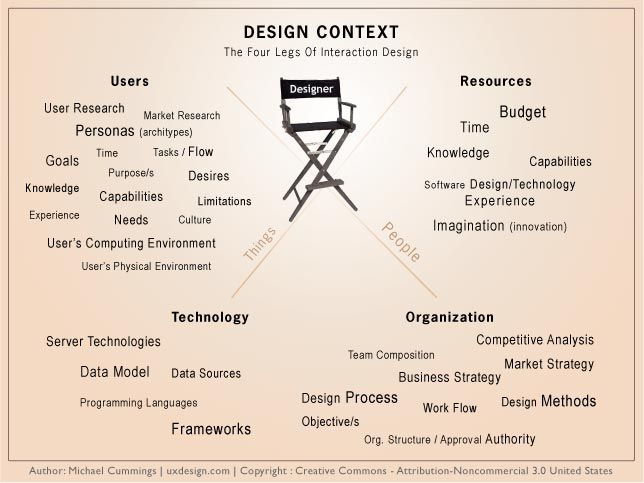
Contextual design is a reflection of the idea that no design exists in a vacuum. That one technology or perhaps system will interact in a much larger context; one of its environment and that that environment will not necessarily remain static (unchanging). Thus contextual design places a design in “context” and seeks to maximize its usefulness.


There are some key principles of contextual design:

System Design Should Support/Extend User’s Current Work Practices

This should be obvious; if you want design to fit easily into a user’s context – it shouldn’t be looking to shake up their world but rather to complement it. If you can do that; then you are a long way to getting your product accepted and liked by a user. If you can’t… well the user may prefer to throw it out the window than take the time to grips with it.

Expertise Does Not Equal the Ability to Articulate Current Work Practices

This is rather less obvious. People tend to be experts at the things that they do regularly; “their current work practices”. However, holding expertise does not necessarily make them experts at communicating what it is they do. Many of us struggle to articulate the concepts, practices and ideas we are most familiar with. This means that the contextual designer must observe those work practices rather than relying on oral accounts of what is being done.


Design Must Take Place in Partnership with Users

If you engage with users in the design phase there is a substantially higher chance that you will design products that suit those users. This is the key concept of all design disciplines; the idea that the user’s experience is critical to developing great products and systems. Contextual designers should not approach their users with forms to fill and boxes to tick but instead should adopt a larger curiosity that involves asking users what they want, need and feel rather than making assumptions on any of these details.

Good Design Should Be Systemic

Even the greatest idea in the world can fall flat on its face if it fails to consider the larger system in which the user operates. Design features must conform to the larger design aesthetic; a giant sized purple button in the middle of your iPhone’s case, for example, is simply not going to work for the iPhone owner – no matter how wonderful the effect of pushing that button. Designers should be looking for coherence in their systems rather than to break the mould.

Design Depends on Explicit Rendering

If you build it, they will come. Well… not always but you can be certain if you build something that people can tell you if they’d come or not. Contextual design requires sketches, prototypes, working models, etc. designers can work with users and vice-versa easily and simply from this perspective. They can talk about what they like and what they don’t and the design can be revised until it finally delivers on its promise.

Of course, these principles apply widely to many design disciplines as well as to contextual design. If you want to better understand contextual design; why not check out our complete text by Karen Hotzblatt on Contextual Design – it’s completely free to read it online.

Header Image: Author/Copyright holder: PionSoft LLC. Copyright terms and licence: All rights reserved. Img

Topics in This Article

Learn More in This Course:

Learn Design and AI From the Best

Get one powerful email each week, like 313,901 others.

Next email in:

What You Should Read Next

  • Read full article
    Don Norman: How You Can Rapidly Move Up by Thinking in Systems (Not Features) - Article hero image

    Don Norman: How You Can Rapidly Move Up by Thinking in Systems (Not Features)

    How can you move up in a company? Learn the fundamentals of business such as statistics, finance, accounting, marketing, supply chain and administration. How do you do that? One way to do this is to get a Master of Business Administration (MBA) degree. But Don says you can also learn them without go

    Social shares
    611
    Published
    Read Article
  • Read full article
    How to Find Your Voice: Speak with Confidence and Clarity - Article hero image

    How to Find Your Voice: Speak with Confidence and Clarity

    You’ve heard it before “It’s not what you said—it’s how you said it.” Your voice can change how people feel—even if your message doesn’t. If you vary your tone and pacing, you can make your ideas sound more trustworthy, exciting, or urgent. Harness this neuroscience-backed communication power and yo

    Social shares
    451
    Published
    Read Article
  • Read full article
    Avoid Death by PowerPoint: Structure Your Slides for Maximum Impact - Article hero image

    Avoid Death by PowerPoint: Structure Your Slides for Maximum Impact

    Your message is ready, your delivery honed. Now, how do you put that brilliance on slides? Discover how to structure your slide deck strategically so that it supports your message, whether you present live or share it for independent review.Whether you're pitching to stakeholders, leading a team mee

    Social shares
    424
    Published
    Read Article
  • Read full article
    Use Feedback as Your Superpower: Learn, Improve, Shine - Article hero image

    Use Feedback as Your Superpower: Learn, Improve, Shine

    Feedback: the word alone can inspire apprehension. Yet, it’s the lifeblood of great design. Whether it’s subtle critique or blunt rejection, how you respond to feedback matters more than you think. You can defend your design—or you can use that moment to learn, improve, and show you're the kind of p

    Social shares
    340
    Published
    Read Article
  • Read full article
    Overcome the Self-Doubt That Stops You from Being an Excellent Presenter - Article hero image

    Overcome the Self-Doubt That Stops You from Being an Excellent Presenter

    Do you doubt your ability to speak up, thinking you’re not the public speaking type? Many people do. But the truth is, most beliefs about presentation skills are simply wrong. Let’s break down these myths and boost your confidence—you’ve got far more potential than you think.In the next video, Morga

    Social shares
    314
    Published
    Read Article
  • Read full article
    Present Like a Pro: Become a Designer Who Leads - Article hero image

    Present Like a Pro: Become a Designer Who Leads

    Your ideas are only as powerful as your ability to communicate them. You can design the perfect solution ... but if nobody understands it, cares about it, or champions it? It goes nowhere. If you can master presentation skills, you’ll open new doors in your design career, access new opportunities, a

    Social shares
    321
    Published
    Read Article
  • Read full article
    Presentation Pitfalls and How You Avoid Them - Article hero image

    Presentation Pitfalls and How You Avoid Them

    You’ve worked hard on your ideas—don’t let simple messaging missteps keep them from landing. Make your brilliant ideas shine in every presentation by deftly sidestepping common messaging missteps, and give your hard work the influence it deserves every time.Morgane Peng, Head of Product Design & AI

    Social shares
    330
    Published
    Read Article
  • Read full article
    How to Change Your Career from Software Development to UX Design - Article hero image

    How to Change Your Career from Software Development to UX Design

    Most people believe that an aesthetic sense or a formal education in visual design is necessary to become a user experience (UX) designer. This perception unfortunately becomes an obstacle for software developers who want to switch their career to UX design.If you’re a software developer who wants t

    Social shares
    727
    Published
    Read Article
  • Read full article
    Design League Savings, AI Tutor, and Pricing Updates - Article hero image

    Design League Savings, AI Tutor, and Pricing Updates

    Rikke and I started IxDF in 2002 with nothing. We lived in a bamboo hut in Thailand with no investors, no safety net, and no plan B. We had a conviction that world-class design education should not be a privilege reserved for people who could afford a $15,000 degree.That conviction has never changed

    Social shares
    169
    Published
    Read Article
  • Read full article
    If You Don’t Fail, You’re Not Trying Hard Enough - Article hero image

    If You Don’t Fail, You’re Not Trying Hard Enough

    In some cultures, people never recover from failure, and Don Norman says this is wrong. In other cultures, failure is seen as a way to learn. David Kelley, the founder of design firm IDEO, once said, “Fail faster, succeed sooner.” Don says this is good, but encourages us to take it one step further,

    Social shares
    606
    Published
    Read Article

Top Articles

Top Topic Definitions

39% of Today's Skills Will Change by 2030

The World Economic Forum expects 39% of today's skills to be transformed or become outdated by 2030.

The good news is that jobs in UX / UI design and AI are among the fastest-growing professions globally.

Build Skills That Keep You Relevant

Privacy Settings

By using this site, you accept our Cookie Policy and Terms of Use.
Customize
Accept all

Be the One Who Inspires

People remember who shares great ideas.

Share on:

Academic Credibility — On Autopilot

Don't waste time googling citation formats. Just copy, paste and look legit in seconds.

Learn Design and AI From the Best

Get one powerful email each week, like 313,901 others.

Next email in: