The Internal Dialogue and Why it Matters to Designers

by Rikke Friis Dam • 8 min read

429 Shares

There’s a voice that most of us will listen to in preference to any other; that voice is our own. If you want to sell products or influence users to take actions, you’ll need that voice to be in agreement with what you want the users to do; get it wrong, and they won’t do it. This alignment of voices holds true most obviously in traditional media such as television advertising, but is it possible to do this via design? Read on and find out.

We All Hear Our Own Voices in Our Heads

We all talk to ourselves; it might not be out loud, but it’s our own thoughts that form an audible voice in our heads. It’s the strongest voice that most of us ever hear. It’s our internal dialogue, and, for most people, it’s the voice they pay most attention to – their own.

The Healthy Internal Dialogue

Author/Copyright holder: The U.S. Army. Copyright terms and licence: Public Domain.

“Do I really want to be doing this?” A healthy internal dialogue gives us the confidence to push ourselves to our limits and try new things.

The best kind of internal dialogue is one which reinforces the positive aspects of our lives. It tells us that we’re clever enough to tackle a new challenge, or that we’re strong enough to deal with adversity. It reminds us that we have confidence, beauty, wit or whatever we need in the moment that we face a particular challenge. It’s like a scanning program that kicks in so as to run an inventory check; by zeroing in on the virtuous characteristics we possess, it is then able to whisper in our minds’ ears, delivering that much-needed affirmation or pep talk.

“Whenever you can’t balance what you see with what you believe you have conflict.”
—Shannon L. Alder, Inspirational author

There’s a whole field of psychotherapy dedicated to helping people improve their internal dialogue. It turns out that when we believe we are capable of something, we are much more likely to succeed at it. That’s true, irrespective of your innate ability, for the task in hand or any other tools, instructions, etc. provided.

Human beings function best when they feel that they are able to make decisions and embrace those decisions. We are hard-wired to grow—the alternative, stagnation, is too depressing to bear, not least because life’s too short to sit doing the same old thing ‘forever’. As long as we can recognise those decisions as being beneficial (i.e., we’re not taking reckless risks), we can overcome seemingly insurmountable odds in most cases.

Why is this important?

Author/Copyright holder: Jakob Montrasio. Copyright terms and licence: CC BY 2.0

A positive internal dialogue lets us make choices that make us feel good about ourselves.

What if your site’s design could influence someone’s internal dialogue? What if you could help people feel better about themselves and, at the same time, sell your products to them? What if you could do that simply, easily and—most importantly—ethically?

Most people want to feel good about what they do; making other people feel better about their choices and decisions is a positive contribution to the world. Not only can influencing someone’s internal dialogue make you more money, but it can make you feel like what you do for a living matters.

Can You Change the Internal Dialogue?

This may be a more challenging matter as there continues to be little research into the most effective way to do this. The best approach to changing internal dialogue is likely to arise through user testing. In particular, you can observe this through user interviews. Doing so will allow you as a designer to ask the users about their internal dialogue. Take care here, though; you’ll be dealing with a strong risk of error any time someone talks about his/her perception of himself/herself. So, when you’re having discussions with users, take note of the point that internal dialogue and self-assessment are different. A personality is a powerful filter that can get in the way between what you hear from that person and what that person hears from within.

However, it may well be worth persevering with this exercise despite the lack of a clear blueprint. Geoffrey James, in his article on Inc.com, “Success secret: Change Your Internal Dialogue”, examines the benefits of altering his own internal dialogue and says:

“If your internal dialogue constantly uses words that leech your energy, you'll always be fighting an uphill battle. What's more, that negative self-talk has a habit of slipping into the words you say to others, which can cast a pall on everything you do.

By contrast, if your internal dialogue uses words that uplift you, you're greasing the wheels to become more successful. What's more, a positive internal dialogue is inevitably echoed in your day-to-day speech, making those around you more success-prone, too.”

Helping others improve their internal dialogue is likely to improve their quality of life, and, in turn, this is likely to improve the way they feel about the product or service of the organization for whom you’re designing.
Author/Copyright holder: gdsteam. Copyright terms and licence: CC BY 2.0

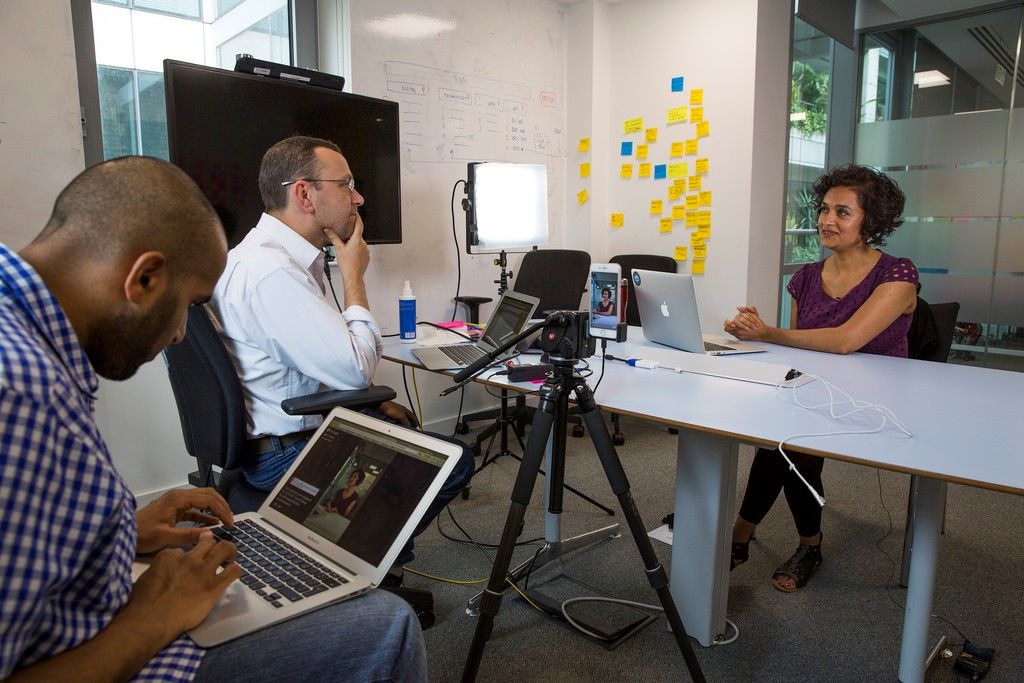
There is no established road map to influencing someone’s inner dialogue; you’ll need to conduct user research so as to work out the impact of your design on inner dialogue.

The Take Away

The internal dialogue is the conversation we have with ourselves; it is the voice of the self. It might be possible to help users shift their internal dialogue through design; if you could shift people’s internal dialogue positively, it is likely that they would view your offerings more positively, and your sales would increase. However, there remains no tried and tested blueprint for this in the first decades of the 21st century. Therefore, you would need to conduct user research focused on internal dialogue in order to determine the impact of your design on such dialogue. As the payout riding on the results of such dialogue can be great, examining how you can manoeuvre in this regard is well worth the effort.

References & Where to Learn More

Geoffrey James, “Success Secret: Change Your Internal Dialogue” Inc.com

Hero Image: Author/Copyright holder: Jean Marc Cote. Copyright terms and licence: Public Domain.

Learn More in This Course:

AI for Designers

6 days
42 % booked
View Course

What You Should Read Next

  • Read full article
    Why Care about Statistical Significance? - Article hero image
    Interaction Design Foundation logo

    Why Care about Statistical Significance?

    The categorical data depicts the success and failure rate of the low-fidelity wireframe above. There is not a large enough difference between the two to determine if the designs were successful.There is an element of error involved in measuring anything. So, when we want to compare measurements, how

    Social shares
    433
    Published
    Read Article
  • Read full article
    Web Fonts: Definition and 10 Recommendations - Article hero image
    Interaction Design Foundation logo

    Web Fonts: Definition and 10 Recommendations

    Web fonts bring digital content to life. They enhance readability, set the tone, and ensure consistency across various platforms—all vital ingredients. When you understand web fonts and their impact, it can help you with effective website creation—and greatly so. We’ll provide a comprehensive overvi

    Social shares
    782
    Published
    Read Article
  • Read full article
    How to Screen Research Participants - Article hero image
    Interaction Design Foundation logo

    How to Screen Research Participants

    Finding the right participants is crucial for gathering user research. We usually need to do research with participants having a particular set of needs or experience. In this short video, you will find out about the basic need for screening and how we make sure that we have suitably qualified parti

    Social shares
    451
    Published
    Read Article
  • Read full article
    Pitfalls in Recruiting Participants for User Research - Article hero image
    Interaction Design Foundation logo

    Pitfalls in Recruiting Participants for User Research

    The level of participant engagement is an important part of the user research results. Our results are dependent on proper engagement with our participants. In this video we look at some of the issues around participant recruitment and hear practical examples that arose in a large online study.[[vid

    Social shares
    420
    Published
    Read Article
  • Read full article
    How to Fit Quantitative Research into the Project Lifecycle - Article hero image
    Interaction Design Foundation logo

    How to Fit Quantitative Research into the Project Lifecycle

    Quantitative research methods fit into the project lifecycle at different stages of the process.In this video, we see where different quantitative research methods fit into a typical project lifecycle. Bear in mind that even with an iterative process such as Agile, the short cycles still address dif

    Social shares
    511
    Published
    Read Article
  • Read full article
    How to Resolve Conflicts Between Design Thinking and Marketing - Article hero image
    Interaction Design Foundation logo

    How to Resolve Conflicts Between Design Thinking and Marketing

    In the past, designers often reported to marketing managers and were neither expected nor allowed to make business decisions. When traditionally-structured companies transition to a design-driven mindset, there can be friction between the marketing and design teams. Let’s take a closer look at this

    Social shares
    682
    Published
    Read Article
  • Read full article
    Stop the Generic Portfolio Trap! Design a Stand-Out Portfolio for Your UX/UI Niche: User Research - Article hero image
    Interaction Design Foundation logo

    Stop the Generic Portfolio Trap! Design a Stand-Out Portfolio for Your UX/UI Niche: User Research

    User research is indispensable—and without it, well... UX design is guesswork. When you’re a user researcher, you know this well—but it can be hard to communicate your work in a way that grabs the viewer and holds their attention. And that’s what a portfolio is all about—grabbing the attention of yo

    Social shares
    384
    Published
    Read Article
  • Read full article
    Top Service Blueprint Templates - Article hero image
    Interaction Design Foundation logo

    Top Service Blueprint Templates

    Service blueprint tools are vital for effective customer experience design—and for designers to make experiences that are exceptional. Here, we’ll discuss why these tools are so important. What’s more, we’ll explore templates and practical resources to create high-quality, efficient service blueprin

    Social shares
    638
    Published
    Read Article
  • Read full article
    How to Write Research Questions that Lead to Confident Design - Article hero image
    Interaction Design Foundation logo

    How to Write Research Questions that Lead to Confident Design

    Designing with Data provides an extensive background to A/B testing.As with all other research methods, we need to start with a research question. A/B testing concerns itself with changes in user behavior, meaning that our questions need to be centered on measurable goals. In many cases, these will

    Social shares
    450
    Published
    Read Article
  • Read full article
    Getting Started - Article hero image
    Interaction Design Foundation logo

    Getting Started

    We start our introduction to A/B and multivariate testing (MVT) by looking at their basic principles and their differences. Note that the video mentions Google Optimize, which has been withdrawn. Google Firebase can be used for mobile platforms. Third-party solutions are needed for A/B testing on th

    Social shares
    228
    Published
    Read Article

Top Articles

Top Topic Definitions

Feel Stuck?
Want Better Job Options?

AI is replacing jobs everywhere, yet design jobs are booming with a projected 45% job growth. With design skills, you can create products and services people love. More love means more impact and greater salary potential.

At IxDF, we help you from your first course to your next job, all in one place.

See How Design Skills Turn Into Job Options
Privacy Settings
By using this site, you accept our Cookie Policy and Terms of Use.
Customize
Accept all

Be the One Who Inspires

People remember who shares great ideas.

Share on:

Academic Credibility — On Autopilot

Don't waste time googling citation formats. Just copy, paste and look legit in seconds.

Feel stuck? Want Freedom?

Get one powerful email each week, like 325,622 others.

Learn to design a life you love.

Next email in:
3
days
8
hrs
56
mins
3
secs