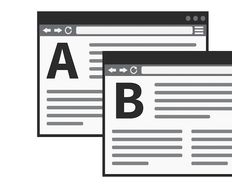
A mix between Research-based Versus Example-based Learning

by Rikke Friis Dam • 7 min read

502 Shares

Both research-based and example-based learning have their merits. Different types of learning provide different insights, and they are both keys to becoming a great designer. At the Interaction Design Foundation, we combine both approaches wherever possible. When taking our courses, you will feel this “oscillation” between examples and research—so, let’s take a closer look at the pros and cons of each. We will start with the pros and cons of example-based learning.

Pros and Cons of Example-Based Learning

You may have noticed that design education often seems to teach from a personal, anecdotal, and example-based perspective. This approach is often embodied in case studies—e.g., “How our re-design made us lose 43% of our customers” or “How we increased the ecommerce conversion rate by 24%“.

Example based learning is valuable and you’ll experience this approach a lot in IxDF’s courses. However, when the example-based mindset is taken to an extreme and applied in development processes, the approach is embodied in statements like "just copy the apps you like" and in a Just-Fucking-Do-It (JFDI) development process. One of the advantages of example-based learning – or indeed development – is that you don’t easily fall into "analysis paralysis" and that you get your design "out there" as fast as possible. It is an approach often used by entrepreneurs with the tenet of "fail forward".

Author/Copyright holder: Uber Technologies Inc. Copyright terms and licence: Fair Use

For example, following the success of the online taxi service Uber.com, many start-ups brand themselves like “Uber for X”: We are “Uber for Home-delivery”, “Uber for Laundry” and essentially try to copy the business model, marketing and success of a well-reputed company.

This approach of copying a design or a business model is well known and is the core of example-based learning and development. The approach does indeed work to a certain extent, but it—unfortunately—also contains the dangers that lead to massive failure.

“He who loves practice without theory is like the sailor who boards ship without a rudder and compass and never knows where he may cast.”
– Leonardo da Vinci, leading artist and intellectual of the Italian Renaissance who's known for his enduring works "The Last Supper" and "Mona Lisa”.

Pros and Cons of Research-Based Learning

As stated above, example-based learning from practice can be great. However, we should not accept an over-simplified division between “research versus practice” or “academia versus industry”. It is regrettable that many design courses underemphasize, or simply ignore, the known science behind the human interactive experience: Research will teach you the tried and tested techniques, and the IxDF prioritizes solid research. And we always relate theory to practice:

“Experience without theory is blind, but theory without experience is mere intellectual play.”
– Immanuel Kant, German philosopher and key figure in modern philosophy, active in the 18th and 19th centuries: his impact endures, particularly in how the main concepts of the mind structure human experience.

Our courses focus on the sciences that underlie the User Experience, such as psychology and sociology, and include research to help you understand what works and what does not work. And, most importantly, why it does – or does not – work. That is the main advantage of theory and research—i.e., to be able to look below the surface and peek into the “inner mechanics” of what makes a great design so great.

“Research is to see what everybody else has seen, and to think what nobody else has thought.”
– Albert Szent-Gyorgyi, Hungarian American physiologist, Nobel Prize Winner, credited with discovering vitamin C.

Author/Copyright holder: Harald Groven. Copyright terms and licence: CC BY-SA 2.0

We promise you will never feel like these guys when you’re studying with the IxDF. By the way, if you don’t happen to recognize the two guys, they are author Franz Kafka and sociologist Max Weber whose ideas profoundly influenced social theory and social research. This image went viral among social researchers – and yeah, no comments on the lack of Photoshop skills :-)

The Take Away

The courses from the Interaction Design Foundation aim to hit a “sweet-spot” between example-based and research-based learning. We aim to stay firmly grounded in practice and real-life examples, but—at the same time—we help you move away from the dangerous de-intellectualization of design that is the cause of so many design failures:

“The difference between design and research seems to be a question of new versus good. Design doesn't have to be new, but it has to be good. Research doesn't have to be good, but it has to be new. I think these two paths converge at the top: the best design surpasses its predecessors by using new ideas, and the best research solves problems that are not only new, but worth solving. So ultimately design and research are aiming for the same destination, just approaching it from different directions.”
– Paul Graham, Hackers & Painters: Big Ideas from the Computer Age. Paul Graham is an English computer scientist and venture capitalist who is known for his work on Lisp, for co-founding Viaweb (which eventually became Yahoo! Store), and for co-founding the Y Combinator seed capital firm.

References & Where to Learn More

Hero Image 1: Author/Copyright holder: Derek Curry. Copyright terms and licence: CC BY-SA 2.0

Hero Image 2: Author/Copyright holder: Phil Aaronson. Copyright terms and licence: CC BY 2.0

Don Norman, 27th annual conference of the Travel and Tourism Research Association, Las Vegas, p. 143, June 1996

Steve Jobs: Good artists copy great artists steal. Interview with Steve Jobs about the creation of the Apple Macintosh. Did Steve Jobs steal from Xerox PARC? 1994.

Paul Graham, Hackers & Painters: Big Ideas from the Computer Age, 2004

Learn More in This Course:

AI for Designers

8 days
19 % booked
View Course

What You Should Read Next

  • Read full article
    Why Care about Statistical Significance? - Article hero image
    Interaction Design Foundation logo

    Why Care about Statistical Significance?

    The categorical data depicts the success and failure rate of the low-fidelity wireframe above. There is not a large enough difference between the two to determine if the designs were successful.There is an element of error involved in measuring anything. So, when we want to compare measurements, how

    Social shares
    432
    Published
    Read Article
  • Read full article
    Web Fonts: Definition and 10 Recommendations - Article hero image
    Interaction Design Foundation logo

    Web Fonts: Definition and 10 Recommendations

    Web fonts bring digital content to life. They enhance readability, set the tone, and ensure consistency across various platforms—all vital ingredients. When you understand web fonts and their impact, it can help you with effective website creation—and greatly so. We’ll provide a comprehensive overvi

    Social shares
    781
    Published
    Read Article
  • Read full article
    How to Screen Research Participants - Article hero image
    Interaction Design Foundation logo

    How to Screen Research Participants

    Finding the right participants is crucial for gathering user research. We usually need to do research with participants having a particular set of needs or experience. In this short video, you will find out about the basic need for screening and how we make sure that we have suitably qualified parti

    Social shares
    450
    Published
    Read Article
  • Read full article
    Pitfalls in Recruiting Participants for User Research - Article hero image
    Interaction Design Foundation logo

    Pitfalls in Recruiting Participants for User Research

    The level of participant engagement is an important part of the user research results. Our results are dependent on proper engagement with our participants. In this video we look at some of the issues around participant recruitment and hear practical examples that arose in a large online study.[[vid

    Social shares
    419
    Published
    Read Article
  • Read full article
    How to Fit Quantitative Research into the Project Lifecycle - Article hero image
    Interaction Design Foundation logo

    How to Fit Quantitative Research into the Project Lifecycle

    Quantitative research methods fit into the project lifecycle at different stages of the process.In this video, we see where different quantitative research methods fit into a typical project lifecycle. Bear in mind that even with an iterative process such as Agile, the short cycles still address dif

    Social shares
    510
    Published
    Read Article
  • Read full article
    How to Resolve Conflicts Between Design Thinking and Marketing - Article hero image
    Interaction Design Foundation logo

    How to Resolve Conflicts Between Design Thinking and Marketing

    In the past, designers often reported to marketing managers and were neither expected nor allowed to make business decisions. When traditionally-structured companies transition to a design-driven mindset, there can be friction between the marketing and design teams. Let’s take a closer look at this

    Social shares
    682
    Published
    Read Article
  • Read full article
    Stop the Generic Portfolio Trap! Design a Stand-Out Portfolio for Your UX/UI Niche: User Research - Article hero image
    Interaction Design Foundation logo

    Stop the Generic Portfolio Trap! Design a Stand-Out Portfolio for Your UX/UI Niche: User Research

    User research is indispensable—and without it, well... UX design is guesswork. When you’re a user researcher, you know this well—but it can be hard to communicate your work in a way that grabs the viewer and holds their attention. And that’s what a portfolio is all about—grabbing the attention of yo

    Social shares
    383
    Published
    Read Article
  • Read full article
    Top Service Blueprint Templates - Article hero image
    Interaction Design Foundation logo

    Top Service Blueprint Templates

    Service blueprint tools are vital for effective customer experience design—and for designers to make experiences that are exceptional. Here, we’ll discuss why these tools are so important. What’s more, we’ll explore templates and practical resources to create high-quality, efficient service blueprin

    Social shares
    638
    Published
    Read Article
  • Read full article
    How to Write Research Questions that Lead to Confident Design - Article hero image
    Interaction Design Foundation logo

    How to Write Research Questions that Lead to Confident Design

    Designing with Data provides an extensive background to A/B testing.As with all other research methods, we need to start with a research question. A/B testing concerns itself with changes in user behavior, meaning that our questions need to be centered on measurable goals. In many cases, these will

    Social shares
    450
    Published
    Read Article
  • Read full article
    Getting Started - Article hero image
    Interaction Design Foundation logo

    Getting Started

    We start our introduction to A/B and multivariate testing (MVT) by looking at their basic principles and their differences. Note that the video mentions Google Optimize, which has been withdrawn. Google Firebase can be used for mobile platforms. Third-party solutions are needed for A/B testing on th

    Social shares
    225
    Published
    Read Article

Top Articles

Top Topic Definitions

Feel Stuck?
Want Better Job Options?

AI is replacing jobs everywhere, yet design jobs are booming with a projected 45% job growth. With design skills, you can create products and services people love. More love means more impact and greater salary potential.

At IxDF, we help you from your first course to your next job, all in one place.

See How Design Skills Turn Into Job Options
Privacy Settings
By using this site, you accept our Cookie Policy and Terms of Use.
Customize
Accept all

Be the One Who Inspires

People remember who shares great ideas.

Share on:

Academic Credibility — On Autopilot

Don't waste time googling citation formats. Just copy, paste and look legit in seconds.

Feel stuck? Want Freedom?

Get one powerful email each week, like 325,742 others.

Learn to design a life you love.

Next email in:
5
days
10
hrs
32
mins
4
secs