Gamification is not a miracle cure for all your product’s woes. It’s not possible to take a lousy process and sprinkle on some game elements and make it fantastic. Similarly, you cannot become so reliant on gamified ideas that you obscure the original purpose of the product. Setting expectations of what you can and what you cannot achieve through gamification are things you need to do early in a project, if you want that project to succeed.
What do You Need from Gamification?
Gamification, the process of incorporating aspects of games into more mundane tasks, is an exciting field. In fact, it’s so exciting that people’s expectations of the gamification process can become unreasonable or unrealistic.
As of the mid-2010s, many people in business would remain skeptical of what gamification can add in terms of business value. So, if you’re championing gamification in your organization, you want to make sure you don’t promise more than you can deliver. Always apply design thinking to your gamification efforts.
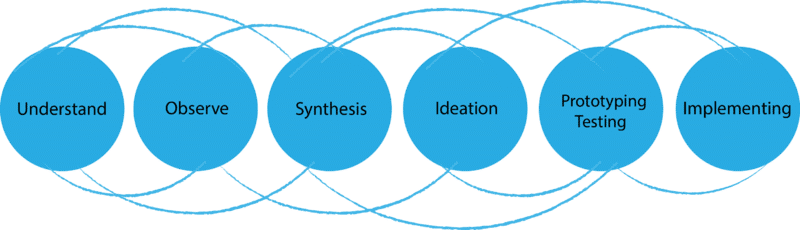
Author/Copyright holder: Wikimedia Deutschland e. V. Copyright terms and licence: CC BY-SA 4.0
The design thinking process, as illustrated above, is just as applicable to gamification as it is to other areas of design.
As Bob Marsh, the CEO of LevelEleven says, “It’s not about ‘gamifying.’ It’s about driving revenue, saving costs, making people more efficient.”
You’re Not Designing a Game
It’s important to note that gamification is about taking some aspects of gaming and applying them to a task to make it more fun. The objective is not to turn the task into a game completely. In fact, the trick to successful gaming is, very often, to keep things simple. Likewise, you should keep the introduction of elements of gamification to a subtle level; that way, the fun comes through without the user’s recognising the point that any sort of game’s going on.
LinkedIn uses a progress bar to drive users to complete their profiles. This is a simple thing to implement. It’s unlikely that making a progress bar dependent on completing increasingly tough levels of a shoot ‘em up game would be as effective. Why?—because users enter into using a social media platform in a different way from how they would a game that calls for blasting most things that appear in the player’s field of view into oblivion.
You need a clear objective for any gamification exercise, and you should be looking to achieve that objective as simply as possible. Keep the purpose of your design’s use firmly in mind.
 Author/Copyright holder: FancyFelix. Copyright terms and licence: Fair Use.
Gamification is not game design. The objective is to enhance an existing system and not to create a game. You’re building a gamification feature into a design, not the other way round.
It’s Not Easy to Get Gamification Right
Don’t let that discourage you, but be mindful of the point that game play in this context is anything but child’s play. You can’t just reach into a bag of random game mechanics and bolt them onto your enterprise applications if you want your gamification efforts to succeed. There’s a place for points, badges and leaderboards, but it’s not everywhere. You need to choose the right tool for the right job, and sometimes this will require some trial and error. That means knowing your target audience inside out, testing your design time and again before rolling it out, and never losing sight of the point that you’re playing another game with higher stakes in the process—producing the best design you can without risking its—and your—reputation.
“Poor game design is one of the key failings of many gamified applications today. The focus is on the obvious game mechanics, such as points, badges and leader boards, rather than the more subtle and more important game design elements, such as balancing competition and collaboration, or defining a meaningful game economy.”
—Brian Burke, Research Vice President at Gartner
Bad or poorly received gamification features may indeed deter your users from getting involved with the task in hand. Your objective is to engage users, not put them off. For instance, LinkedIn has a decidedly professional look and nature. With a little visualizing, you can picture potential users as being business executives, looking up each other so as to gain an in-depth understanding of who each is and what each person can do. It would be the last place for you to introduce a glitzy-looking element. It’s not that these people are deadly serious all the time and detest leisure; it’s just that there’s a time and place for everything—and, regardless of the point that attitudes towards gamification pivot on the generation gap, businesspeople will likely remain serious-minded for millennia to come. So, remember whom you’re designing for. To keep testing features before releasing them can help with this, but a real measurement of success normally requires input from the entire user base.
Don’t Treat Your Users as Toys
It can be tempting to see gamification as a means to introduce additional layers of control in the workplace or to try and fool people into doing more than they are expected to. That’s a bad idea. First and foremost, it’s unethical, even if one might argue that seeing who can puppeteer their users for the most profit could itself be boasted as a game at private cocktail parties. Still, apart from the rights and wrongs of ‘persuading’/‘conning’ people into doing things, users will work out quickly when they’re being manipulated or forced into things, anyway. Then, they’ll tend to withdraw from the game environment, and the offending design will become known as, say, a Skinneresque rat maze or the front lines on a chess board. Not only do people tend to dislike being viewed as rats or pawns, but they can also make their displeasure with a design like that known in a very public way.
It’s important to take an ethical approach to gamification and imagine yourself on the receiving end of whatever you’re creating. As a line in the song “If Only” by The Calling accurately proclaims: “We can’t mislead to make things right.” So, at the same time as you’re reminding yourself exactly who will use your design, remember, too, that they’re not stupid. Particularly when you’ve got a user base of adults who can discuss your design amongst themselves—and tell the rest of the world about it—the last thing you want to do is to try to outsmart them in this way. Once a user feels patronised, used and tricked, it may be only a matter of time before the first reviews appear. Therefore, if your design respects their intelligence, it will stand a better chance of winning their loyalty and, dare we hope, even more users.
 Author/Copyright holder: Pixabay. Copyright terms and licence: CC0
Treating users as toys is a great way to make them resent rather than embrace your gamification efforts.
Gamification Will Not Fix Bad Process or Business Models
A poorly designed process doesn’t become a well-designed process because you add some achievement badges. Similarly, a lousy business model remains a lousy business model no matter how you dress it up – as they say in England, “A pig in a dress is still a pig.”
Game mechanics can enhance good ideas and good processes and help increase adoption and engagement of new processes. But don’t try and use gamification as a Band Aid for a lousy idea – it won’t work. As you can see, gamification can be very useful in the enterprise context, but it is not a magical cure all for an organization’s ills either.
The Take Away
Gamification isn’t a magic wand. Bad products aren’t going to be good products just because you add some gamification. There’s a limit to what you can achieve through gamification, and you don’t want the product to become a game with a remote secondary benefit; gamification design is not gaming design. You need to focus on what you can realistically expect to achieve early in the design process and be very conscious that you can’t make a pig in a dress anything but a pig… no matter how much gamification you do. Lastly, never lose sight of the point that your users can see through trickery. It might only take one or two bad reviews for your design to earn the questionable title of cynical exploiter instead of what you want it to be—a hit.
References & Where to Learn More
Janaki Mythily Kumar and Mario Herger, Gamification at Work: Designing Engaging Business Software, The Interaction Design Foundation, 2014
Nic Fleming, “Gamification: Is It Game Over?”. BBC Future.
Hero Image: Author/Copyright holder: Teacup Pigs. Copyright terms and licence: Fair Use.