Continuum of Understanding

Your constantly-updated definition of Continuum of Understanding and collection of videos and articles.
Be a conversation starter: Share this page and inspire others!

98 Shares

What is Continuum of Understanding?

Information visualization is most commonly employed in the process of understanding data but how does that work in practice? At what stage in that process is information visualization valuable and what does the process as a whole look like? It's important for you to know the process of understanding data to be able to best employ information visualization techniques in your work. The process is best known as the continuum of understanding.

The continuum of understanding is a process that theorizes how people understand and learn from data.

Nathan Shedroff first proposed this model, describing it as a 4-step process where one’s understanding will shift and transform until it culminates as wisdom.

The 4-step process happens as follows:

1. Data

2. Information

3. Knowledge

4. Wisdom

Data gains meaning and becomes useful when it is processed and transformed into information.

One way to propel the continuum of understanding is by using the tools and methodologies specific to information visualization. When designing information visualization, designers process and sort data and present it in a context that enables the audience to glean insights.

Learn More About Continuum of Understanding

Make learning as easy as watching Netflix: Learn more about Continuum of Understanding by taking the online IxDF Course Information Visualization.

Why? Because design skills make you valuable. In any job. Any industry.

In This Course, You'll

  • Get excited when you discover how to turn complex information into actionable visuals that drive people's decision-making and accelerate business results. Did you know that visuals are processed 60,000 times faster in the brain than text? That's why you can inform and persuade so quickly and effortlessly with information visualizations! With large amounts of information at the center of every company, your ability to visualize information is a highly sought-after skill and will help you excel in any job. You already visualize information every day, like highlighting important points in a presentation or sketching a diagram to explain an idea, so it's easier than you think to master Information Visualization, no matter your background.

  • Make yourself invaluable when you enlighten and motivate people with your visualization skills. Your new skills will empower you to transform the vast sea of information in journalism, marketing, research, User Experience, and User Interface design into clear, actionable insights. With easy-to-follow frameworks, you'll create visuals for apps and websites with user interfaces so easy to navigate that people will love them. More love, better business outcomes, and the kind of salary that reflects your value. As AI becomes a powerful tool for visualizing information, you stay in demand because your timeless human-centered design skills let you turn data into visuals people actually resonate with and act on. Remember those meetings overwhelmed by endless rows of data? It won't happen on your shift, as you'll transform complex information into impactful visuals that make your ideas stand out instantly.

  • Gain confidence and credibility as you learn from the best. You'll get step-by-step guidance to easily display any information type. You'll get downloadable templates to carry out user observations and conduct user interviews with empathy. This Information Visualization course will give you the practical, in-demand design skills you need to get your message across and stand out in your field!

It's Easy to Fast-Track Your Career with the World's Best Experts

Master complex skills effortlessly with proven best practices and toolkits directly from the world's top design experts. Meet your expert for this course:

  • Alan Dix: Author of the bestselling book “Human-Computer Interaction” and Director of the Computational Foundry at Swansea University.

Get an Industry-Recognized IxDF Course Certificate

Increase your credibility, salary potential and job opportunities by showing credible evidence of your skills.

IxDF Course Certificates set the industry gold standard. Add them to your LinkedIn profile, resumé, and job applications.

Course Certificate Example

Be in distinguished company, alongside industry leaders who train their teams with the IxDF and trust IxDF Course Certificates.

Our clients: IBM, HP, Adobe, GE, Accenture, Allianz, Phillips, Deezer, Capgemin, Mcafee, SAP, Telenor, Cigna, British Parliament, State of New York

All Free IxDF Articles on Continuum of Understanding

Read full article
The Continuum of Understanding and Information Visualization - Article hero image
Interaction Design Foundation logo

The Continuum of Understanding and Information Visualization

Information visualization is a process by which data (or information) is represented to help the recipient of the information build an accurate representation of it in their mind. It is most common for information visualization to be constructed graphically (e.g. to facilitate visual understanding)

Social shares
671
Published
Read Article

The Continuum of Understanding and Information Visualization

The Continuum of Understanding and Information Visualization

Information visualization is a process by which data (or information) is represented to help the recipient of the information build an accurate representation of it in their mind. It is most common for information visualization to be constructed graphically (e.g. to facilitate visual understanding) but it may also be carried out in sound (e.g. to facilitate aural understanding) often, but not always, for the visually impaired to be able to understand data.

The term “information visualization” was coined at the Xerox PARC labs in the 1980s and was meant to signify that a new discipline in design was needed to create artifacts that would aid in the comprehension of data. While the term may be relatively new – the concept is not and though computers are commonly employed today to visualize information; information visualization may still be carried out with nothing more than a pen and paper (for visual) or a tape recorder (for aural).
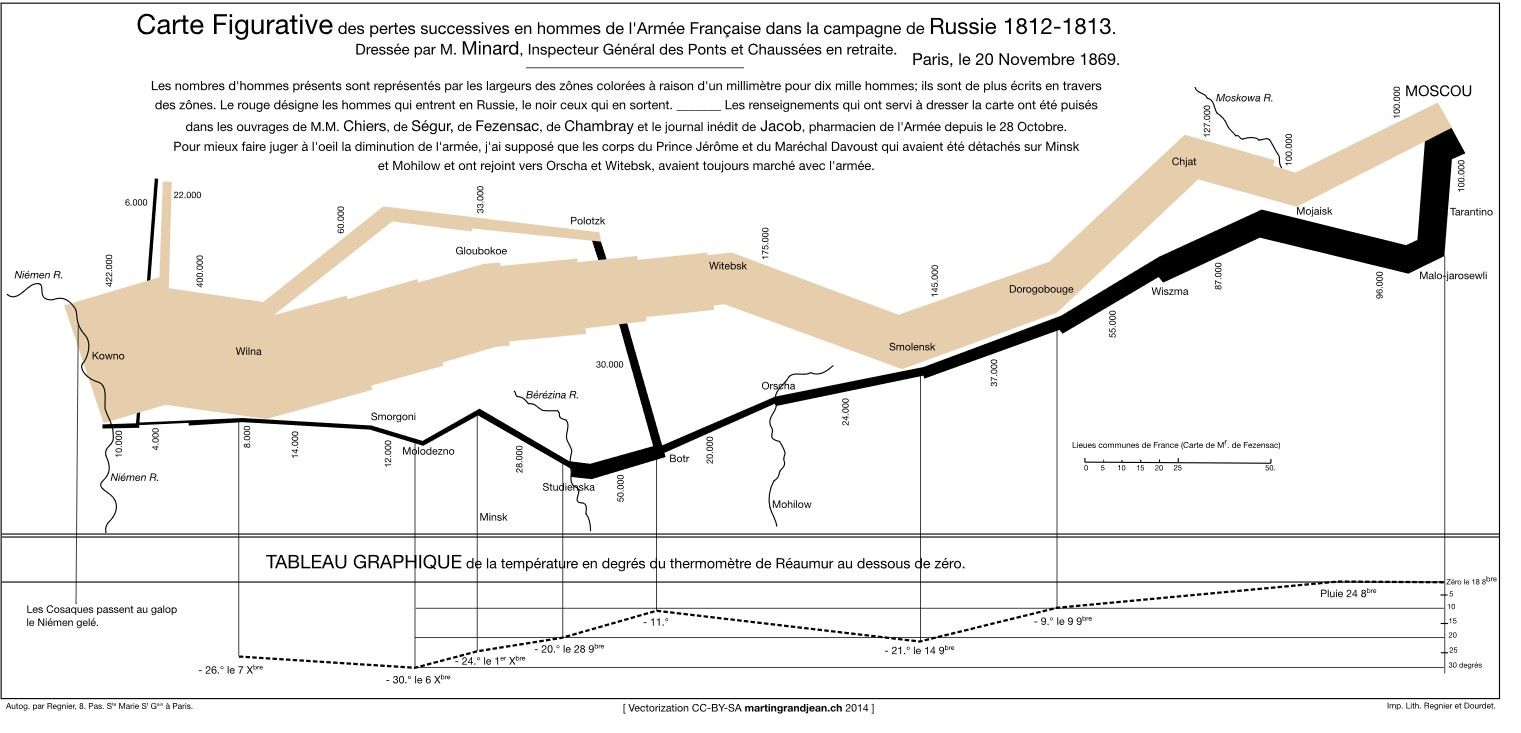

Author/Copyright holder: MartinGrandjean. Copyright terms and licence: CC BY-SA 3.0

This diagram (above), Minard’s Map, is one of the earliest complex pieces of information visualization. It shows the march of Napoleon’s army during the invasion of Russia in 1812. It was done completely without the use of computers (though the version pictured above has been rendered “prettier” with the use of graphic design).

The Process of Understanding Data

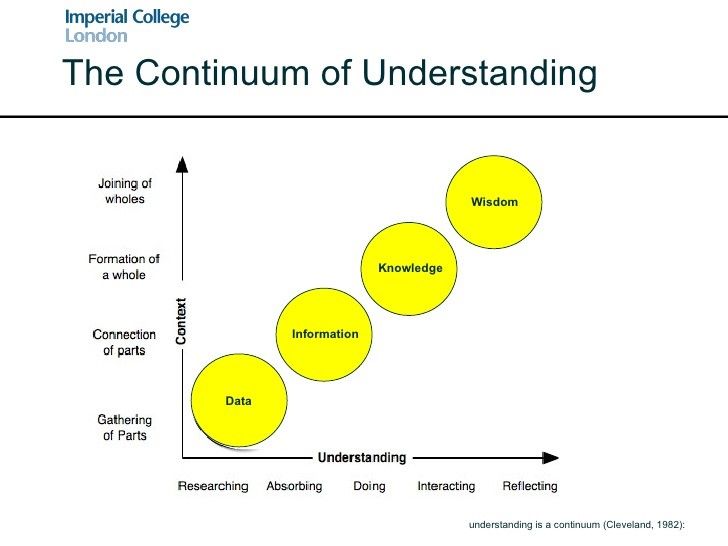
Nathan Shedroff, the renowned interaction designer, proposed in his paper “Information Design” a process by which we understand data. He offers a “continuum of understanding” which begins with data and culminates in wisdom. Along the way, the data is transformed in order to help us gain that wisdom.

Author/Copyright holder: Imperial College London. Copyright terms and licence: All rights reserved.

1. Data

We begin the process of understanding with data. Data, itself, has no intrinsic meaning. It is the first building block in the process of extracting information. For example, I may have data on the occurrence of cancer in a population but that data is relatively meaningless without context. It is only through the act of comparison with other populations or other time intervals that I can create meaning from these figures.

2. Information

The next step in the process is to give the data meaning and transform it from data into information. This involves sorting data, processing it, and presenting it in a format which brings substance to that data. The National Health Service, in the United Kingdom, for example will take data on the incidence of cancer in many populations – it will compare rates across time and geography and tabulate it to enable it be examined for trends.

3. Knowledge

Knowledge is the process by which we put information to use. We test hypotheses and develop practical applications for the information at this stage. We examine the information in a viable context so that we can discover the value of that information and how it can be put to work for us. Without application, information is also relatively useless but when we apply information to the world around us – it enables us to learn and grow.

4. Wisdom

Wisdom is the final step in the continuum of understanding. It is the point at which we have gained so much knowledge and expertise from the data that we have become able to judge the data itself (in a qualified manner). Wisdom is something we create for ourselves throughout this process; it is not something that we can teach to others – it is something that is brought about through study and careful interpretation of knowledge derived from data.

Where Does Information Visualization Come Into the Continuum of Understanding?

Information visualization will be used to help transform data into information. It provides us with a set of tools and methodologies by which we can sort, process and represent data to deliver valuable information in context.

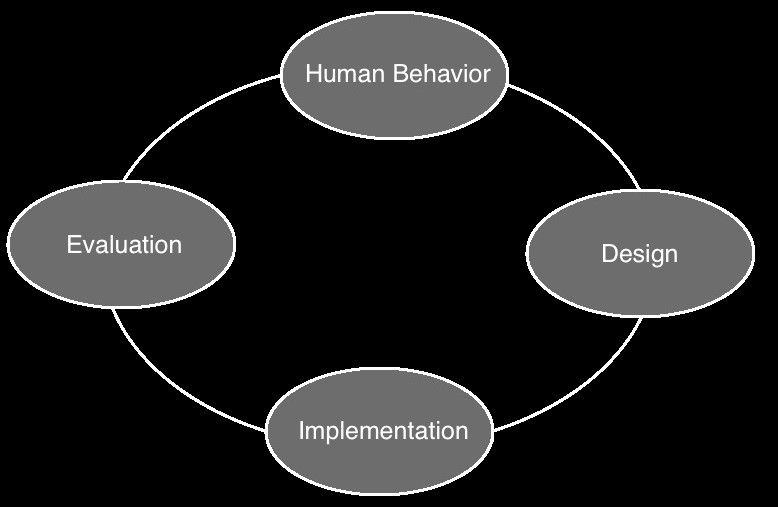
Information visualization, for a long time, was a subset of HCI (Human Computer Interaction) that is the study of how users interact with the computer equipment they employ; a basic explanation of the HCI process can be found in the diagram below. However, information visualization is now very much considered to be a separate discipline.

Author/Copyright holder: Sanilshah. Copyright terms and licence: CC BY-SA 3.0

Its focus is very much on aiding the cognitive processes of human beings to fully understand the data that they are presented with. This may be done visually or auditorily. It is most commonly done through the use of computing and this explains why information visualization was once part of the HCI discipline – there is a natural overlap between the two disciplines. This is because over the past decades computers have become increasingly powerful tools capable of crunching even the largest data sets and turning them into representative models. However, there is no requirement for computer modeling within the field of information visualization – it just makes the job much easier.

The Take Away

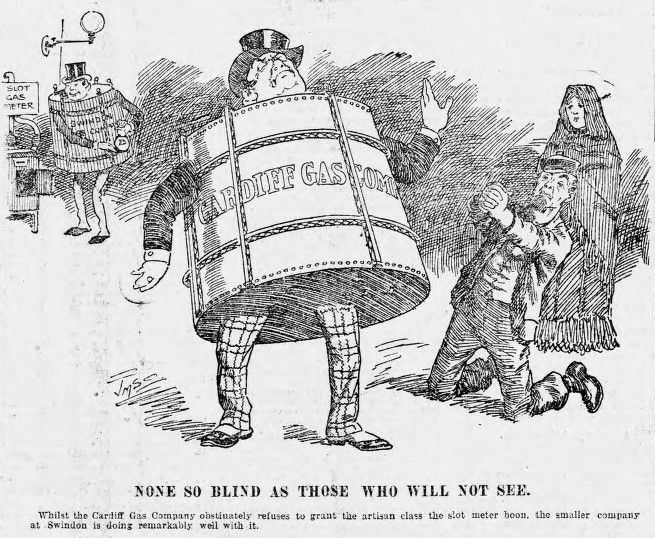
John Heywood, coined the term “There is none so blind as those who will not see” in 1956 according to the Random House Dictionary of Popular Proverbs and Sayings. It is often a fair assessment of people but in this age of increasingly complex data, it is fair to say that many cannot see deeply into information without the assistance of information visualization.

Author/Copyright holder: Joseph Morewood Staniforth. Copyright terms and licence: Public Domain.

The discipline bridges the gap on the continuum of understanding between data and information and allows us to go on and develop both knowledge and, hopefully, wisdom from that data.

References and Resources

Nathan Shedroff’s original paper on Information Design – Edited by Robert Jacobson. Information Design. MIT Press, Cambridge, MA, 1999.

Nathan Shedroff is still very active in the field of Interaction Design. Check out his thoughts on a range of topics.

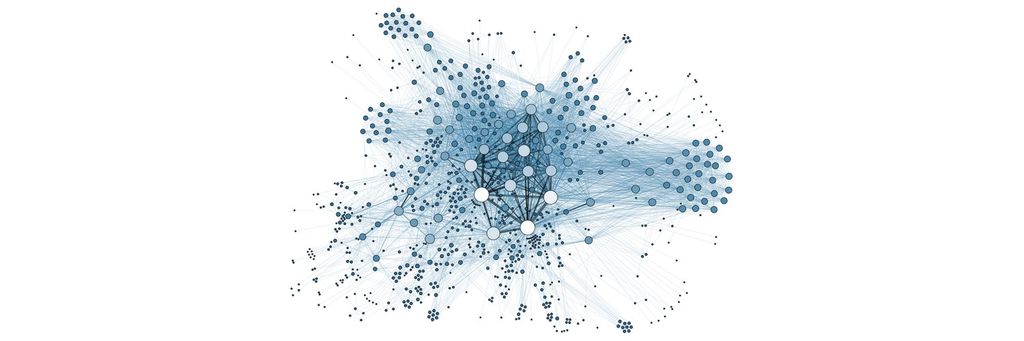
Hero Image: Author/Copyright holder: Martin Grandjean. Copyright terms and licence: CC BY-SA 3.0

Feel Stuck?
Want Better Job Options?

AI is replacing jobs everywhere, yet design jobs are booming with a projected 45% job growth. With design skills, you can create products and services people love. More love means more impact and greater salary potential.

At IxDF, we help you from your first course to your next job, all in one place.

See How Design Skills Turn Into Job Options
Privacy Settings
By using this site, you accept our Cookie Policy and Terms of Use.
Customize
Accept all

Be the One Who Inspires

People remember who shares great ideas.

Share on:

Academic Credibility — On Autopilot

Don't waste time googling citation formats. Just copy, paste and look legit in seconds.