UX and Google – How the Search Giant Has Been Subtly Improving SEO UX for Years

• 8 min read

534 Shares

This year, for the first time, Google stated that user experience would be a core part of gaining rankings for mobile websites. A poorer user experience would send your site hurtling down the rankings. This appeared to come as a shock to many in the SEO community and despite assurances that content was still king – many seemed to feel that this surprise had come entirely out of left field.

But did it? Isn’t it true that Google has been subtly focusing on UX with each and every algorithm update? We think that it is true and we’d like to take a walk through some of those updates and examine them in a UX context.

What’s certainly true is that Google’s not doing any of this to be vindictive. The Western world’s most popular search engine is number one because its own user experience continues to improve constantly. It’s that process of improvement that keeps its competitors at bay and 70% of the search audience (give or take a few percent) happy with Google to the exclusion of those competitors. So it shouldn’t be surprising that the UX of Google’s results are important – that UX in part defines the UX of using Google in the first place.

2008 – Google Instant

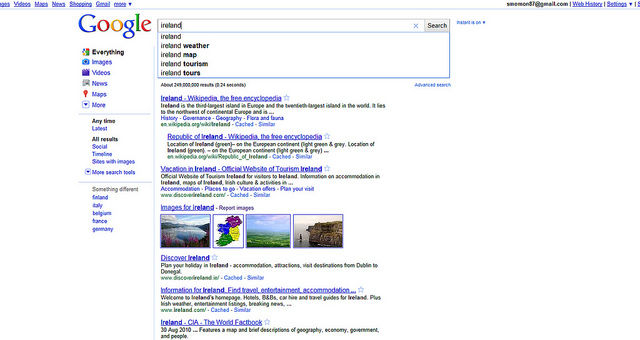
Well, to be fair, in 2008 the feature was Google Suggest but it got a new name in 2010 and has remained Google Instant ever since. The feature, is the auto-complete style function that takes place when a user starts typing in the search box.

Google Instant stops users from making mistakes and speeds up searching and the 2010 update made the whole process instant. The feature is barely noticeable now; we’re so used to it. The added convenience of Google Instant merged into the Google user experience near seamlessly.


Author/Copyright holder: Sean MacEntee. Copyright terms and licence: CC BY 2.0

2010 – Google Gets Social

On a web dominated by social media; it made sense for Google to examine the user experience of search in context with that social environment. They announced that they would begin to measure how content was shared, liked, etc. on social media and reward content with a rankings boost if it performed well on social media.

You can argue that this leads to a dumbing down of the web until you’re blue in the face but the truth is that search engines are supposed to deliver the most popular and useful content. The user experience is enhanced by a built in measure of popularity in ranking results.

2011 – Google Gets Fresh

It seems reasonable that search engine users want to view the most recent content available on a subject. After all a paper from 20 years ago might well lack the current thinking in the field and deliver a poor user experience as a result.

Google, got to grips with this in 2011 and started to reward “fresh content” with a boost in their rankings. Users no longer had to scan through half-a-dozen (or sometimes more) to find relevant and recent content that delivered instant benefits.



Author/Copyright holder: Kristina Alexanderson. Copyright terms and licence: CC BY 2.0

2012 – Google Conquers the Advertising Hogs

It’s perfectly reasonable to advertise services, etc. within content. After all, that’s how many internet entrepreneurs support themselves – through advertising.

However, there comes a point when advertising obscures the content. Some site owners were in effect spamming their users with endless adverts “above the fold” and hiding the content that visitors were interested in – below the fold.

So, Google decided enough was enough and sites like these started to plummet down the rankings in 2012. This is clearly a User Experience related change; sites stuffed to the brim with adverts make for a lousy user experience. Google’s tackling of this issue must be one of the most welcome changes made to SEO design in the last decade.

Another Subtler Google Change

Google has taken another successful UX related step to improve the algorithm too:

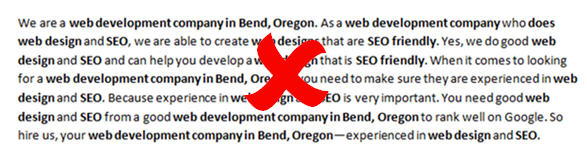
It has started to stamp out the practice of keyword stuffing. At one point in time, all you needed to do to rank a page was to stuff it with the keyphrase that would be used in the search engine’s search box. That led to unreadable garbage content where the same phrase was used in each and every paragraph (and in some cases in each and every line) on a page. Keyword stuffing no longer delivers high search positions and the internet is a better place for it.


Author/Copyright holder: Smart Solutions. Copyright terms and licence: All rights reserved Img source


Possible UX Improvements in the Future?

We don’t know where Google will take its UX SEO roadmap in the future. The company wisely keeps this data under its hat to stop people from trying to game the system; though gaming continues and many UX related updates are dedicated to stamp out such gaming (for example, the use of private blog networks to create high volumes of incoming links has become pointless in the last few years).

Yet, we suspect that keyword stuffing’s replacement – synonym stuffing (where you keep using the same phrase over and over but changing the exact words in the phrase for words with the same meaning) is going to end up a waste of time sooner rather than later. Truly semantic search is on the horizon and junk content is going to be much easier to identify by algorithm.

We also figure those sites that have become over reliant on heavy amounts of visuals to the detriment of copy are also going to find that they get a slap on the wrists soon.

What Does This Mean for SEO Experts?

All this leads us to believe that SEO expertise is no longer enough to propel your website to the top of the rankings in Google. You need UX expertise that truly focuses on user experiences. Google is going to do more and more to reward sites that users genuinely love and the only way to be certain that your web property is among them – is to ensure that the UX of your site is fantastic.

Header Image: Author/Copyright holder: Unknown. Copyright terms and licence: Unknown. Img


Learn More in This Course:

AI for Designers

12 days
13 % booked
View Course

What You Should Read Next

  • Read full article
    What is Interaction Design? - Article hero image
    Interaction Design Foundation logo

    What is Interaction Design?

    Interaction design is an important component within the giant umbrella of user experience (UX) design. In this article, we’ll explain what interaction design is, some useful models of interaction design, as well as briefly describe what an interaction designer usually does.A simple and useful unders

    Social shares
    1.5k
    Published
    Read Article
  • Read full article
    Apple’s Product Development Process – Inside the World’s Greatest Design Organization - Article hero image
    Interaction Design Foundation logo

    Apple’s Product Development Process – Inside the World’s Greatest Design Organization

    Apple’s Product Development Process may be one of the most successful design processes ever implemented. With a valuation that exceeds $2 trillion, there’s a lot that designers can learn from Apple and introduce into their own design environments.Apple is a notoriously secretive business. In Steve J

    Social shares
    1.4k
    Published
    Read Article
  • Read full article
    Shneiderman’s Eight Golden Rules Will Help You Design Better Interfaces - Article hero image
    Interaction Design Foundation logo

    Shneiderman’s Eight Golden Rules Will Help You Design Better Interfaces

    Follow Ben Shneiderman’s 'Eight Golden Rules of Interface Design' if you want to design great, productive and frustration-free user interfaces. Apple, Google and Microsoft are among some of the highly successful companies whose well-designed products reflect Shneiderman’s rules. The characteristics

    Social shares
    1.4k
    Published
    Read Article
  • Read full article
    How to Change Your Career from Graphic Design to UX Design - Article hero image
    Interaction Design Foundation logo

    How to Change Your Career from Graphic Design to UX Design

    If there’s an occupation that is 100% linked with the public’s idea of what design is all about, it’s graphic design. From the familiar golden arches of the McDonald’s brand to the typography and colors of movie posters, graphic designers create some of the most iconic and ubiquitous designs around

    Social shares
    1.4k
    Published
    Read Article
  • Read full article
    The Grid System: Building a Solid Design Layout - Article hero image
    Interaction Design Foundation logo

    The Grid System: Building a Solid Design Layout

    Now that we’ve seen some grids at work in the Rule of Thirds article, let’s examine them a little more deeply. As a concept that deals so fundamentally with the fabric and background of our work as designers, it’s easy to overlook the power of grids and think more about the elements we want to creat

    Social shares
    1.4k
    Published
    Read Article
  • Read full article
    The Principles of Service Design Thinking - Building Better Services - Article hero image
    Interaction Design Foundation logo

    The Principles of Service Design Thinking - Building Better Services

    Service design is all about taking a service and making it meet the user’s and customer’s needs for that service. It can be used to improve an existing service or to create a new service from scratch. In order to adapt to service design, a UX designer will need to understand the basic principles of

    Social shares
    1.4k
    Published
    Read Article
  • Read full article
    A Simple Introduction to Lean UX - Article hero image
    Interaction Design Foundation logo

    A Simple Introduction to Lean UX

    Lean UX is an incredibly useful technique when working on projects where the Agile development method is used. Traditional UX techniques often don’t work when development is conducted in rapid bursts – there’s not enough time to deliver UX in the same way. Fundamentally Lean UX and other forms of UX

    Social shares
    1.3k
    Published
    Read Article
  • Read full article
    Dieter Rams: 10 Timeless Commandments for Good Design - Article hero image
    Interaction Design Foundation logo

    Dieter Rams: 10 Timeless Commandments for Good Design

    Let’s pay a virtual visit to a famous industrial designer’s workshop. By examining the principles of his winning approach, we can incorporate vital elements into our designs in the “less is more” age.As user experience practitioners, most of us have worked with Nielsen and Molich’s 10 heuristics or

    Social shares
    1.3k
    Published
    Read Article
  • Read full article
    The 7 Factors that Influence User Experience - Article hero image
    Interaction Design Foundation logo

    The 7 Factors that Influence User Experience

    User Experience (UX) is critical to the success or failure of a product in the market but what do we mean by UX? All too often UX is confused with usability which describes to some extent how easy a product is to use and it is true that UX as a discipline began with usability – however, UX has grown

    Social shares
    1.3k
    Published
    Read Article
  • Read full article
    10 Free-to-Use Wireframing Tools for UX Designers in 2026 - Article hero image
    Interaction Design Foundation logo

    10 Free-to-Use Wireframing Tools for UX Designers in 2026

    Wireframes help you quickly ideate and test your ideas. While paper wireframes are the fastest to create, digital wireframes look more polished and presentable. If you are looking for a pocket-friendly wireframing tool, look no further.Whether you prefer browser-based apps or offline desktop tools,

    Social shares
    1.3k
    Published
    Read Article

Top Articles

Top Topic Definitions

Feel Stuck?
Want Better Job Options?

AI is replacing jobs everywhere, yet design jobs are booming with a projected 45% job growth. With design skills, you can create products and services people love. More love means more impact and greater salary potential.

At IxDF, we help you from your first course to your next job, all in one place.

See How Design Skills Turn Into Job Options
Privacy Settings
By using this site, you accept our Cookie Policy and Terms of Use.
Customize
Accept all

Be the One Who Inspires

People remember who shares great ideas.

Share on:

Academic Credibility — On Autopilot

Don't waste time googling citation formats. Just copy, paste and look legit in seconds.

Feel Stuck? Want Freedom?

Join 326,029+ designers who get one powerful email each week. Learn to design a life you love.

Next email in
1
day
13
hrs
53
mins
41
secs

Free forever. No spam. Unsubscribe anytime.