Our personal values can often be a little hard to define. Why?—because our real values and the values that we aspire to sometimes conflict. An honest examination of our values, however, is vital to succeed as an entrepreneur or freelancer. That’s because when we work in harmony with our values, we’re more likely to enjoy and appreciate what we do. Moreover, understanding our real values can help us reflect on our business ideas and help us change and improve our business ideas until they meet our values. This in turn ensures that we bring the best value to our clients.
Many would-be business owners know exactly what they want to do and why they want to do it; others aren’t really sure. Whichever position you’re in, sitting down and working out your values before you begin a business makes great sense.
When your values are clear to you, making decisions becomes easier.
– Roy E. Disney
There’s also a lot of evidence showing that when we work in harmony with our values, we become happy in the things we do, as the International Association of Wellness Professionals espouse in “Why Following Your Passion is Healthy For You”. Conversely, if we work against our values and don’t incorporate our interests and passions, we become unhappy. That’s pretty much common sense, too, if you think about it.
As a university student, the co-founder of the Interaction Design Foundation, Rikke Friis Dam, travelled and worked as a Divemaster at tropical destinations during all her summer holidays. There was no doubt about her passions and interest in diving and helping others to learn how to dive. But one season, when she was working off the beautiful peninsula of Perhentian Island in Malaysia, one instructor advised her and the other Divemaster just to leave even inexperienced divers on their own at the end of the dive group if they couldn’t keep up with the rest of the group or if they were having difficulties with their ears or masks and needed assistance. Normally, the rest of a dive group has to wait for the Divemaster and instructor to solve these issues; instead, this instructor simply continued to show the group the planned and exciting underwater tour—while others were struggling.
Leaving divers – inexperienced or not – to solve their own problems is highly irresponsible as it could cause injuries and, in the worst case, death, e.g., if a diver panics because of a bit of water in his mask and decides to shoot to the surface. It’s a part of the Divemaster’s job to help out all divers in the group even if it ruins the perfect dive experience for the other divers and they only get to see half of the planned dive.

Author/Copyright holder: Rikke Friis Dam and the Interaction Design Foundation. Copyright terms and licence: CC BY-NC-ND.
Rikke Friis Dam, working as a Divemaster. Divemasters have a responsibility to those they serve; leaving inexperienced divers to fend for themselves causes a serious clash with a good Divemaster’s value system.
Rikke Friis Dam decided to quit the job early and look for a new diveshop to work for that summer so as to deliver the goods as a responsible Divemaster, helping divers have a safe and fun experience. That, an essential part of her values and a huge part of the Divemaster job description, is a just and moral code. It is, of course, both the instructor and Divemaster’s responsibility to help and guard divers to have a safe and fun experience.
A valuable lesson here is that you should not do work when it is not in line with your values. You should try to change the settings. In Rikke’s case, such a change would have involved persuading that instructor to change his irresponsible value prioritization of putting fun above safety. Or, you should simply quit the job if you cannot change the work conditions so they meet your values and responsibly so.
“Try not to become a man of success. Rather become a man of value.”
― Albert Einstein
So How Do You Determine Your Values?
You start by allocating an hour to yourself. Go somewhere quiet, take a pen and paper, and be prepared to ask some tough questions—really look inside yourself for honest answers. Throughout the exercise, write down your answers. Articulating things in writing helps you review them and examine them for honesty.
Perhaps the following statement can help you determine your values:
“What you risk reveals what you value.”
― Jeanette Winterson, award-winning English author
Phase 1 – Describe, in as Much Detail as Possible – and Give Yourself Some Advice:
The three life (including work) experiences, events or achievements in your life, to date, that make you most proud of yourself and gave you a deep feeling of happiness and fulfilment.
Common rules and features among these three life events.
What advice would you give yourself today? It’s up to you if you want to knit together one or more pieces of advice for yourself. Usually, you will end up with two to five pieces of advice for yourself.
Phase 2 – Describe, in as Much Detail as Possible – and Give Yourself Some Advice:
The three failures or mistakes in your life (including work), to date, that have made you feel the most ashamed about your actions and thoughts. Which actions caused you pain where you now know that you could have acted differently and more wisely to create a better outcome from the given situations?
Common rules between these three life events.
What advice would you give yourself today? It’s up to you if you want to knit together one or more pieces of advice for yourself. Usually, you will end up with two to five nuggets of advice. Take them as you find them—they’ll be valid and powerful.

We’re certain that your advice will be better than this advice…
Phase 3 – Cut the Fat
Try to cut each of those chunks of advice (which are, in essence, your values) back to a short statement. So, for example, you might have said; “You need to learn to take more risks when the costs of doing so are low. You miss out on rewards because you tend to be over cautious.” This could be shortened to, “Take more calculated risks.” If you can get down to a single word, that’s better still, but it’s not always easy to do so. In this case, you would end up with one or two words: “risk” or “calculated risks”.
Phase 4 – Prioritize Your Values
Now, write down all your values on pieces of paper, and try to organize them in a hierarchy so you place your most important values at the top of a pyramid and the least important ones at the bottom.
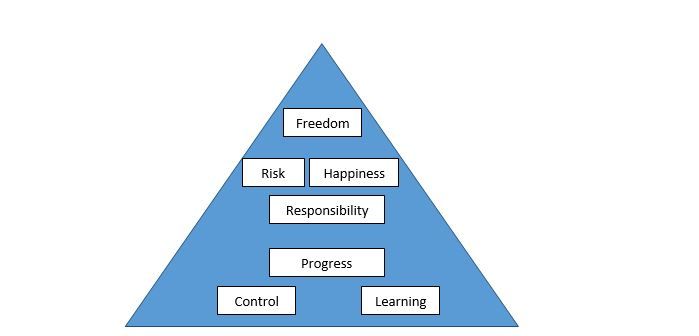
The pyramid structure shows an example of which values stand highest as our priorities.
Phase 5 – Test Your Values and Improve Your Business Concept and Ideas
Now, put those values in context with the way you live your life to help you understand whether the values you’ve decided upon are, in fact, your core—or most important—values. It’s time to ask:
Is there a situation where that value acts against your interests? “Take more risks” may sound awesome, but if you only really enjoy complete stability in your life, it may not be a useful value. Take each value and ask this question.
Then, take each value and ask whether that value can bring you towards a future you would love. For example, if you’ve chosen “freedom” as your most important value, it makes a great deal of sense if you start an online business where you’re free to work from wherever you desire. On the other hand, if you’ve chosen “stability” or “growing roots”, you may not want to pursue a life as a digital nomad, which could sound very attractive at first, but this wouldn’t be the ideal lifestyle choice for you. You could still start that online business you dream of, but you may want to work from your home city instead of travelling the world while starting your business.
You may find a need to repeat the whole process several times until you get to your core values. You can seek feedback from someone—who knows you well and whom you trust—to help you see things in their correct light without being harmful. Feedback isn’t much use to you if you’re not going to put it into practice; having said that – sometimes feedback isn’t valuable, and you can choose not to act on it, as long as you’ve thought about it first.
It’s worth noting that you don’t have to be finished in a single hour. You can take as long as you need to understand your values (for some people, the process can take months in earnest).
The Take Away
An honest examination of our values is vital to succeed as an entrepreneur or freelancer. When we work in harmony with our values, we’re more likely to enjoy and appreciate what we do, and it’s easier to make the right decisions, too. When you’ve been going through a deliberate process to elicit your values, you can set out to accomplish a life and build a business in harmony with those values.
References & Where to Learn More
Hero Image: Author/Copyright holder: Hernán Piñera. Copyright terms and licence: CC BY-SA 2.0
Define Your Personal Core Values, Kevin Daum, Inc. Com, 26th of April 2013.
Jeanette Winterson, Written on the Body, 1993