Social Evolution and Why We Need to Communicate

by Rikke Friis Dam • 8 min read

762 Shares

Human beings are social animals. We want to be in the company of friends or family and share our lives with them. We want to talk about the minutiae of our lives: what we had for dinner, the commute to work, etc. as much as we do about the big things in our lives. Let’s take a look at the brain and see how social behaviour “comes about”. By getting a firm grounding of this dynamic, you’ll have fresh insight into how you design for your usership.

Social Capacity is an Evolved Capacity

The very outermost layer of the human brain is called the neocortex. If you take a human being in a social setting and use a Magnetic Resonance Imager (MRI) to scan his/her brain – you’ll find that the neocortex is where all the action is. When you compare the neocortex in human beings with the neocortex of primates (monkeys, gorillas, etc.) you can see that the human neocortex is a lot bigger than that of any primate. In short, our brains evolved to deliver a social capacity.
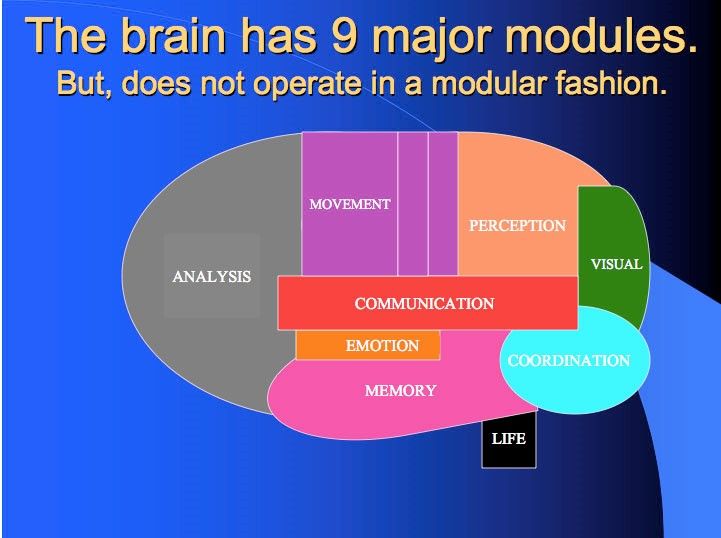
Author/Copyright holder: Webber. Copyright terms and licence: Public Domain.

It’s quite important to know that while specific areas of the brain, such as the neocortex, are responsible for specific tasks, they don’t operate in isolation. All parts of the brain work together.

Why Did We Evolve that Capacity?

Without an enhanced sense of social awareness, it would have been difficult, if not impossible, for human beings to cooperate on the scale that they do. It is our capacity for cooperation that has enabled us to rise to the top of the food chain on earth. Human beings are weaker than many predatory species. For example, a human being cannot outfight a lion at least without exceptional training, skill and a lot of luck. A group of human beings can easily take on a lion and expect to win.

Why is this Important?

One of the strongest capacities of a social creature is its ability to communicate. Wherever you go in the world, you’ll see groups of people gathered together to share ideas, catch up on trivia and engaged in all forms of communication that are currently technologically possible.

“Communication leads to community, that is to understanding and mutual valuing.”
— Rollo May, American Psychologist

That urge to communicate leads us to adapt technology to communicate with, too. When the printing press made its debut in Europe circa 1440, its purpose was to create copies of books at an affordable price. Yes, copies of the Bible rolled off first, but a more far-reaching effect was to arrive with the new technology. Within a short while, people were printing notices on the press and distributing them in public places. Printing didn’t just mean we could share knowledge; it meant we could communicate with more people and more easily than we could before. Instead of having to go round your village and discuss a new idea with everyone, you could leave the idea on a church doorstep or the wall of an inn and let people come back to you.
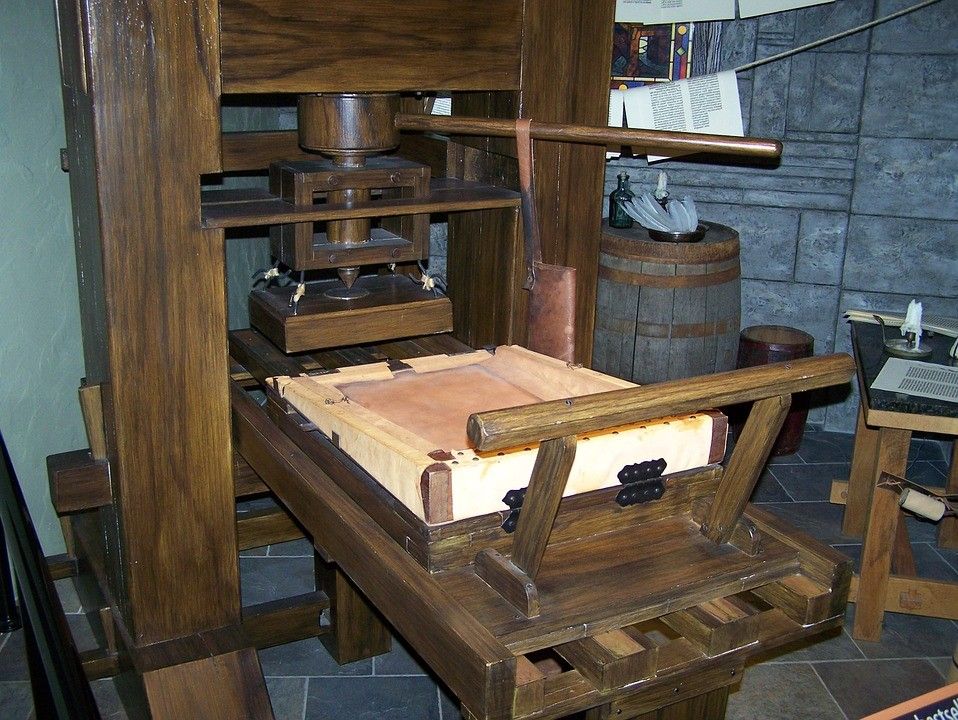
Author/Copyright holder: Pixabay. Copyright terms and licence: CC0

The printing press was invented to promote communication—specifically, to reduce the prices of books so that anyone, who could read, could access the thoughts and ideas inside.

No-one ever intended the telephone to become a device of mass communication. The original telephone was supposed to be a clever replacement for the telegraph. You could go to an office and for a considerable fee send a message to someone elsewhere in the country. One operator would speak to another, who would record the message and then pass it on to the recipient.

Then businesses started to realize that they could benefit from a direct telephone service but still the telephone companies weren’t focused on the mass market. It took a lot of pressure from the public before they became commercially available for installation in any home.

The Internet brought e-mail, and it was Hotmail which brought e-mail to the masses. Now you could send a message to anyone, anywhere whenever you wanted to. Adoption of e-mail was incredibly swift, even faster than adoption of the telephone.

The ultimate evolution of the social realm for the Internet was the social network. MySpace arrived nearly 15 years after the Internet began. It may seem hard to believe, but Facebook really only began taking off internationally at the start of 2007. Nearly everyone you know will have a Facebook account. It’s an incredible reach for a recent invention. Communication sells. As we are social creatures, it’s what drives us forward.

Author/Copyright holder: Pixabay. Copyright terms and licence: CC0

It’s hard to imagine life before Facebook... even though Facebook only really began rolling across to take the planet by storm in 2006 or so.

Why Does This Matter to Designers?

This all matters to us as designers because if you can find a way to enable better communication, you can drive usage and purchasing behaviour. This may be direct, as with the design of the telephone – people bought telephones and used them because they found them useful. It may also be indirect, as with Facebook – where users do not pay for services, but advertisers pay for services because it enables them to communicate with users of the service.

The Take Away

Human beings evolved as social animals, and with that evolution of social behaviour came the need to communicate. Devices that have facilitated communication have tended to produce far-reaching, and sometimes unexpectedly successful, effects. Products that drive our ability to communicate with each other can have a huge advantage over those that don’t. Communication is a fundamental need, and meeting it can be a powerful way to gain users and customers. With that in mind, aim to incorporate this observation into your output as much as you can. The more you can link people together, the more you can make whatever you’re offering accessible to a global marketplace where, perhaps, everyone can talk about it.

References & Where to Learn More

Course: Psychology of E-Commerce: How to Sell Online

History of the telephone

A brief history of Facebook

Hero Image: Author/Copyright holder: Johanna Pung. Copyright terms and licence: CC BY-SA 3.0

Learn More in This Course:

AI for Designers

6 days
42 % booked
View Course

What You Should Read Next

  • Read full article
    Why Care about Statistical Significance? - Article hero image
    Interaction Design Foundation logo

    Why Care about Statistical Significance?

    The categorical data depicts the success and failure rate of the low-fidelity wireframe above. There is not a large enough difference between the two to determine if the designs were successful.There is an element of error involved in measuring anything. So, when we want to compare measurements, how

    Social shares
    433
    Published
    Read Article
  • Read full article
    Web Fonts: Definition and 10 Recommendations - Article hero image
    Interaction Design Foundation logo

    Web Fonts: Definition and 10 Recommendations

    Web fonts bring digital content to life. They enhance readability, set the tone, and ensure consistency across various platforms—all vital ingredients. When you understand web fonts and their impact, it can help you with effective website creation—and greatly so. We’ll provide a comprehensive overvi

    Social shares
    782
    Published
    Read Article
  • Read full article
    How to Screen Research Participants - Article hero image
    Interaction Design Foundation logo

    How to Screen Research Participants

    Finding the right participants is crucial for gathering user research. We usually need to do research with participants having a particular set of needs or experience. In this short video, you will find out about the basic need for screening and how we make sure that we have suitably qualified parti

    Social shares
    451
    Published
    Read Article
  • Read full article
    Pitfalls in Recruiting Participants for User Research - Article hero image
    Interaction Design Foundation logo

    Pitfalls in Recruiting Participants for User Research

    The level of participant engagement is an important part of the user research results. Our results are dependent on proper engagement with our participants. In this video we look at some of the issues around participant recruitment and hear practical examples that arose in a large online study.[[vid

    Social shares
    420
    Published
    Read Article
  • Read full article
    How to Fit Quantitative Research into the Project Lifecycle - Article hero image
    Interaction Design Foundation logo

    How to Fit Quantitative Research into the Project Lifecycle

    Quantitative research methods fit into the project lifecycle at different stages of the process.In this video, we see where different quantitative research methods fit into a typical project lifecycle. Bear in mind that even with an iterative process such as Agile, the short cycles still address dif

    Social shares
    511
    Published
    Read Article
  • Read full article
    How to Resolve Conflicts Between Design Thinking and Marketing - Article hero image
    Interaction Design Foundation logo

    How to Resolve Conflicts Between Design Thinking and Marketing

    In the past, designers often reported to marketing managers and were neither expected nor allowed to make business decisions. When traditionally-structured companies transition to a design-driven mindset, there can be friction between the marketing and design teams. Let’s take a closer look at this

    Social shares
    682
    Published
    Read Article
  • Read full article
    Stop the Generic Portfolio Trap! Design a Stand-Out Portfolio for Your UX/UI Niche: User Research - Article hero image
    Interaction Design Foundation logo

    Stop the Generic Portfolio Trap! Design a Stand-Out Portfolio for Your UX/UI Niche: User Research

    User research is indispensable—and without it, well... UX design is guesswork. When you’re a user researcher, you know this well—but it can be hard to communicate your work in a way that grabs the viewer and holds their attention. And that’s what a portfolio is all about—grabbing the attention of yo

    Social shares
    384
    Published
    Read Article
  • Read full article
    Top Service Blueprint Templates - Article hero image
    Interaction Design Foundation logo

    Top Service Blueprint Templates

    Service blueprint tools are vital for effective customer experience design—and for designers to make experiences that are exceptional. Here, we’ll discuss why these tools are so important. What’s more, we’ll explore templates and practical resources to create high-quality, efficient service blueprin

    Social shares
    638
    Published
    Read Article
  • Read full article
    How to Write Research Questions that Lead to Confident Design - Article hero image
    Interaction Design Foundation logo

    How to Write Research Questions that Lead to Confident Design

    Designing with Data provides an extensive background to A/B testing.As with all other research methods, we need to start with a research question. A/B testing concerns itself with changes in user behavior, meaning that our questions need to be centered on measurable goals. In many cases, these will

    Social shares
    450
    Published
    Read Article
  • Read full article
    Getting Started - Article hero image
    Interaction Design Foundation logo

    Getting Started

    We start our introduction to A/B and multivariate testing (MVT) by looking at their basic principles and their differences. Note that the video mentions Google Optimize, which has been withdrawn. Google Firebase can be used for mobile platforms. Third-party solutions are needed for A/B testing on th

    Social shares
    228
    Published
    Read Article

Top Articles

Top Topic Definitions

Feel Stuck?
Want Better Job Options?

AI is replacing jobs everywhere, yet design jobs are booming with a projected 45% job growth. With design skills, you can create products and services people love. More love means more impact and greater salary potential.

At IxDF, we help you from your first course to your next job, all in one place.

See How Design Skills Turn Into Job Options
Privacy Settings
By using this site, you accept our Cookie Policy and Terms of Use.
Customize
Accept all

Be the One Who Inspires

People remember who shares great ideas.

Share on:

Academic Credibility — On Autopilot

Don't waste time googling citation formats. Just copy, paste and look legit in seconds.

Feel stuck? Want Freedom?

Get one powerful email each week, like 325,622 others.

Learn to design a life you love.

Next email in:
3
days
8
hrs
53
mins
39
secs