8 Tips for Conducting UX Interviews

• 8 min read

550 Shares

Conducting interview with users can be hugely rewarding. It is, however, a bit of a challenge to get the process right and many first-time interviewers are just a little bit nervous about going one-on-one with their interviewees. As with many other UX research techniques that process can be a little easier if you follow a few simple tips to develop your user interviews:

Set Objectives and Stick to Them

An interview is a conversation but unlike a social chat which is free to wander wherever its participants want to go; an interview needs to reveal useful insights to help the UX design process. That means you need to have some clear (and ideally written) objectives before you start the interview. What do you want to learn? How will you get to learn that?

This should enable you to generate a list of useful questions to target that information. Of course, people being people – your users will still wander off piste, your job is to gently nudge them back in the right direction and control the flow of conversation to get the results you want.

Take It Slow and Build Rapport

An interview cannot be held as an interrogation. Firstly, you’re not the police or security forces and secondly, you don’t want your users to feel like criminals. That means developing rapport with the participants in your interviews so that they want to help you.

This process can begin before they even enter the building for the interview. Contacting participants ahead of time and helping them understand what they do and the format of the interview can help put nervousness to bed. When they arrive a pleasant greeting and an offer of a drink can also help form a quick bond.

When the interview begins a few minutes for pleasantries and opening up a conversation can also help develop rapport before you go into details.
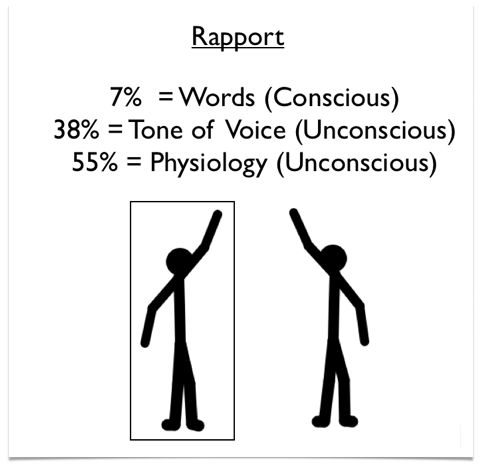


Author/Copyright holder: Excellence Assured. Copyright terms and licence: All rights reserved Img source

Don’t Forget to Acknowledge the Person

If you start a conversation in a bar; you maintain eye contact – you smile, you nod your head, etc. Non-verbal acknowledgment of someone in a conversation is important. So is verbal acknowledgement; from murmurs of enthusiasm to the occasional; “That’s great feedback.” These are the social cues that make up a conversation.

This is as true in the interview setting as it is in a bar. Your user is a human being not just a test subject and conversations need to feel authentic to them.

Let Them Be The Expert

It can be tempting to feel that we are the experts in the room; after all it’s our project and our business but when it comes to the user interview – we’re not experts. The user being interviewed is the expert. It doesn’t matter how much experience you have or how clever you are – you cannot predict what the participant will say.

That means making it explicit that you have come to listen to the user and to learn from them. Reassure them that there are no wrong answers and that their opinions are all that matters in these sessions.

Learn to Love Silence

Ask any salesperson and they’ll tell you that once the order has been asked for; “the first person to speak loses the deal.” Silence is something that many of us are not comfortable with. There’s something scary about a space with no words. Yet, it’s silence in which we reflect and think about what we’re going to say.

Sometimes, you have to shut up and endure silence for the participant in an interview to volunteer what they really want to say. Silence encourages them to speak. Don’t fill that silence for them.

Be Cautious About Leading Questions

A leading question is one which pre-supposes a “good” answer. For example; “Don’t you think that this is the best incarnation of our product so far?” Is clearly designed to elicit a “Oh, yes!” from the respondent.

Leading questions are a great way to introduce bias into your interview responses. Interviewees, by and large, don’t attend an interview to contradict the person in authority. Thus a leading question will often receive the expected response rather than the honest response someone might have wanted to give.

Wherever possible ask more open-ended questions; “Which incarnation of the product has been your favourite?” for example.



Author/Copyright holder: Unknown. Copyright terms and licence: Unknown Img source

Develop Follow Up Questions on the Fly

Whilst a plan and an outline for your interview are important; it’s also important to deviate from that plan when you’re presented with something really interesting. If someone touches on something and it feels important, drop the script for a bit and follow up on the fly.

“So, you just said XYZ and I find that really interesting. Can you tell me a bit more about that issue and why it matters to you?” is a good way to do this. It shows that you’ve been paying attention to what’s been said and that the person’s opinion has value too.

Interrupt if You Have To

Interviews are held on a timescale. If your participant has a tendency to head into the rough as they verbally meander around everything except what you want to talk to them about; you need to bring them back on track.

This does not mean being rude. It just means that you have to take a breath and interject. Something along the lines of; “That’s really valuable but can I just change tack here? I would really like to know about XYZ at this moment in time…”

This reassures the participant that you still value their opinion but enables a change of course to get the interview moving in the right direction.

Summary

Interviewing is a great way to conduct user research. It can also be a lot of fun. Interacting with users and discovering more about the way they feel about your products can be really interesting and enjoyable. To get the most out of user interviews really just means having a process in place and trying to keep to that process (though a touch of flexibility can help sometimes too).

Header Image: Author/Copyright holder: Thomas Link. Copyright terms and licence: CC BY-SA 2.0



Learn More in This Course:

AI for Designers

9 days
19 % booked
View Course

What You Should Read Next

  • Read full article
    Why Care about Statistical Significance? - Article hero image
    Interaction Design Foundation logo

    Why Care about Statistical Significance?

    The categorical data depicts the success and failure rate of the low-fidelity wireframe above. There is not a large enough difference between the two to determine if the designs were successful.There is an element of error involved in measuring anything. So, when we want to compare measurements, how

    Social shares
    432
    Published
    Read Article
  • Read full article
    Web Fonts: Definition and 10 Recommendations - Article hero image
    Interaction Design Foundation logo

    Web Fonts: Definition and 10 Recommendations

    Web fonts bring digital content to life. They enhance readability, set the tone, and ensure consistency across various platforms—all vital ingredients. When you understand web fonts and their impact, it can help you with effective website creation—and greatly so. We’ll provide a comprehensive overvi

    Social shares
    781
    Published
    Read Article
  • Read full article
    How to Screen Research Participants - Article hero image
    Interaction Design Foundation logo

    How to Screen Research Participants

    Finding the right participants is crucial for gathering user research. We usually need to do research with participants having a particular set of needs or experience. In this short video, you will find out about the basic need for screening and how we make sure that we have suitably qualified parti

    Social shares
    450
    Published
    Read Article
  • Read full article
    Pitfalls in Recruiting Participants for User Research - Article hero image
    Interaction Design Foundation logo

    Pitfalls in Recruiting Participants for User Research

    The level of participant engagement is an important part of the user research results. Our results are dependent on proper engagement with our participants. In this video we look at some of the issues around participant recruitment and hear practical examples that arose in a large online study.[[vid

    Social shares
    419
    Published
    Read Article
  • Read full article
    How to Fit Quantitative Research into the Project Lifecycle - Article hero image
    Interaction Design Foundation logo

    How to Fit Quantitative Research into the Project Lifecycle

    Quantitative research methods fit into the project lifecycle at different stages of the process.In this video, we see where different quantitative research methods fit into a typical project lifecycle. Bear in mind that even with an iterative process such as Agile, the short cycles still address dif

    Social shares
    510
    Published
    Read Article
  • Read full article
    How to Resolve Conflicts Between Design Thinking and Marketing - Article hero image
    Interaction Design Foundation logo

    How to Resolve Conflicts Between Design Thinking and Marketing

    In the past, designers often reported to marketing managers and were neither expected nor allowed to make business decisions. When traditionally-structured companies transition to a design-driven mindset, there can be friction between the marketing and design teams. Let’s take a closer look at this

    Social shares
    682
    Published
    Read Article
  • Read full article
    Stop the Generic Portfolio Trap! Design a Stand-Out Portfolio for Your UX/UI Niche: User Research - Article hero image
    Interaction Design Foundation logo

    Stop the Generic Portfolio Trap! Design a Stand-Out Portfolio for Your UX/UI Niche: User Research

    User research is indispensable—and without it, well... UX design is guesswork. When you’re a user researcher, you know this well—but it can be hard to communicate your work in a way that grabs the viewer and holds their attention. And that’s what a portfolio is all about—grabbing the attention of yo

    Social shares
    383
    Published
    Read Article
  • Read full article
    Top Service Blueprint Templates - Article hero image
    Interaction Design Foundation logo

    Top Service Blueprint Templates

    Service blueprint tools are vital for effective customer experience design—and for designers to make experiences that are exceptional. Here, we’ll discuss why these tools are so important. What’s more, we’ll explore templates and practical resources to create high-quality, efficient service blueprin

    Social shares
    638
    Published
    Read Article
  • Read full article
    How to Write Research Questions that Lead to Confident Design - Article hero image
    Interaction Design Foundation logo

    How to Write Research Questions that Lead to Confident Design

    Designing with Data provides an extensive background to A/B testing.As with all other research methods, we need to start with a research question. A/B testing concerns itself with changes in user behavior, meaning that our questions need to be centered on measurable goals. In many cases, these will

    Social shares
    450
    Published
    Read Article
  • Read full article
    Getting Started - Article hero image
    Interaction Design Foundation logo

    Getting Started

    We start our introduction to A/B and multivariate testing (MVT) by looking at their basic principles and their differences. Note that the video mentions Google Optimize, which has been withdrawn. Google Firebase can be used for mobile platforms. Third-party solutions are needed for A/B testing on th

    Social shares
    225
    Published
    Read Article

Top Articles

Top Topic Definitions

Feel Stuck?
Want Better Job Options?

AI is replacing jobs everywhere, yet design jobs are booming with a projected 45% job growth. With design skills, you can create products and services people love. More love means more impact and greater salary potential.

At IxDF, we help you from your first course to your next job, all in one place.

See How Design Skills Turn Into Job Options
Privacy Settings
By using this site, you accept our Cookie Policy and Terms of Use.
Customize
Accept all

Be the One Who Inspires

People remember who shares great ideas.

Share on:

Academic Credibility — On Autopilot

Don't waste time googling citation formats. Just copy, paste and look legit in seconds.

Feel stuck? Want Freedom?

Get one powerful email each week, like 325,753 others.

Learn to design a life you love.

Next email in:
5
days
16
hrs
4
mins
14
secs