It may not be popular but outbound telemarketing is one of the most effective strategies for growing a business. The good news is that this doesn’t have to be hard, and it doesn’t have to involve bullying potential clients into submission, either. Building an effective telemarketing strategy for business growth is all about learning to tap into the value that you bring your clients and potential clients.
Telemarketing is different from telesales. The latter is about trying to open and close business over the phone. Telemarketing, on the other hand, is all about trying to create opportunities. It can be used for market research (polling the opinion of decision makers) or it can be used simply to collect accurate information to employ other marketing techniques (such as finding out the decision maker’s name and e-mail address in order to target e-mail marketing).
If you’re a little bit nervous about conducting telesales, then telemarketing can also be a great way to learn to cold call without worrying about failure rates. Just remember what Zig Ziglar, the marketing guru said; “Timid salesmen have skinny kids.” Gaining the confidence to sell will serve you and your business very well.
10 Tips for Successful Telemarketing
Have a Plan
Before you begin telemarketing, make certain that you know what your objective is for the exercise. If it’s collecting e-mail addresses, you may well—for smaller and medium-sized companies—be able to obtain these from the first point of contact (whoever answers the phone). If it’s to talk to a decision maker, you’re going to need a way of convincing the first point of contact (and possibly the second if they have a secretary or Personal Assistant, PA) to put you through.
Have a Script
Once you have your objective in mind, you can create a small script or scripts that will help you achieve your objective. For example, if you want a few specific e-mail addresses—the script might be:
“Hi, my name’s Sally. I’m calling from logo design company XYZ. I’d like to send your marketing manager an introductory e-mail about our services. Could you tell me the name and e-mail address please?”
Your script is your guide to how you will conduct the first part of your call. It doesn’t have to be followed perfectly, and you will find that you’ll naturally vary the wording slightly from call to call – it’s just there to remind you of what you want to say, in case you get stuck.
Speak Slowly and Clearly
It’s normal to be a little nervous when you first start cold calling; unfortunately, that nervousness can often cause you to blurt out your script rather than relay it in a way the person on the other end of the line can understand.
Dropping your arms to your sides when you get through can create pressure on the diaphragm and help you slow down. With a more natural speed, you’ll sound more sincere. Sincerity works well in conducting business. And it feels good, too.
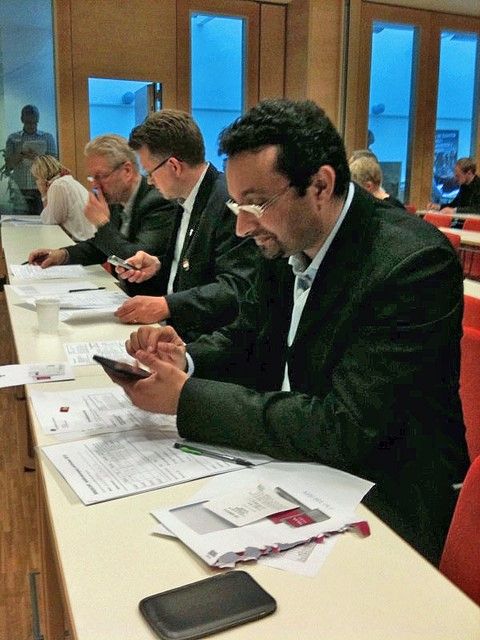
Author/Copyright holder: Socialdemokraterna. Copyright terms and licence: CC BY-NC-ND 2.0
There’s nothing wrong with working from a script. It keeps you focused on what you need to get out of the call. Make sure you don’t over-rehearse though and end up sounding like a robot.
Be Prepared to Have a Conversation
The person on the other end may have questions for you. You should be prepared to talk through any issues or concerns they have. If telemarketing were simply a “make a call, get an answer, hang up” proposition, it would be a much faster form of marketing than it actually is, and we wouldn’t need to write much more about it here.
Be Prepared to be Told “No” or “No, Thank you”
Truthfully, sometimes the response will be even ruder. Don’t let it upset you. If you feel confident, you can try—politely—to argue your case, but sometimes a “no” really is a “no”. Imagine the shoe on the other foot, too—you don’t say “yes” all the time, do you? Let it go, thank the person for taking the time and try again another day. Telemarketing requires a lot of persistence to produce good results.
Handling the Gatekeeper
Company receptionists are often taught to avoid putting calls through to managers or directors. They’re also often taught to refuse to give out information over the phone.
If you find yourself stuck at the gatekeeper (that first point of contact) and have tried a few times, then you can try to get round them. Here are two strategies for this:
Call before the company is officially open or half an hour after it officially closes. Many receptionists only keep the official working hours of the company, but many managers and staff work earlier and later than these hours.
Ask for somebody who’s lower down in the corporate food chain. One strategy the author found that worked really well was calling a company and asking to speak to somebody on their helpdesk. Helpdesk staff aren’t trained to keep gates closed, and they’re often only too happy to be helpful – it’s in their job description after all.
You have other ways to get round a gatekeeper, but they require a lot more confidence to pay off. When you’re fully confident with telemarketing, you might want to examine these additional strategies.
Always End a Call Politely
Whether you get what you wanted or not, always thank the person on the other end for his or her time. It may take many calls to get what you want, and you’ll be remembered, and not in the way you want to be, if you’re not polite. You’re only as good as your last call, and first impressions last. Of course—it almost goes without saying—you should be polite throughout the entire call, too.

Author/Copyright holder: Bart Everson. Copyright terms and licence: CC BY 2.0
It can be tempting to be rude at times, but that’s not the lasting impression you want to leave of your business, is it?
Always Take Action on Your Calls
If you say you’re going to send some marketing material – send it. Ideally, send it right there and then. Never leave it longer than the end of the working day—the sundown rule. If you waste somebody’s time or leave them dangling, waiting for undelivered promises, they won’t be likely to buy your services in the future. And they can tell others about you.
Practice Makes Perfect
It can take a little while to get comfortable with telemarketing; don’t give up if the first call isn’t perfect. Remember that the worst thing that can happen is that someone will say “no”, which leaves you no worse off than you were before you made the call.
Obey the Law
Most countries have no laws governing telemarketing to businesses. However, before you start telemarketing, check with your legal representative to ensure that’s the case where you live.
You need to be particularly careful if your clients are small home-based businesses; telemarketing to consumers (which is how this could be interpreted) is governed by strict rules in many parts of the world. Ignoring this can burn a telemarketer—there may be legal repercussions, i.e., fines, etc. Always get legal advice on this subject before moving forward with your telemarketing efforts.
 Author/Copyright holder: U.S. Government. Copyright terms and licence: Public Domain.
In the main, laws regarding telemarketing protect consumers (individuals) and not businesses, but do your research and make certain of your legal position before you call anyone.
The Take Away
Telemarketing is used in conjunction with other marketing to further a sale or to conduct market research. It is not the same as telesales (though the terms are confusingly often interchangeable in literature).
As long as you follow a process and take a little time to practice, you’ll find becoming an efficient telemarketer in a short space of time a very easy endeavour.
References & Where to Learn More
Hero Image: Author/Copyright holder: Garry Knight. Copyright terms and licence: CC BY 2.0
Zig Ziglar, Secrets of Closing the Sale, 2004
How to prepare a telemarketing program: Have a Telemarketing Plan for a Successful Campaign