How to Run a Great User Workshop

• 8 min read

547 Shares

The whole point of UX research is to get in touch with your users. One technique for doing so is the user workshop. You bring together a group of users (and possibly the client too) and get them to talk about their opinions, behaviours, feelings, etc.

It’s worth noting that user workshops are not ideal for basing your decision making processes on – they rely a little too much on people “telling you what they do” rather than “showing you what they do”. However, they can provide excellent insights that help you guide future research efforts.

In general, you use user workshops at the start of a project for ideas gathering. The good news is that user workshops aren’t particularly expensive to run so they can be incorporated into a UX research plan fairly easily.

So let’s take a look at how to run a great user workshop:

It All Starts with a Plan

Before you can even think about holding a user workshop you need to start to bottom out what you want to get from the workshop:

Which types of user do you want to speak to?

What data are you expecting to get from the workshop?

Which discussion topics are most likely to lead to the data you need and provide other valuable insights?

Then you want to:

Create Some Profiles of Potential Participants

How many participants do you need? What are the kinds of people you want represented in the group?

The more accurate a profile you have, the more likely it is that you will recruit useful participants. Make certain that you think about the numbers carefully too, half-a-dozen users might be perfect for a simple discussion forum but you might need a few more if you’re going to do something which involves a lot of additional exercises.
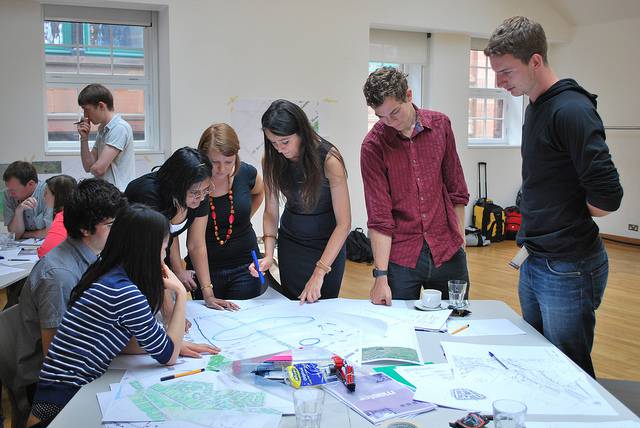


Author/Copyright holder: Scottish Government. Copyright terms and licence: CC BY-NC 2.0

Recruit the Participants

How you go about this is up to you but remember that recruiting users always takes more time than you hope it will. You can use an agency to speed up the process (at a cost) or reach out to your user base. Always make sure that you recruit slightly more bodies than you need, someone always fails to show up.

Make certain that the incentives you offer are sensible but enough to encourage participation. You don’t have to hand over huge sums of money but $5 probably won’t be enough and $500 is probably too much (people who don’t care a jot about the product will be happy to turn up for $500).

Brief Participants in Advance

You want the user workshop to focus on achieving your objectives and not on explaining to participants why they are there. Send a letter or an e-mail to each participant and explain what you will be doing, what they should be doing, how much time will be spent, and anything they need to do or prepare in advance. Then when they arrive… you can get straight down to business.

Find a Decent Venue

Venues should be easy to get to for the participants. Don’t choose somewhere 12 miles out of town and away from all public transport links.

Do choose somewhere that will comfortably hold all your participants and any activity sessions you want to run.

On the Day – Opening the Session

Many people will never have attended a user workshop before; it’s a good idea to hold a brief kick off speech at the start of the session to get them comfortable with what’s expected of them. Something like this should be fine:

“Welcome! Today, we’re going to be hold discussion based sessions about our product. We want you to speak up and share your insights and will encourage you to do so throughout the process. Don’t be afraid to put across your viewpoint, I am not the client and your feedback will be treated with total confidentiality. Don’t be afraid to tell us what you don’t like, it helps us help the client to build things you do like. And please remember, there are no daft ideas – say what’s on your mind, whenever you want to. Thank you for coming.”



Author/Copyright holder: David Orban. Copyright terms and licence: CC BY 2.0

Get People Talking

Don’t present long speeches at your participants. You’ve got a whole bunch of users together – you want to hear from them, you can talk to yourself after they’ve gone home if you really need to deliver a speech.

The more active people are physically, the more likely they are to become involved intellectually too. Try not to keep everyone in their seats. Get some flipcharts or Post-It notes and get them stood up and scribbling ideas down. (This also helps to manage larger groups where you can’t listen to everybody at once anyway).

You shouldn’t use user workshops to drill deeply into any given issue (there are better research techniques for this) what you want is a wide array of useful feedback on many topics. Kill any subject that you feel has become exhausted and move on quickly.

Step in as a facilitator and close down, gently, any individual who is monopolizing the group’s time and draw out, also gently, those who are more reserved and encourage them to speak up too. It’s a group exercise and not an interview.

Don’t be afraid to wait for a response to a question. A little silence just means people are thinking – not that they are ignoring you.

Record the Proceedings

You’re going to miss a ton of useful data when you’re facilitating user workshops. The best way to overcome this is to video and record the session for repeated review later. If you can’t do this – then get an observer or two to come in and make notes in addition to your own. The extra bandwidth this gives will enable far more feedback from the same session.



Author/Copyright holder: Ben Kraal. Copyright terms and licence: CC BY-NC-ND 2.0

After the User Workshop

It’s time to let people know what you’ve discovered. That means reporting on the workshop. Don’t write a huge 200 page report – no-one will read it. Instead highlight key observations and potential action that can be taken on these. If you videoed the session – use video highlights to support these observations.

Summary

Getting user workshops right, can take a little practice but the tips above should help you get started without too much hassle.

Header Image: Author/Copyright holder: Scottish Government. Copyright terms and licence: CC BY-NC 2.0

Learn More in This Course:

AI for Designers

8 days
32 % booked
View Course

What You Should Read Next

  • Read full article
    Why Care about Statistical Significance? - Article hero image
    Interaction Design Foundation logo

    Why Care about Statistical Significance?

    The categorical data depicts the success and failure rate of the low-fidelity wireframe above. There is not a large enough difference between the two to determine if the designs were successful.There is an element of error involved in measuring anything. So, when we want to compare measurements, how

    Social shares
    433
    Published
    Read Article
  • Read full article
    Web Fonts: Definition and 10 Recommendations - Article hero image
    Interaction Design Foundation logo

    Web Fonts: Definition and 10 Recommendations

    Web fonts bring digital content to life. They enhance readability, set the tone, and ensure consistency across various platforms—all vital ingredients. When you understand web fonts and their impact, it can help you with effective website creation—and greatly so. We’ll provide a comprehensive overvi

    Social shares
    782
    Published
    Read Article
  • Read full article
    How to Screen Research Participants - Article hero image
    Interaction Design Foundation logo

    How to Screen Research Participants

    Finding the right participants is crucial for gathering user research. We usually need to do research with participants having a particular set of needs or experience. In this short video, you will find out about the basic need for screening and how we make sure that we have suitably qualified parti

    Social shares
    450
    Published
    Read Article
  • Read full article
    Pitfalls in Recruiting Participants for User Research - Article hero image
    Interaction Design Foundation logo

    Pitfalls in Recruiting Participants for User Research

    The level of participant engagement is an important part of the user research results. Our results are dependent on proper engagement with our participants. In this video we look at some of the issues around participant recruitment and hear practical examples that arose in a large online study.[[vid

    Social shares
    419
    Published
    Read Article
  • Read full article
    How to Fit Quantitative Research into the Project Lifecycle - Article hero image
    Interaction Design Foundation logo

    How to Fit Quantitative Research into the Project Lifecycle

    Quantitative research methods fit into the project lifecycle at different stages of the process.In this video, we see where different quantitative research methods fit into a typical project lifecycle. Bear in mind that even with an iterative process such as Agile, the short cycles still address dif

    Social shares
    510
    Published
    Read Article
  • Read full article
    How to Resolve Conflicts Between Design Thinking and Marketing - Article hero image
    Interaction Design Foundation logo

    How to Resolve Conflicts Between Design Thinking and Marketing

    In the past, designers often reported to marketing managers and were neither expected nor allowed to make business decisions. When traditionally-structured companies transition to a design-driven mindset, there can be friction between the marketing and design teams. Let’s take a closer look at this

    Social shares
    682
    Published
    Read Article
  • Read full article
    Stop the Generic Portfolio Trap! Design a Stand-Out Portfolio for Your UX/UI Niche: User Research - Article hero image
    Interaction Design Foundation logo

    Stop the Generic Portfolio Trap! Design a Stand-Out Portfolio for Your UX/UI Niche: User Research

    User research is indispensable—and without it, well... UX design is guesswork. When you’re a user researcher, you know this well—but it can be hard to communicate your work in a way that grabs the viewer and holds their attention. And that’s what a portfolio is all about—grabbing the attention of yo

    Social shares
    383
    Published
    Read Article
  • Read full article
    Top Service Blueprint Templates - Article hero image
    Interaction Design Foundation logo

    Top Service Blueprint Templates

    Service blueprint tools are vital for effective customer experience design—and for designers to make experiences that are exceptional. Here, we’ll discuss why these tools are so important. What’s more, we’ll explore templates and practical resources to create high-quality, efficient service blueprin

    Social shares
    638
    Published
    Read Article
  • Read full article
    How to Write Research Questions that Lead to Confident Design - Article hero image
    Interaction Design Foundation logo

    How to Write Research Questions that Lead to Confident Design

    Designing with Data provides an extensive background to A/B testing.As with all other research methods, we need to start with a research question. A/B testing concerns itself with changes in user behavior, meaning that our questions need to be centered on measurable goals. In many cases, these will

    Social shares
    450
    Published
    Read Article
  • Read full article
    Getting Started - Article hero image
    Interaction Design Foundation logo

    Getting Started

    We start our introduction to A/B and multivariate testing (MVT) by looking at their basic principles and their differences. Note that the video mentions Google Optimize, which has been withdrawn. Google Firebase can be used for mobile platforms. Third-party solutions are needed for A/B testing on th

    Social shares
    226
    Published
    Read Article

Top Articles

Top Topic Definitions

Feel Stuck?
Want Better Job Options?

AI is replacing jobs everywhere, yet design jobs are booming with a projected 45% job growth. With design skills, you can create products and services people love. More love means more impact and greater salary potential.

At IxDF, we help you from your first course to your next job, all in one place.

See How Design Skills Turn Into Job Options
Privacy Settings
By using this site, you accept our Cookie Policy and Terms of Use.
Customize
Accept all

Be the One Who Inspires

People remember who shares great ideas.

Share on:

Academic Credibility — On Autopilot

Don't waste time googling citation formats. Just copy, paste and look legit in seconds.

Feel stuck? Want Freedom?

Get one powerful email each week, like 325,668 others.

Learn to design a life you love.

Next email in:
4
days
21
hrs
19
mins
4
secs