Are Twitter’s Current Problems UX Related?

• 8 min read

425 Shares

There’s no doubt that of all the social networks the most beloved by the media is Twitter. The network’s format of quick, pithy opinions has led to dozens of collated articles in the news. It’s cheap and easy to find opinions on Twitter and, of course, whatever viewpoint you wish to represent – there’s always someone out there somewhere who feels strongly in the way that you’d like them to.

Yet, beneath the surface things aren’t all roses. Twitter’s share price has been in gradual decline since its IPO. While Facebook has made great progress in monetizing its platform – Twitter is still struggling. At the Q4 earnings in February, investors began asking some hard questions of the Twitter management team.

It turns out that Twitter’s problems may run deeper than first thought. The service has approximately 1 billion users which is certainly a healthy amount of market penetration. Though this pales in comparison to Facebook’s numbers.

What is more shocking is that only about 25% of Twitter’s users are active users. The definition of active user being “someone that logs on to the platform once a month”. That’s around 200 million active users. Compare that to Facebook’s more than 1 billion active users each month and you can start to see why Twitter’s shareholders aren’t exactly ecstatic.

In fact, if you examine the latest active usage statistics – you find that Twitter is lagging behind LinkedIn, WeChat, WhatsApp and even Google+ in terms of active users.

Sign ups for the platform are also dwindling. Where once the social network could expect to rapidly replace inactive users with active users – this is no longer the case. Worse, in the case of new sign ups Business Insider notes that 80% of these sign ups don’t end up as “active users”. That’s a higher percentage than the existing user base.
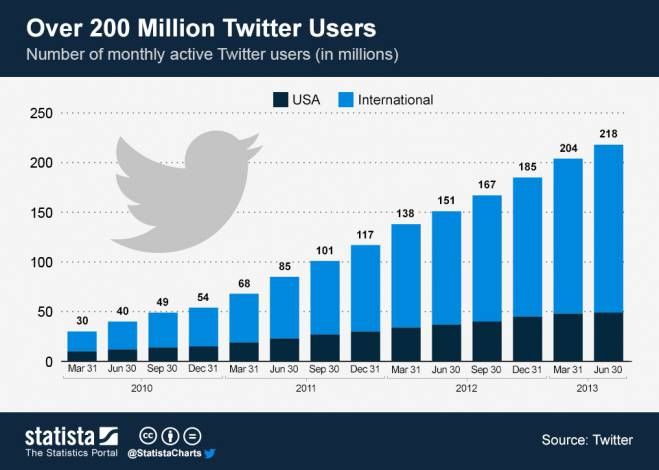


Author/Copyright holder: Statista. Copyright terms and licence: All rights reserved Img source

So What’s the Problem?

Twitter hasn’t been particularly forthcoming about the issues it faces as a platform, understandably – a company with declining share prices is hardly likely to air its issues and provoke further decline but it appears that the fundamental issues are user experience related.

The biggest selling point of Twitter, historically, has been its ability to provide up-to-the-minute information from a variety of sources. The trouble is that this can be overwhelming for a new user with no experience of the platform. It’s not like Facebook where you can quickly catch up with everything your friends have to stay; it’s hard enough to keep up with what’s going on at any given moment.

And it’s probably this single aspect of the Twitter experience that makes it so hard to retain users. Sure, there are 200 million or so people who like this – at least they like it enough to log in at least once a month; but it’s clear there are over 700 million people who don’t like it enough to log in at least once a month too.

The outgoing CEO, Dick Costolo, was pretty tight-lipped at the Q4 shareholder’s meeting over the problems users face when curating an interesting and engaging Twitter feed but from an external perspective and an unscientific show of hands when talking to those who tried and left Twitter – it seems pretty clear that this is the biggest barrier to entry for Twitter.

The short messaging format may make it the easiest network to become a contributor to but it also makes it the “noisiest” social network too. Twitter often delivers more content in 5 minutes than people’s Facebook networks deliver in a week.

So how can Twitter go about addressing this UX problem without alienating its core audience?



Author/Copyright holder: TechCrunch. Copyright terms and licence: CC BY 2.0

Enter Project Lightning

Twitter seems to have acknowledged the UX issue without specifically saying so. It has recently announced “Project Lightning”. It’s going to be part of Twitter’s mobile app and may be used on other websites and apps too. It will also be available to non-users of Twitter (possibly to attract new sign ups).

The idea is simple. If you want to follow the data stream from something like an event; it’s quite possible that the torrent of data generated is going to deter you from keeping an eye on Twitter. Hundreds of “We’re all at E3!” messages aren’t going to be something you want to read.

So project lightning’s solution is to use a set of Twitter editors to curate that stream to a more manageable and more valuable stream. Except the majority of the content won’t be tweets – it’s going to be video and photographic content.

Other sites will be able to embed these streams so that their users can follow them in real time (in much the same way that is possible to embed a YouTube video on your site today).

The project moves away from focusing on following people and to focusing on following events.


Is It Enough?

It’s good to see Twitter addressing a user experience problem and trying something new. Unfortunately, there are similar services from Snapchat and from Instagram. These newer networks are already winning the hearts and minds of the youth market and in the case of Instagram already have more active users than Twitter (and Snapchat is catching up fast with 200 million active users per month).

Snapchat has also surpassed Twitter in that it has already learned to monetize its live global stories feature. With a 10 second video earning $400,000 in revenue from the Live Stories stream. Snapchat has even go so far as to set up an ad-agency so that it can help advertisers deliver vertical video that can be used on the platform.

What Next?

It remains to be seen if Project Lightning is the first step in a bigger program of improvements or whether Twitter is currently waiting to see if it’s the whole solution to its woes. What we do know is that Twitter has some world class UX design talent in house and that the ailing social network shouldn’t be written off just yet. However, it’s clear that improvements need to come quickly before competitors take even more of the company’s market share.

Header Image: Author/Copyright holder: Unknown. Copyright terms and licence: Unknown. Img Source

Learn More in This Course:

AI for Designers

9 days
19 % booked
View Course

What You Should Read Next

  • Read full article
    Why Care about Statistical Significance? - Article hero image
    Interaction Design Foundation logo

    Why Care about Statistical Significance?

    The categorical data depicts the success and failure rate of the low-fidelity wireframe above. There is not a large enough difference between the two to determine if the designs were successful.There is an element of error involved in measuring anything. So, when we want to compare measurements, how

    Social shares
    432
    Published
    Read Article
  • Read full article
    Web Fonts: Definition and 10 Recommendations - Article hero image
    Interaction Design Foundation logo

    Web Fonts: Definition and 10 Recommendations

    Web fonts bring digital content to life. They enhance readability, set the tone, and ensure consistency across various platforms—all vital ingredients. When you understand web fonts and their impact, it can help you with effective website creation—and greatly so. We’ll provide a comprehensive overvi

    Social shares
    781
    Published
    Read Article
  • Read full article
    How to Screen Research Participants - Article hero image
    Interaction Design Foundation logo

    How to Screen Research Participants

    Finding the right participants is crucial for gathering user research. We usually need to do research with participants having a particular set of needs or experience. In this short video, you will find out about the basic need for screening and how we make sure that we have suitably qualified parti

    Social shares
    450
    Published
    Read Article
  • Read full article
    Pitfalls in Recruiting Participants for User Research - Article hero image
    Interaction Design Foundation logo

    Pitfalls in Recruiting Participants for User Research

    The level of participant engagement is an important part of the user research results. Our results are dependent on proper engagement with our participants. In this video we look at some of the issues around participant recruitment and hear practical examples that arose in a large online study.[[vid

    Social shares
    419
    Published
    Read Article
  • Read full article
    How to Fit Quantitative Research into the Project Lifecycle - Article hero image
    Interaction Design Foundation logo

    How to Fit Quantitative Research into the Project Lifecycle

    Quantitative research methods fit into the project lifecycle at different stages of the process.In this video, we see where different quantitative research methods fit into a typical project lifecycle. Bear in mind that even with an iterative process such as Agile, the short cycles still address dif

    Social shares
    510
    Published
    Read Article
  • Read full article
    How to Resolve Conflicts Between Design Thinking and Marketing - Article hero image
    Interaction Design Foundation logo

    How to Resolve Conflicts Between Design Thinking and Marketing

    In the past, designers often reported to marketing managers and were neither expected nor allowed to make business decisions. When traditionally-structured companies transition to a design-driven mindset, there can be friction between the marketing and design teams. Let’s take a closer look at this

    Social shares
    682
    Published
    Read Article
  • Read full article
    Stop the Generic Portfolio Trap! Design a Stand-Out Portfolio for Your UX/UI Niche: User Research - Article hero image
    Interaction Design Foundation logo

    Stop the Generic Portfolio Trap! Design a Stand-Out Portfolio for Your UX/UI Niche: User Research

    User research is indispensable—and without it, well... UX design is guesswork. When you’re a user researcher, you know this well—but it can be hard to communicate your work in a way that grabs the viewer and holds their attention. And that’s what a portfolio is all about—grabbing the attention of yo

    Social shares
    383
    Published
    Read Article
  • Read full article
    Top Service Blueprint Templates - Article hero image
    Interaction Design Foundation logo

    Top Service Blueprint Templates

    Service blueprint tools are vital for effective customer experience design—and for designers to make experiences that are exceptional. Here, we’ll discuss why these tools are so important. What’s more, we’ll explore templates and practical resources to create high-quality, efficient service blueprin

    Social shares
    638
    Published
    Read Article
  • Read full article
    How to Write Research Questions that Lead to Confident Design - Article hero image
    Interaction Design Foundation logo

    How to Write Research Questions that Lead to Confident Design

    Designing with Data provides an extensive background to A/B testing.As with all other research methods, we need to start with a research question. A/B testing concerns itself with changes in user behavior, meaning that our questions need to be centered on measurable goals. In many cases, these will

    Social shares
    450
    Published
    Read Article
  • Read full article
    Getting Started - Article hero image
    Interaction Design Foundation logo

    Getting Started

    We start our introduction to A/B and multivariate testing (MVT) by looking at their basic principles and their differences. Note that the video mentions Google Optimize, which has been withdrawn. Google Firebase can be used for mobile platforms. Third-party solutions are needed for A/B testing on th

    Social shares
    225
    Published
    Read Article

Top Articles

Top Topic Definitions

Feel Stuck?
Want Better Job Options?

AI is replacing jobs everywhere, yet design jobs are booming with a projected 45% job growth. With design skills, you can create products and services people love. More love means more impact and greater salary potential.

At IxDF, we help you from your first course to your next job, all in one place.

See How Design Skills Turn Into Job Options
Privacy Settings
By using this site, you accept our Cookie Policy and Terms of Use.
Customize
Accept all

Be the One Who Inspires

People remember who shares great ideas.

Share on:

Academic Credibility — On Autopilot

Don't waste time googling citation formats. Just copy, paste and look legit in seconds.

Feel stuck? Want Freedom?

Get one powerful email each week, like 325,789 others.

Learn to design a life you love.

Next email in:
5
days
20
hrs
1
mins
16
secs